Get Full Government Meeting Transcripts, Videos, & Alerts Forever!
Get email alerts on the School Construction Financing topic
No spam. Unsubscribe anytime.
West Warwick discusses $55M–$65M school bond scenarios as RIDE Stage 2 deadline nears
Summary
The Town Council received an update on the school building committee's Stage 2 submission to the Rhode Island Department of Education and a detailed presentation from financial adviser Hilltop Securities on bond-size and timing options, reimbursement mechanics and potential budget impacts.
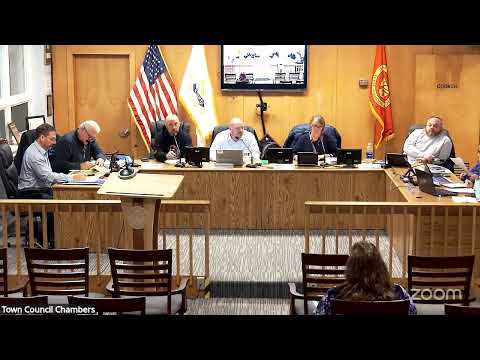
The West Warwick Town Council reviewed the School Building Committee's plan to submit Stage 2 to the Rhode Island Department of Education (RIDE) and heard detailed financing options from Hilltop Securities on Jan. 21.
The committee plans to file its Stage 2 submission with RIDE by Feb. 15 and scheduled a joint meeting of the school committee and council for Feb. 12 so the council can act on the committee's recommendation. Matt Belace, a municipal finance adviser with Hilltop Securities, walked the council through several bond-issue scenarios, potential reimbursement levels and the timing implications for town budgets.
Why it matters: the school projects under consideration are large and the town expects a substantial RIDE reimbursement. That reimbursement — discussed in the meeting as about 65%, and cited elsewhere in the discussion as 68.3% for West Warwick for the relevant fiscal year — would significantly reduce the town’s net debt burden but creates a cash-flow pressure in the years before full reimbursement arrives.
Belace told councilors the town has a comparatively low debt level against assessed value and is well positioned to issue general obligation bonds. He presented six scenarios that start with par amounts of $55 million, $60 million and $65 million and that can be issued either as a single bond or split into two bond issues. He said the town could also seek authorization up to roughly $80 million to preserve flexibility, but authorization does not require immediate issuance.
Belace summarized trade-offs: a single bond has lower issuance costs but creates a larger immediate budget impact; two bond issues can stagger payments and soften the upfront burden in the fiscal year before RIDE begins reimbursing. He said the town assumes a closing date in January 2026 for planning purposes and described typical structures such as 30-year debt (lower annual payments, higher total interest) versus 20-year debt (higher annual payments, lower total interest).
On reimbursement timing, Belace said RIDE will not pay any reimbursement until substantial completion of projects; if projects are substantially complete in fiscal 2027, the reimbursement would start in fiscal 2028 and include a catch-up payment that year. That sequencing creates a notable budget pressure in fiscal 2027 when the town still must make debt service payments before the reimbursement arrives.
Belace also discussed market mechanics, including the potential for “market premium” on tax-exempt municipal bonds. He said prevailing market conditions can produce premium proceeds that increase the project fund without increasing par amount; he cited typical market-premium ranges of roughly 6% to 10% in recent years as an example, which could allow issuing less par to reach the same project funds.
Councilors and staff asked timing and election-process questions. The group noted that a bond authorization placed before voters must comply with election law; one speaker observed that a Title 17 election process (for bond questions) requires specific timelines including early voting. The council will plan how to fit any referendum or voter authorization into the schedule and whether to include other items on a potential bond ballot.
No formal vote was taken at the Jan. 21 meeting. The council was told the next steps are the Feb. 12 joint meeting of the school committee and council to consider a formal recommendation and completing the RIDE Stage 2 submission by Feb. 15.
Officials emphasized a conservative approach to budgeting and projections. Belace said, “A lot of people refer to it as a once-in-a-lifetime investment,” and counsel recommended planning on conservative reimbursement and cost assumptions to avoid underfunding the projects.
What’s next: the School Building Committee will hold a final community engagement meeting Jan. 22 at 6 p.m. in the high school media center. The council and school committee will meet jointly Feb. 12; if the council votes to authorize bonding, further procedural steps and any required voter questions would follow state election timelines and approvals through the Rhode Island Health and Educational Building Corporation, the conduit issuer used for RIDE reimbursements.
Speakers quoted or summarized in this story are drawn from the council meeting transcript.