Get Full Government Meeting Transcripts, Videos, & Alerts Forever!
Get email alerts on the Site Review Jail Addition topic
No spam. Unsubscribe anytime.
Albemarle ARB approves additions and screening for Charlottesville Regional Jail with condition on razor wire visibility
Summary
The Albemarle County Architectural Review Board approved a certificate of appropriateness for ARB 2024-77, a proposed addition and screening at the Albemarle–Charlottesville Regional Jail, with a condition requiring plan notes clarifying the relative heights and locations of the security screen and razor wire and that razor wire not be visible from EC Street.
The Albemarle County Architectural Review Board on an approved a certificate of appropriateness for ARB 2024-77, a proposed addition and screening at the Albemarle–Charlottesville Regional Jail, with a condition that notes on the plans clarify the relative heights and locations of the ornamental metal screen, the security fence and any razor wire and that razor wire "may not be visible from the EC Street."
Board and staff said the applicant addressed most concerns raised at a December preliminary review, leaving a single condition to clarify the plans. Planning staff said the proposed addition adds darker brick bands to break up large upper wall areas, introduces an ornamental metal screen to mask a security fence and rooftop mechanical equipment, and adds landscaping near utilities. Staff identified one unresolved design deviation: the proposed window glass is darker than ARB corridor standards, at 22% visible light transmittance and 13% reflectance compared with the guideline minimum transmittance of 40%.
The nut graf: the board approved the project because members found the design changes addressed previous concerns about wall blankness, visibility of security fencing and rooftop equipment, and site landscaping, but added a plan-note condition to ensure the ornamental screen, security fence and razor wire are shown and located so razor wire is not visible from the public corridor.
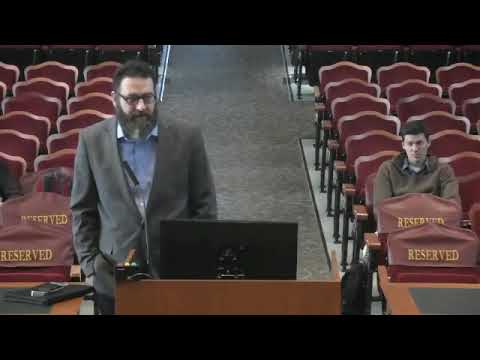
In its presentation, staff described the changes since the preliminary review and recommended approval with a single clarifying condition. Staff noted the darker glass: "It's a tinted gray glass with 22% light transmittance and 13% reflectance. The transmittance does not meet the criteria. The criteria say the number should not drop below 40, but the applicant indicates that the darker glass is needed for extra security in this location." The applicant, Michael Gibson of Mosley Architects, answered questions about the screen and fencing and confirmed that razor wire would be behind the screen fence so it would be screened from view.
Board members spoke in support of the revisions. Several members praised the added brick banding, the metal screen in place of the existing security fence, and the added landscaping. One board member suggested a plan note describing "the relative height of the chain link security fence with the ornamental metal screen" and that the plan clarify where razor wire would be placed; another asked for a note that the razor wire not be visible from the corridor. The board discussed whether the sample of darker glass should be a condition; staff said they had not included a change-to-comply condition for the glass because it appeared in a limited location and staff did not expect a negative corridor impact.
After discussion, a motion to approve the certificate of appropriateness as recommended by staff, amended to require that both architectural and site plans clarify the relative height and locations of the razor wire and security screen and that razor wire may not be visible from the EC Street, passed by roll call. The recorded roll call in the transcript shows Aye votes from Mr. Henningsen, Mr. Hancock, Mr. Stoner, Mr. Matsuno and Mr. Vanderwirth.
The board moved on to the next agenda item after the approval. The county staff and applicant will update the plans to add the required notes and clarifications before final plan sign-off.