
Council delays decision on city resolution supporting Encino Rio Lofts tax-credit application after community-notification dispute
Get AI-powered insights, summaries, and transcripts
Sign Up Free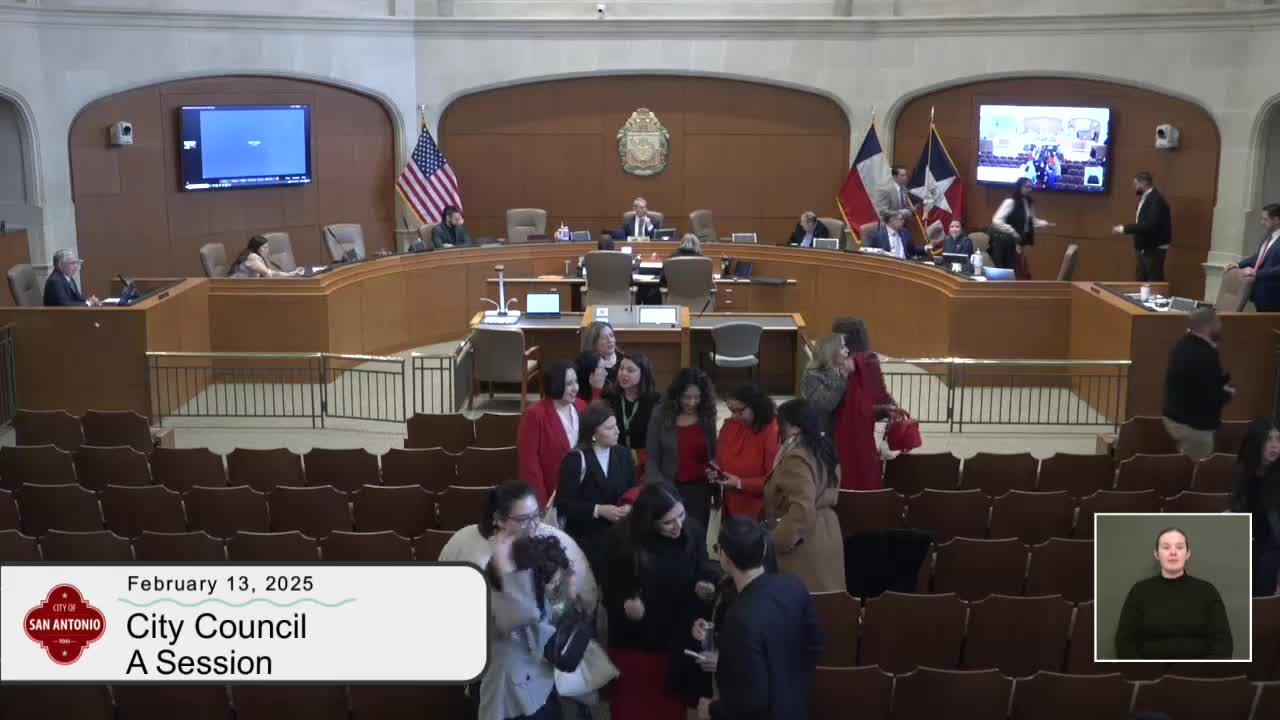
Summary
The San Antonio City Council on Feb. 13 continued consideration of a resolution endorsing a 78-unit affordable housing project’s application for 9% tax credits after members debated whether the developer properly notified neighbors.
The San Antonio City Council on Feb. 13 continued action on a resolution endorsing Encino Rio Lofts LLC’s application for 2025 competitive 9% housing tax credits from the Texas Department of Housing and Community Affairs (TDHCA), after debate over whether the developer had adequately engaged surrounding neighborhoods.
Councilmember Courage, who pulled the item from the consent agenda, said the developer did not complete a neighborhood public meeting and that his office had not been sufficiently notified. "I don't feel that my office was sufficiently notified about everything involved in this," Courage said during the meeting.
The dispute quickly broadened into a policy conversation about how the city should weigh community engagement when providing letters or resolutions of support. Veronica Garcia, director of the city's Neighborhood and Housing Services Department, told council members the project is a 78-unit development with an affordability mix that staff said followed the council-adopted scoring policy: "10% of the units are at the very deeply affordable, so 30% of the area median income. . . . Half of the project is for families at 50% of the area median income or below," Garcia said. She also told the council the city cannot require a developer to hold a public meeting because doing so could violate the federal Fair Housing Act.
Housing staff and other council members described the technical scoring process for TDHCA applications and the city rubric used to recommend support. Pete (housing staff) said the city uses an adopted scoring matrix and that projects that score above a minimum threshold are recommended for resolutions of support; when projects tie, the state’s tiebreakers control awards. Council members urged a future policy review so the rubric better accounts for community engagement, transit access and other local priorities.
Several council members argued both for and against withholding the city resolution. Supporters of moving the item forward said withholding a letter of support could reduce the city’s chances of attracting limited state tax-credit awards; opponents said developers should be expected to meet a basic standard of neighborhood outreach. Councilmember Pelaez framed the choice as one of accountability: "It's such a low bar to set. Right? Which is please engage with your neighbors," Pelaez said.
After additional procedural motions, the council voted to continue the item to the Feb. 20 council meeting to allow more time for follow-up. During the meeting staff said they had received an email from the developer withdrawing the item; if the withdrawal is formalized the item will not appear on the next agenda.
Why it matters: TDHCA’s 9% competitive tax credits are a primary funding source for permanently affordable rental housing. Council support letters add weight to applications. The council’s debate highlighted a tension between promoting as many competitive applications as possible to secure awards and ensuring local community engagement before the city endorses projects.
What’s next: Councilmembers directed staff to return with the scoring rubric and pursue a policy discussion about how community engagement should factor into future city recommendations. The item will return only if the developer re-files after the stated withdrawal.