Get Full Government Meeting Transcripts, Videos, & Alerts Forever!
Get email alerts on the Short Term Rentals topic
No spam. Unsubscribe anytime.
Austin council pauses short‑term rental overhaul, sends staff back to refine licensing and enforcement
Summary
The Austin City Council discussed a proposed rewrite of short‑term rental rules (item A40), went into a closed legal session and directed staff to return with a simplified, licensing‑focused proposal and delayed implementation while procurement and legislative developments proceed.
The Austin City Council discussed a proposed ordinance (item A40) to restructure short‑term rental (STR) regulation, licensing and enforcement and went into closed session on legal issues before continuing the public discussion.
Mayor Kirk Watson opened item A40 after the council resumed business from an executive session. Council member Jose Velasquez, who pulled the ordinance for discussion, said District 3 is one of the city’s most STR‑dense areas and urged careful work on the proposal to "get this right."
The ordinance on the agenda, as described at the work session, would amend city code section 4‑18‑25 to remove references to STR types, move STR regulations into Title 4 (business regulations), create new offenses and set penalties. The agenda noted no fiscal impact for the item.
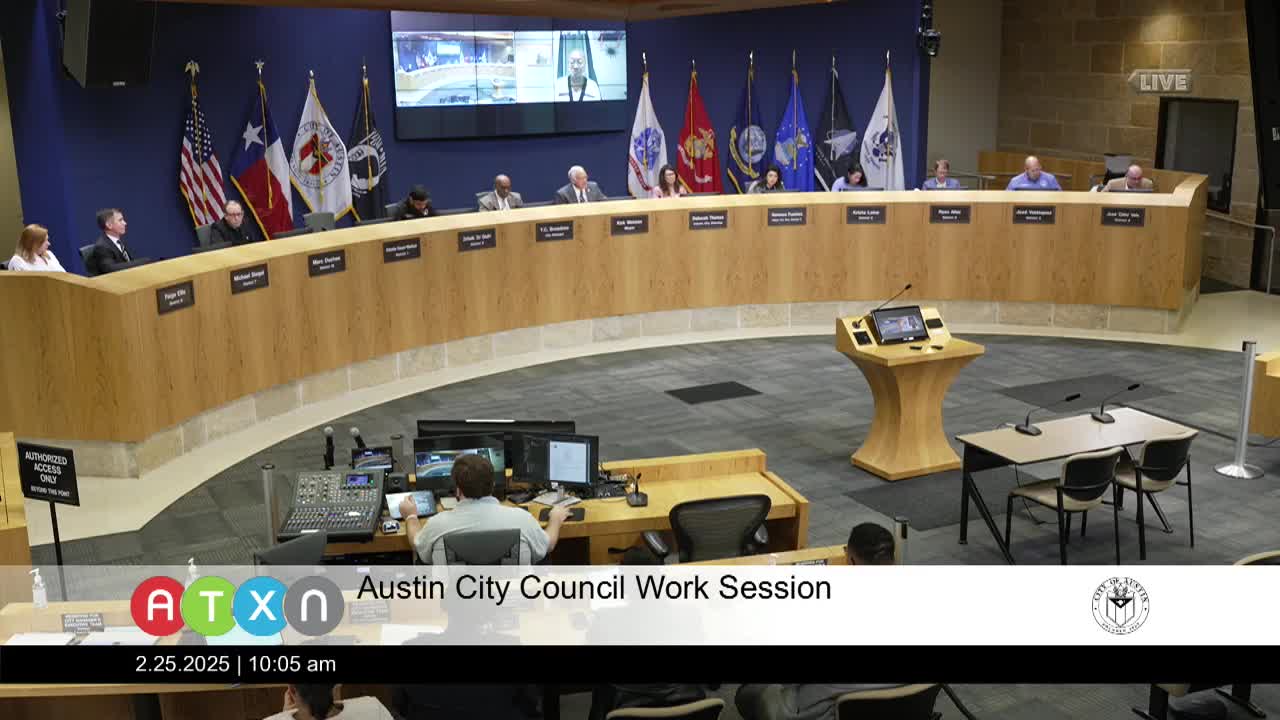
Executive session: The council went into a closed executive session at 10:05 a.m. to consult with attorneys about item A40 under Texas Government Code Section 551.071 and returned to open session at 10:57 a.m. The public record states the closed session was limited to legal discussion; no public votes were taken in closed session.
Licensing, technology and enforcement timeline: City staff told council they are seeking a vendor to implement a modern licensing system and platform‑scraping tools to improve compliance and data transfer. Staff estimated average licensing turnaround under a new system at about four weeks but said a new vendor and system could shorten that time. On procurement timing, staff said the RFP scope is near completion and that the minimum advertised RFP period is about two weeks, with selection and implementation to follow.
On administrative rules and enforcement, staff said the city could adopt emergency rules under existing code to stand up implementation procedures; that emergency process provides about a 120‑day runway to draft permanent rules. Staff also said the current ordinance allows enforcement for advertising without a license (which can be cited based on the ad alone) and for operating without a license (which generally requires an on‑site contact to confirm operation).
Council direction and delay: Multiple council members signaled support for pausing major regulatory changes while the Texas Legislature is in session and while the city strengthens technical and enforcement tools. Mayor Watson proposed — and council members supported — moving administrative actions now (for example, transferring business‑oriented regulations out of zoning into Title 4) while adopting a simplified version of item A40 focused on licensing requirements and delaying implementation so the city can coordinate with legislative outcomes, complete back‑end systems and prepare outreach. Council members suggested a delayed implementation date after the legislative session (members discussed a target of late July for a resumption of council consideration).
Hotel occupancy tax: Council members emphasized urgency around collection of unpaid hotel occupancy taxes from STRs. The mayor and others noted that improved collection would provide revenue for the new convention center and cultural programs; council asked staff to prioritize measures that capture hotel occupancy tax revenue.
Public engagement and materials: Council member Velasquez requested FAQs and outreach materials that council offices can share. Staff said they would produce public education and marketing materials once the ordinance and vendor processes were finalized and that they would coordinate with council offices for outreach.
Outcome: The council did not adopt A40 at the Feb. 25 work session. Members directed staff to return with a refined, administratively focused proposal and implementation timeline and to continue procurement and development of licensing and platform tools. No formal votes were recorded on A40 during the session.