Get Full Government Meeting Transcripts, Videos, & Alerts Forever!
Get email alerts on the Education Language Access topic
No spam. Unsubscribe anytime.
Tulsa Public Schools outlines bilingual, refugee supports and language-access tools
Summary
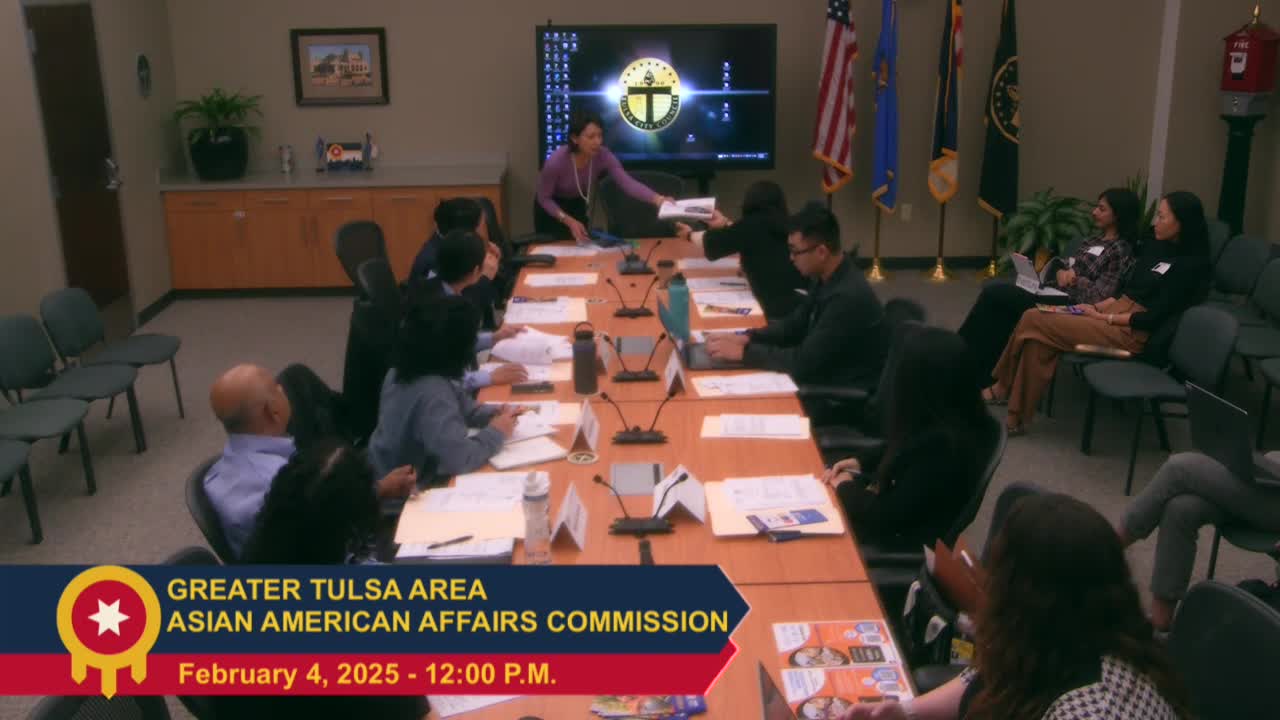
Mary Carmen Mitchell, manager of Bilingual Immigrant Services for Tulsa Public Schools, told the Asian Affairs Commission on Feb. 8 that the district provides language assistance, refugee navigators and targeted family-engagement services for newcomer students, and she asked the commission to help boost participation among Asian American and Pacific Islander families.
Mary Carmen Mitchell, manager of Bilingual Immigrant Services for Tulsa Public Schools, told the Asian Affairs Commission on Feb. 8 that the district provides language assistance, refugee navigators and targeted family-engagement services for newcomer students, and she asked the commission to help boost participation among Asian American and Pacific Islander families.
Mitchell said Tulsa Public Schools serves more than 33,000 students districtwide and that Asian American and Pacific Islander students number about 1,000 — roughly 3 percent of the system. She said the district’s top five non-English languages are Turkish, Hmong, Marshallese, Pashto and Dari (in addition to Spanish).
Officials said the district provides a range of supports: in-person and telephonic interpreters, translated document services, a multilingual parent advisory committee, new-family welcome sessions in the top languages, and printed "ISP" cards families can hand to school staff to request interpreters.
Mitchell described staffing the district has added for refugees: five school-based refugee liaisons assigned to campuses with the highest numbers of Afghan students, and two district-level refugee navigators who support other schools. "We have about 255 refugee students enrolled in Tulsa Public Schools. Actually, we have about 300, but 255 are Afghan," she said, and added that the district receives refugee grants routed through federal resettlement channels.
The district offers a separate paper enrollment process and one-on-one assistance for newly arrived refugee families and schedules a school welcome meeting to orient parents to academic expectations, contacts, and school processes. Mitchell said her team also verifies contact information and whether families have requested language access so they will receive communications from schools in their preferred language.
Mitchell described the district’s efforts to increase biliteracy recognition: Tulsa offers a Seal of Biliteracy for seniors who demonstrate proficiency in languages such as Hmong, Chuukese, Chinese, Japanese, Korean, Somali, Vietnamese and Indonesian, and the district is working to expand recognition to Marshallese and Dari.
Commissioners and staff asked whether recent changes in federal refugee funding would affect services; Mitchell said the district’s refugee grants and services have not been suspended and that staff continue to support newly arrived families, including help with employment and school transition.
The district emphasized family-engagement tactics: twice-monthly newcomer welcome sessions at community locations with in-person and Zoom options; multilingual text messaging; and a Multilingual Parent Advisory Committee that both provides feedback and helps identify needed services. Mitchell urged commissioners to promote family-engagement events and to attend to increase participation among AAPI families, who currently attend at lower rates than Spanish-speaking families.
Ending — Mitchell invited commissioners to partner with the district and attend family-engagement events. "We would love to be able to partner with you all," she said, and asked the commission to help the district identify community entry points for Hmong, Chuukese, Marshallese, Pashto- and Dari-speaking families.