Get Full Government Meeting Transcripts, Videos, & Alerts Forever!
Get email alerts on the Conservation Easements topic
No spam. Unsubscribe anytime.
Frontier Land Alliance reports rising volunteer support but recurring vandalism on El Paso conservation easements
Summary
Frontier Land Alliance told the El Paso Open Space Advisory Board that monitoring of three city-held conservation easements found strong stewardship and growing volunteer engagement, but recurring illegal trails, sign theft and vandalism at Lost Dog and Nappland remain unresolved concerns.
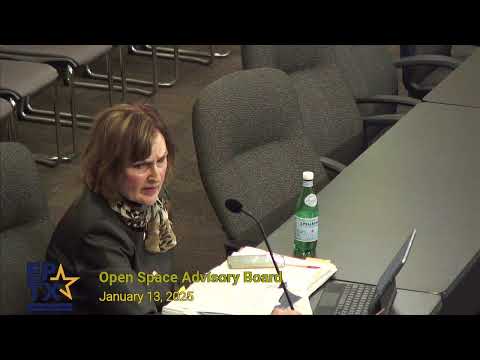
At a meeting of the El Paso Open Space Advisory Board, a representative of the Frontier Land Alliance said annual monitoring shows the three city conservation easements — Lost Dog Nature Preserve, Nappland Nature Preserve and Thunder Canyon Nature Preserve — are generally in good condition, but that vandalism and repeated creation of unauthorized trails are causing ongoing damage.
"It's putting restrictions on the surface of the land, sometimes subsurface of the land, for the preservation of the conservation values. And this is done in perpetuity for future generations," Frontier Land Alliance speaker Janae said, describing the purpose of conservation easements. She said Frontier completed annual site visits in October 2024 and praised the open-space manager Rocio Wanquillo and volunteers for expanded work in 2024.
Janae reported several monitoring metrics: volunteer hours more than doubled from roughly 2022 levels to "over 560 hours a year," individual volunteers increased from about 100 to 225, and trail work increased (Lost Dog had more than 3,000 feet of trail work and seven volunteer events; Nappland recorded roughly 3,300 feet of trail maintenance and more than 315 volunteer hours and 15 events). She said Frontier recorded roughly 705 trail users at Lost Dog during monitoring visits.
Janae gave site details: Thunder Canyon is about 26 acres (conserved in 2007) with no formal trails but used for occasional education and cleanup events; Lost Dog is the largest site she reviewed, described as about 1,001 acres with more than 10 miles of trails (conserved May 2021); Nappland is about 353 acres with 3.5 miles of trail. She also cited an external report from Texan by Nature estimating ecosystem values tied to Nappland, saying the report calculated roughly $1,000,000 in avoided costs for water-related ecosystem services and approximately $210,000 in ecosystem value for 353 acres.
Board members and staff focused on enforcement and repair. Janae and board members described two recurring problems at Lost Dog and Nappland: (1) individuals creating unauthorized “cut-through” trails that cause erosion and are repeatedly reopened after volunteers fill and revegetate them; and (2) vandalism and theft of trail signs (Janae said four signs purchased with water-utilities funds are missing). Janae described restoration efforts: multiple volunteer events to remove illegal trails, planting over 40 prickly pear pads and moving rocks to block the cut-throughs, only to have the features removed repeatedly.
Board member Dr. Bonar asked who has authority to enforce against trail-cutting and vandalism. Kevin Smith, speaking for the city, said, "I believe it'd be the police department that would be involved rather than code enforcement," and warned that prosecution depends on the district attorney's office choosing to press charges; he recalled a prior trail-cutting case that did not proceed with prosecution. Janae and board members recommended options such as vandal-resistant signage, gabions or rock features to block new trails, targeted surveillance or video evidence to support prosecution and closer coordination with State Park rangers where trails cross into state land.
Janae and board members asked staff to pursue technical fixes with partners: water-utility staff already sponsor some signs and trailheads, and Frontier plans to coordinate with Cesar at Franklin Mountains State Park on vandal-resistant approaches (gabions and signage). Janae described the partnership with El Paso Water and city staff as productive overall and said monitoring is essential to keep the easements' conservation values intact.
Board members asked for follow-up: more durable signage, coordination with police and the district attorney on enforceability thresholds, and continued public outreach to discourage illegal trail creation. Janae said she has shared the Texan by Nature report with council representatives and is available to present to City Council.
The discussion occurred during the agenda item "Update on the conservation easements"; no board policy change or formal enforcement action was taken at the meeting. The board and staff agreed to pursue technical fixes and additional coordination with law enforcement and state park staff as next steps.