Get Full Government Meeting Transcripts, Videos, & Alerts Forever!
Get email alerts on the Oil And Gas topic
No spam. Unsubscribe anytime.
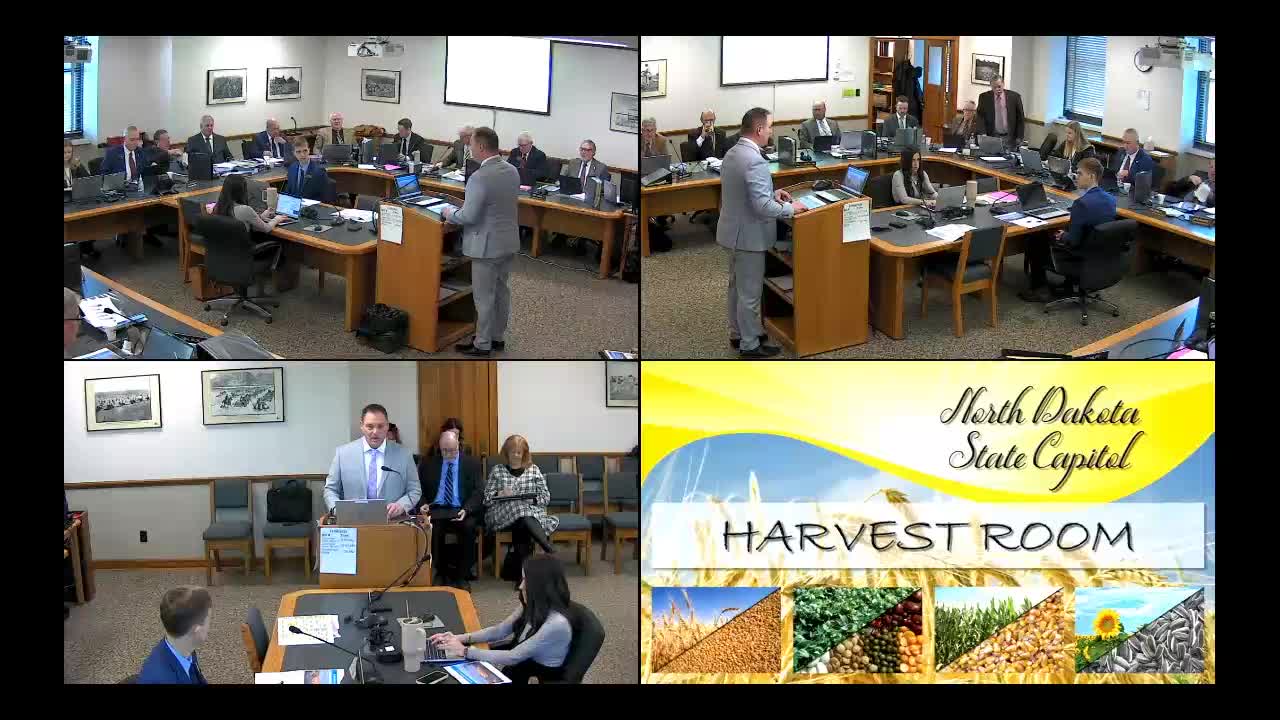
North Dakota mineral resources director: investor priorities, extended laterals and gas takeaway shape Bakken's near-term outlook
Summary
Nathan Anderson, director of the North Dakota Department of Mineral Resources, told the Senate Appropriations Committee that investor expectations for shareholder returns — not production growth — are the primary driver of current U.S. oil activity and that North Dakota’s Bakken inventory and pipeline capacity will shape production decisions in the near term.
Nathan Anderson, director of the North Dakota Department of Mineral Resources, told the Senate Appropriations Committee that investor expectations for shareholder returns, not production growth, are the primary driver of current U.S. oil activity and that North Dakota’s Bakken inventory and pipeline capacity will shape production decisions in the near term.
Anderson spoke during an afternoon Appropriations Committee work session and presented state production statistics, Bakken inventory estimates, enhanced oil recovery pilot work and the status of federal Infrastructure Investment and Jobs Act grants that fund orphan-well plugging and reclamation. He told the committee that state production is expected to remain roughly flat in 2025.
Why it matters: oil and gas taxes and related revenues are a principal source of state income. Shifts in how companies prioritize capital — toward returning cash to shareholders rather than drilling growth — and limits on gas takeaway capacity could cap North Dakota’s production growth and influence tax receipts that flow to the state budget.
Anderson said the U.S. oil sector has changed since the shale boom: “currently in the United States, production growth really is not the driver, it's, it's shareholder returns,” and added that after COVID many surviving companies focused on cash returns to investors rather than aggressive production growth. He told senators he expects a relatively steady rig count and frac-crew activity for 2025, and forecast state production to “hover between that 1.1 to 1,200,000 barrels for 2025.”
On Bakken inventory, Anderson described the department’s tiered map of acreage: core “tier 1” acreage showed the strongest rock and was estimated in his presentation to be 85%–90% developed. He said the department’s slide set included numbers for remaining wells and inventory dynamics and cautioned the figures are “very dynamic” and change if oil price or drilling activity shifts.
Anderson highlighted longer laterals as a continuing technological trend in the basin, noting operators are submitting permits for 3-mile laterals and that he had heard of a recently completed 4-mile lateral in North Dakota. He said extended-reach wells “improves those economics and allows companies to drill in those areas,” including fringe and tier-2 acreage.
On enhanced oil recovery (EOR), Anderson summarized several pilot projects in the state using different fluids and “huff-and-puff” testing. He described the work as important but still experimental for unconventional shale rock; on EOR he noted the state has both completed and active pilots and said such work could extend the productive life of some wells.
The director described federal IIJA funding the department has used to plug and reclaim orphan or idled well sites. He said a 2022 grant awarded roughly $25 million is nearing completion with only “like $100 to $200,000 remaining,” and that a newer formula grant has more onerous federal requirements — such as historical-preservation and endangered-species-related reviews — that have complicated participation for some states. Anderson told the committee, “these sites have already been disturbed and, and they really just need to be plugged and put back to their natural state.”
On gas takeaway, Anderson relayed an analysis prepared by the North Dakota Pipeline Authority showing a potential pipeline constraint if oil production grows toward 1.3 million barrels per day and gas-to-oil ratios continue their current trend. He urged continued efforts to incent gas-utilization and takeaway projects, including the possibility of using associated gas in-state for industrial uses such as data centers.
He also summarized non-Bakken activity (about 3% of state production, with roughly 20 wells per year historically) and warned that mergers among large producers can reduce local drilling activity as companies seek efficiencies. He listed several recent or ongoing industry consolidations discussed in the presentation.
Committee discussion touched on requests for additional data (for example, the number of early Bakken wells that have been plugged and abandoned and the number of large lateral spacing orders already approved). Anderson said the department would provide follow-up numbers when available. The committee chair called the briefing “a mostly positive update” and welcomed Anderson to his new role.
The presentation and committee Q&A did not include formal motions or votes.
Ending: Anderson closed by thanking the department staff and state geologic survey for their analyses; the committee adjourned after scheduling follow-up committee activity.