Get Full Government Meeting Transcripts, Videos, & Alerts Forever!
Get email alerts on the Water Availability topic
No spam. Unsubscribe anytime.
Comal County residents tell commissioners 2022 water-availability report underestimates drought risk; seek stronger review
Summary
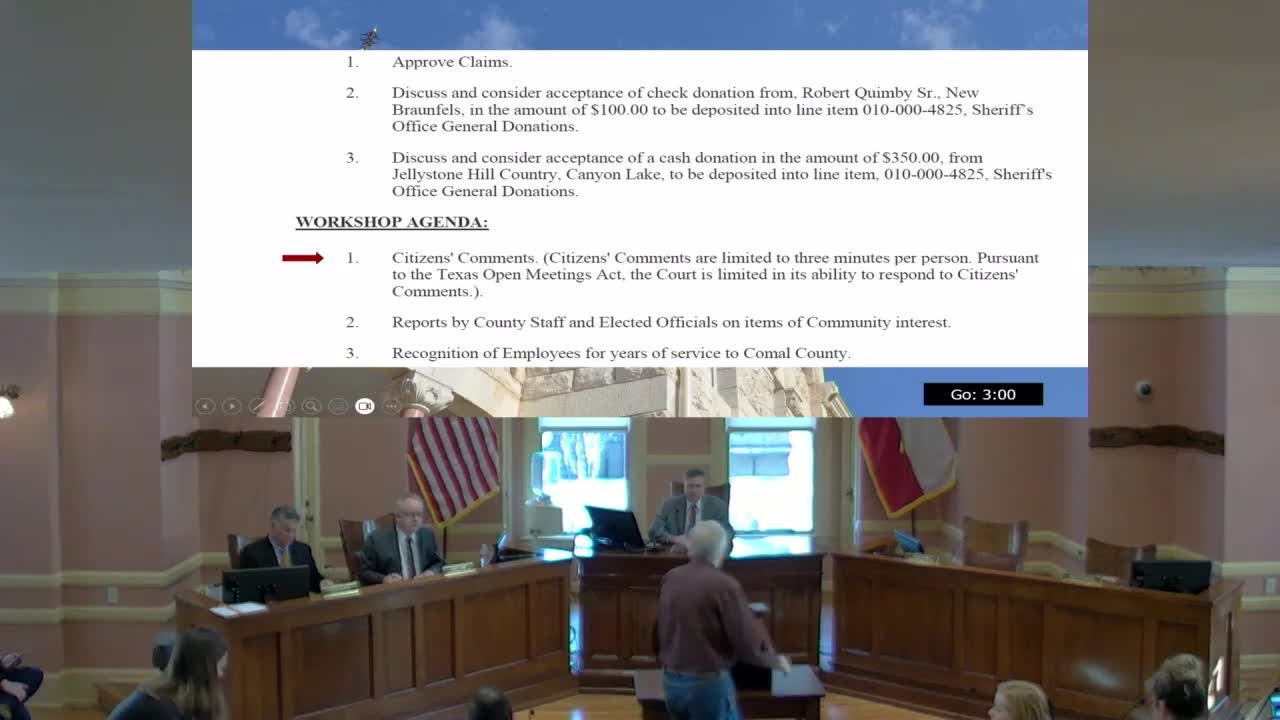
Two Comal County residents presented detailed critiques of the Texas Water Company's 2022 Water Availability Report at the Jan. 23 commissioners court meeting, urging the court to require a presentation and to strengthen county requirements for water-availability reporting ahead of the 2025 report.
Comal County residents Jonathan Gulick and John Haidor told the Comal County Commissioners Court on Jan. 23, 2025, that the Texas Water Company's 2022 Water Availability Report (WAR) overstates available supply and fails to account adequately for drought conditions, and they urged the court to require greater scrutiny and methodological changes before the company submits its next report.
Gulick, identifying himself as a Comal County resident, said he read the 2022 WAR and its five appendices and concluded the document contained "a number of significant issues." He told the court that, based on county drought-stage records, Texas Water Company customers in Comal County were under stage 1 to stage 4 drought restrictions for 90.2% of the three-year span from Jan. 1, 2022, to Dec. 31, 2024 (989 days), and he said the 2022 WAR did not describe how drought contingency or emergency measures could force increasingly severe restrictions on customers.
"I can accept conserving water due to drought restrictions, but I cannot accept Texas Water Company overestimating water availability by not taking into account drought conditions," Gulick said. He recommended the court ask Texas Water Company to present to the county engineer and to Commissioner Leacotte what methodological changes it will make for the 2025 WAR; he also asked to attend that presentation.
John Haidor, who identified himself as a Precinct 4 resident and a Texas certified professional geoscientist (badge no. 775), delivered a 55-page investigative report and said his independent Monte Carlo forecast models indicate realistic uncertainties could cause demand to outpace supply in as little as 10 years. "My models show that water supply gaps are being driven by rapid growth and exist apart from the recent drought, which has only served to bring that gap forward," Haidor said.
Haidor told the court he does not believe the 2022 WAR was prepared with intent to deceive, but he said current Comal County subdivision regulations do not include "specific and robust regulatory requirements" for WAR preparation, vetting, approval, or use. He said such requirements are important so suppliers, the county, the groundwater conservation district and the Guadalupe-Blanco River Authority (GBRA) can better manage supply and promote conservation measures.
Haidor said he had met with Texas Water Company and delivered his report; he said the company acknowledged deficiencies in the 2022 WAR and said it would consider his proposed methodological changes for the 2025 WAR. Both speakers asked the court to require a presentation or additional review before the 2025 WAR is accepted by county staff.
The court accepted the printed materials from the speakers. The transcript records no formal action or directive from the court to require a TWC presentation or to change county regulations during the Jan. 23 session.
Why it matters: Comal County is experiencing rapid population growth; county decisions about how to evaluate a utility's long-range water-availability analysis affect planning approvals, subdivision review and residents' expectations about future water restrictions. The speakers argued that better methodological standards and a formal presentation from the supplier could reveal supply gaps sooner and allow coordinated conservation or supply actions.
Court context and next steps: Neither a formal vote nor a staff direction to update subdivision regulations appeared in the meeting record. Both speakers left copies of their materials with the court; the transcript does not record whether county staff agreed to a follow-up briefing or what timeline, if any, the county might set for changes to WAR requirements.