Get Full Government Meeting Transcripts, Videos, & Alerts Forever!
Get email alerts on the Minitex Elibrary topic
No spam. Unsubscribe anytime.
Minitex, eLibrary Minnesota presenters urge sustained funding as usage grows
Summary
Minitex and university and student witnesses told the Senate committee that shared services—interlibrary loan, eLibrary Minnesota (ELM) databases, eBooks—reach millions of users and face rising subscription costs; they asked legislators to protect and increase funding.
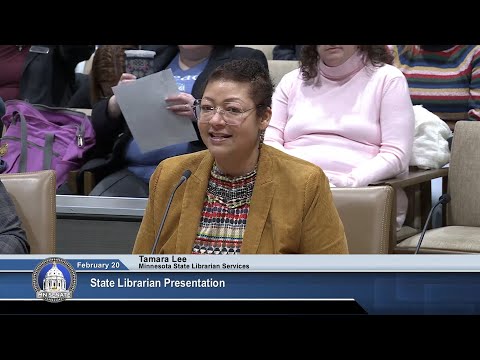
Minitex Director Maggie Snow told the Senate Education Finance Committee on Feb. 20 that Minitex provides a statewide backbone of shared library services including interlibrary loan (MNLINK), statewide delivery, digital collections and cooperative purchasing.
“Readers can easily request items to be sent to their local library, campus, or school,” Snow said, describing MNLINK and a statewide delivery system that reaches “over 500 libraries within a day or 2 of receiving their requests.” Snow said Minitex is a program of the Office of Higher Education and receives primary funding from that office along with federal funds passed through State Library Services.
Snow said Minitex manages statewide digital collections including eLibrary Minnesota (ELM), a set of more than 55 research and information databases used through schools, public libraries, academic libraries and an ELM portal. In the hearing transcript Snow stated: “Last year, curious Minnesotans searched Elm 50 5 Million times. That's almost 10 searches per resident of the state.”
Student and higher-education witnesses described ELM and related resources as essential. Ankit Machopadhyay, a junior at Eagan High School, told senators he uses ELM databases for research, debate and classwork and noted that ELM had not seen a funding increase since 2007. Kate Peterson, undergraduate services librarian at the University of Minnesota, said eLibrary Minnesota provides databases that help thousands of students transition from high school to college and that subscription costs for databases have risen “well beyond inflation.”
Snow listed other Minitex services: a unified catalog of roughly 14,000,000 library resources across Minnesota, an eBooks Minnesota collection (including a K–8 subset for classroom simultaneous use), the Minnesota Digital Library with digitized historical items, AskMN statewide virtual reference answered by staff from more than 35 libraries, and a cooperative purchasing program that Snow said saves Minnesota libraries $3–4 million annually.
Legislators asked about federal funding. Senator Clark asked how much federal funding Minitex receives; Snow replied that Minitex receives “about $1,400,000 in federal funding through state through the grants to states program administered by State Library Services.” Snow told the committee she could not be more certain than the committee itself about future federal appropriations.
Presenters and witnesses asked legislators to preserve ELM funding to avoid shifting subscription costs to local libraries or losing access to databases that support classroom instruction.
Why it matters: ELM and Minitex services provide statewide access to subscription research databases, eBooks and interlibrary loan; rising subscription costs and flat funding risk shifting costs locally and reducing equitable access to vetted information resources for students and the public.