Get Full Government Meeting Transcripts, Videos, & Alerts Forever!
Get email alerts on the Libya topic
No spam. Unsubscribe anytime.
UNSMIL tells Security Council Libya remains divided as human rights abuses, migration and election obstacles persist
Summary
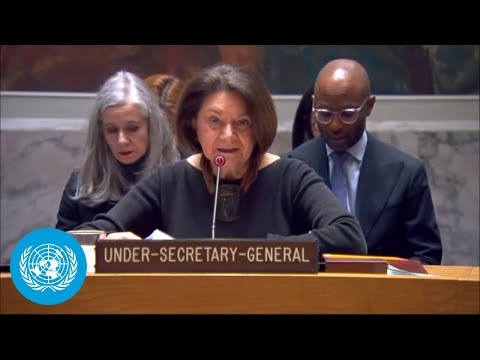
A United Nations Support Mission in Libya (UNSMIL) representative told the Security Council that Libya remains politically divided and unstable, with competing institutions, continuing human rights abuses and armed actors impeding progress toward national elections.
A United Nations Support Mission in Libya (UNSMIL) representative told the Security Council that Libya remains politically divided and unstable, with competing institutions, continuing human rights abuses and armed actors impeding progress toward national elections.
UNSMIL said an advisory committee of 20 Libyan experts — 35 percent women — has been established to examine contentious elements of the electoral law that have prevented national polls, and that the committee has recently convened in Tripoli and reconvened for further meetings to develop options for overcoming those obstacles. The mission is also facilitating structured political dialogue and consultations among Libyan economic experts, including a meeting in Tunis, to identify priorities for economic governance.
The advisory committee is not a decision-making body but its proposals are intended to support efforts to remove legal and procedural barriers to holding national elections, the representative told the council. The briefing stressed that national elections depend in part on agreement over an overarching fiscal framework; UNSMIL said no progress has been made on a unified budget or agreed spending framework, and urged resolution to support the Central Bank of Libya’s stabilization efforts.
On governance, the representative said a dispute over the leadership of the Libyan Audit Bureau has escalated, threatening the bureau’s integrity, and urged that oversight bodies be kept free from politicization. The briefing also said litigation and conflicting court rulings have left the presidency of the High Council of State unresolved after six months, and that the High Council of State remains divided and unable to fully perform its institutional role.
UNSMIL recounted a December facilitated agreement among the Presidential Council, the House of Representatives and the High Council of State on a draft national reconciliation law; it said subsequent parliamentary amendments raised concerns about the independence of a future National Reconciliation Commission. The representative noted that, through an African Union-led process, a charter for reconciliation was agreed in Zintan and adopted on Feb. 14 in Addis Ababa, but that some Libyan stakeholders have not endorsed that charter.
On local polls, UNSMIL said successful municipal elections were held in 56 municipalities in November 2024 and that preparations are under way for elections in a next group of 63 municipal councils. The mission reported that the preliminary candidate-nomination phase produced more than 4,900 nominees, including 1,345 women; voter registration is the next step and the High National Elections Commission requires government funding to proceed.
Security concerns highlighted in the briefing included continued activity by non-state and quasi-state armed actors. The representative said that in December the minister of state for cabinet affairs, Adel Juma, was injured in an armed attack on his car in Tripoli and called for a full, transparent investigation. The Libyan National Army took control of a military base in Ubari that had been held by forces aligned with a Government of National Unity–affiliated commander, the briefing said.
UNSMIL described the 2020 ceasefire agreement as only partially implemented and said renewed efforts by Libyan authorities are needed to meet remaining provisions and to enable reunification and reform of security institutions. The mission reported a positive development in December when it facilitated a joint technical team of senior military and police officers from the Government of National Unity and the Libyan National Army to improve coordination on border security, counterterrorism and irregular migration.
The representative also warned of an increase in arbitrary arrests and enforced disappearances, and reported 15 deaths in custody recorded since March 2024. UNSMIL has reportedly been granted access to detention facilities in Mitiga, Benghazi and Al Burayqah (as reported to the council) and said wider access and systemic reforms are needed to align Libya’s justice and corrections systems with international human rights standards.
On migrants and asylum seekers, the briefing described “serious human rights violations,” including torture and cruel and inhuman treatment. UNSMIL cited the discovery of mass graves linked to raids on human trafficking sites: one on a farm in Jikrah in northeastern Libya and another in Al Kufra in the southeast. To date, the mission reported 93 bodies exhumed in those districts and called for full, independent investigations.
The briefing outlined humanitarian needs tied to arrivals from Sudan: UNSMIL and UN partners reported that the 2025 Libyan chapter of the Sudan refugee regional response plan targets some 446,000 people and requires about $106 million, roughly double the 2024 requirement; the representative urged donors to provide continued support.
Concluding, the UNSMIL representative urged Security Council support for the newly appointed special representative, Hannah Tetteh, who was expected to take up her functions in Tripoli the next day, and expressed appreciation for Deputy Special Representative Stephanie Koury, who served as officer in charge and helped lay groundwork for the UN-facilitated political process.
The council briefing included detailed descriptions of ongoing political, security and humanitarian problems but did not record any Security Council decision, vote or formal action during the presentation.