Get Full Government Meeting Transcripts, Videos, & Alerts Forever!
Get email alerts on the School Library Census topic
No spam. Unsubscribe anytime.
Census finds many Minnesota school libraries understaffed; lawmakers urged to tie aid to statutory definition
Summary
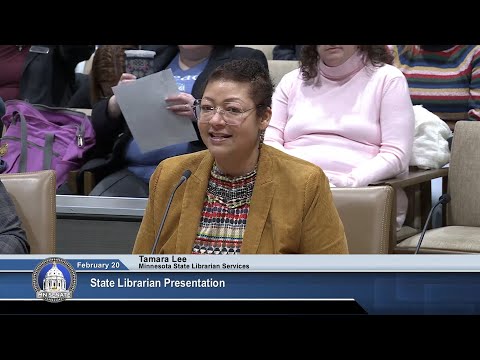
A statewide school library census presented Feb. 20 to the Minnesota Senate Education Finance Committee found nearly half of responding schools lack a licensed library media specialist, and many library media centers operate on small budgets. Presenters urged the Legislature to link state school library aid to the statutory definition of a media center and to support hiring and licensure.
A statewide school library census released to the Minnesota Senate Education Finance Committee on Feb. 20 found wide variation in staffing, budgets and use of state school library aid.
The census, conducted in 2024 and presented by Ashley Dress, school library consultant at the Southeast Library System, and Anna Granias of Wilder Research, drew responses from 1,528 of 1,777 eligible K–12 public and charter schools. Dress said the survey aimed to inform “decision makers like yourselves” about what schools need to preserve and strengthen library media centers (LMCs).
The report found that 81% of responding schools reported having a library media center. But nearly 46% of schools do not have a licensed library media specialist (LMS) serving the LMC, the presenters said. Among schools that reported an LMS, more than half said the person worked less than full time. The American Association of School Librarians’ recommended staffing — a full‑time licensed media specialist plus full‑time support staff — was met by about 6% of schools in the survey, the presenters said.
Survey respondents identified funding and district staffing decisions as the most common reasons for lacking licensed staff. Dress said many media-center duties were being performed by paraprofessionals or classroom teachers who lack LMS licensure; the presenters added that 25% of respondents reported working at more than one school.
The census also cataloged media-center budgets. Anna Granias said nearly half of media centers reported annual budgets under $5,000 and the median media‑center budget was $5,000. Schools reported a mix of funding sources: district funds, school funds, fundraising (PTA/PTO/book fairs), school library aid and occasional one‑time grants or donations.
Granias described the state school library aid distribution enacted in 2023: automatic distributions calculated at the greater of $16.11 per adjusted pupil unit (APU) or $40,000 for school districts and $20,000 for charter schools. But she said awareness of those funds among on-the-ground library staff was limited: about 40% of respondents said they were unaware their school had received the state aid, and of those who knew, roughly 49% said they were unsure how the money impacted the media center.
Presenters and witnesses told senators the data suggested some districts used the state distribution to maintain existing staffing rather than expand or strengthen media programs. Dress urged legislators to “strengthen the use of school library aid dollars by connecting it to the statutory definition of a school library” and recommended supports to help districts hire licensed media specialists and provide protected time for library instruction.
District and local librarians gave mixed accounts. Marie Hajjukovich, a district media specialist in Stillwater Public Schools, described the state aid as “transformative” for her district: increased staffing, new purchases and sharply higher circulation rates. She said Stillwater added nearly 5,000 new books across its three secondary schools and saw circulation increases of about 50% year‑over‑year at the high school.
By contrast, Laura Gingras, formerly an elementary school librarian in Waconia, described cuts in her district that removed licensed positions and left elementary libraries staffed by teachers without media training. Gingras told the committee those changes reduced student access to digital citizenship lessons, research instruction and library-curated collections.
Committee members reacted to the findings. Chair Kunish (chair duties were briefly filled by Senator Bonnie Wesslin at the hearing) and other senators said they planned to examine whether program guidance or statutory language should be tightened to ensure state dollars reach media centers and support licensed staffing.
The presenters recommended continuing one‑time appropriations to regional systems to support licensure and professional development and urged stronger district‑level consultation with media staff on how school library aid is spent.
Why it matters: Licensed media specialists provide instruction in information literacy, digital citizenship and curriculum support; the census’ mix of low budgets and part‑time or absent LMS staffing suggests statewide inequities in access to those services and prompted calls for legislative adjustments to ensure aid strengthens, rather than simply preserves, existing capacity.