Get Full Government Meeting Transcripts, Videos, & Alerts Forever!
Get email alerts on the Elections Integrity topic
No spam. Unsubscribe anytime.
Residents and election watchers raise chain-of-custody, camera and countywide-voting concerns at Williamson County court
Summary
Multiple public commenters told the Williamson County Commissioners Court they observed failures in camera monitoring and ballot-chain procedures during 2024 early voting and urged changes to countywide voting and local processes.
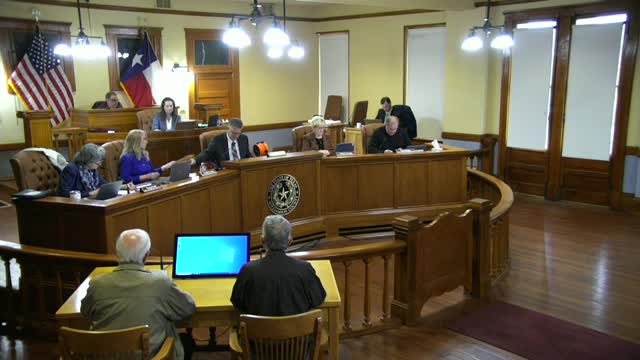
Several residents and appointed poll watchers told the Williamson County Commissioners Court on Feb. 12 that they observed problems with voting‑site cameras, ballot transfers and ballot‑package handling during the 2024 early voting period and called for process changes and further county review.
The comments came during the court’s public comment period and were delivered by multiple speakers, including a county resident who said he monitored election cameras, a GOP precinct chair who led a volunteer audit team, a poll watcher who followed a ballot box from a polling site, and local party activists.
Vince Sall, of Georgetown, told the court he monitored nine election cameras during the November 2024 election and said only three were online during early voting on Nov. 1 and that one central‑count camera “was not online until after central count station had convened on 11/02/2024.” He said the lack of online cameras “during handling of ballot boxes is a clear violation of the Texas Election Code.”
Paul Parker, GOP precinct chair of Precinct 472, called countywide voting “illegal” as he described what he and his volunteer team view as an inherent privacy problem in countywide voting systems. Parker summarized his handout to the court, saying his group’s review found “from 1 to 3% of voters' ballots can be identified using unique combinations of ballot style and polling location,” and saying the result is a conflict between requirements that a voting system both “preserve the secrecy of the ballot” and “be capable of providing records from which the operation of the voting system may be audited.” Parker urged the court to form a working group of citizens and election‑office representatives to evaluate returning to precinct‑level voting.
Dr. Laura Presley, identifying herself as a poll watcher representing True Texas Elections, said she followed an early‑voting ballot box from the Jester Annex site and said the Williamson County sheriff’s deputy accompanying the transfer failed to follow the box all the way to the elections office. Presley said she observed the elections employee who transported the box drive onto I‑35 and later exceed 80 miles per hour on an access road, and she cited Texas Election Code provisions in arguing the deputy’s conduct violated the chain‑of‑custody requirement. Presley said she reported the incidents to Sheriff Gleason and that the sheriff “committed to correcting the issues,” but she added she continued to receive reports of gaps in coverage throughout early voting.
Marsha Strickler Watson, a precinct chair and representative of the Capital Area Conservative Republicans Club, told the court poll judges and technicians are “not consistently following the election code law or properly filling out the chain of custody forms when ballot … stock is delivered to the polling places.” Watson pointed to training materials that, she said, conflict with statutory language and asked the court to ensure poll judges are trained to open delivered ballot packages, inspect the serial numbers and retain documentation to support later audits.
Speakers repeatedly asked the court to reopen or increase Election Commission engagement and to provide a formal venue where citizens, observers and election staff can review procedures and follow up on audit findings. Several speakers provided affidavits or handouts to the court and said they will submit records for the court’s official file.
Court members did not take formal action during the public comment period; several commissioners acknowledged the comments and said staff would follow up. The court later moved into executive session and reconvened with no public action recorded related to the election comments.
Ending: Commenters recommended concrete steps — training poll judges to inspect serial numbers, enforcing deputies’ escort duties for ballot boxes, forming a citizen‑staff working group, and evaluating whether countywide voting preserves ballot secrecy while supporting audits. Those suggestions will require action by election officials or future agenda items for formal consideration.