Get Full Government Meeting Transcripts, Videos, & Alerts Forever!
Get email alerts on the STATE AGENCIES & GOVT'L AFFAIRS SENATE topic
No spam. Unsubscribe anytime.
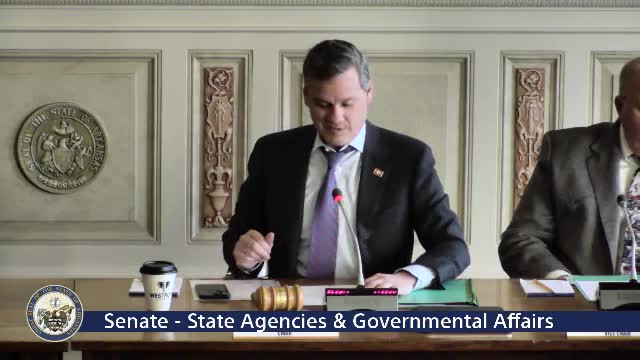
Senate State Agencies committee adopts rules, allows short technical verbal amendments
Summary
The Senate State Agencies and Government Affairs Committee adopted its rules for the session after debate over automatic placement of bills on the agenda and how long an unpresented bill should remain on the agenda. The committee also set meeting days and a deadline for running constitutional amendments.
The Senate State Agencies and Government Affairs Committee on Thursday adopted its committee rules for the session after a debate over whether bills should be placed automatically on committee agendas and how long an unpresented bill should remain listed.
The committee voted to adopt the draft rules with one change: rule 3 was amended to permit short technical verbal amendments. The chair announced the rules were adopted by voice vote after members discussed and declined to remove the automatic-placement provision in rule 4.
Committee vice chair Senator John Payton urged the committee to strike rule 4, which would prevent every bill referred to the committee from automatically appearing on the agenda. "If you look at your draft there, the rules number 4, all bills referred to state agencies and government affairs committee will automatically be placed on the committee agenda... I would just suggest that we, follow suit and strike number 4 there," Payton said, arguing that the change adopted in the Public Health Committee made agendas clearer for the public. Several members said they supported the goal of a concise public agenda but worried about practical consequences for sponsors who might miss short notice deadlines.
Senator Clark led the successful amendment to rule 3, saying the committee should allow "short technical verbal amendments" so that minor, non-substantive wording fixes would not stall a bill. "In other committees, for some time we have amended this rule... short technical verbal amendments are allowed," Clark said.
Members debated the interaction of rules 4 and 5: rule 4 (automatic placement) would put all referred bills on the agenda immediately, while rule 5 provides that a bill that appears on the agenda but whose sponsor does not present it will be dropped from the agenda after two consecutive meetings. Several members proposed reducing the number in rule 5 from two meetings to one to keep the agenda cleaner while preserving timely placement for late referrals.
Staff and members clarified operational timelines: under the committee's stated practice, notices to add a bill to the agenda should be given 48 hours before the meeting; members said four hours is insufficient and that 48 hours is the working lead time used when scheduling. Carly Cooper of the Bureau of Legislative Research explained that if a bill is filed and referred to the committee by Tuesday under current rules, it can appear on the committee's Thursday agenda; if the rule is changed so sponsors must ask to place a bill, the earliest it could appear would be the following week unless the chair or staff are notified in time.
The committee also confirmed its regular meeting schedule — Tuesdays at 10 a.m., with Thursdays reserved as needed — and discussed the constitutional amendment calendar. Members noted the filing deadline for constitutional amendments is Wednesday, Feb. 12, and the committee recommended using Thursday, Feb. 13, as the deadline for running constitutional amendments in the committee.
The meeting concluded after agency representatives in the room introduced themselves to the committee; the chair adjourned the meeting after adopting the rules.