Get Full Government Meeting Transcripts, Videos, & Alerts Forever!
Get email alerts on the Rv Park Alcohol And Site Conditions topic
No spam. Unsubscribe anytime.
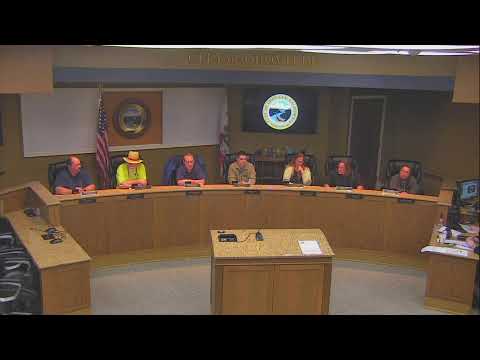
Oroville commission approves alcohol sales permit conditions and 8‑foot fencing for new luxury RV park
Summary
The commission approved conditions allowing alcohol sales at a planned 27‑space luxury RV park, required security and screening measures, and a fencing plan (6‑ and 8‑foot sections) aimed at separating the site from adjacent schools; the commission also amended the park's maximum consecutive stay to match city code.
The Oroville City Commission on Jan. 23 approved conditions for alcohol sales and a site fencing plan for a proposed 27‑space luxury RV park, and amended the project's length‑of‑stay limit to match the city's transient occupancy code.
Staff presented the applicant's proposal for a private, members‑only resort-style RV park with a gated entry, a welcome center and a clubhouse. The applicant is seeking two alcohol licenses: a Type 21 license for the welcome center "supply store" (off‑sale containers for guests to take to their sites) and a license to allow on‑site open‑container service at the clubhouse (staff said ABC indicated that would likely be a Type 47). Planning staff said notice for the alcohol permit went to about 57 properties because the California Department of Alcoholic Beverage Control requires a 500‑foot notice radius.
Why it matters: The proposed park sits adjacent to several school facilities and a public pool, and neighbors and school officials voiced safety and exposure concerns during public comment. The commission added site controls and conditioned approval on multiple measures the city said are intended to limit access and visibility from surrounding properties.
The proposed controls and conditions discussed by staff and the applicant include: a gated entry system tied to a guest access card that also functions as a cashless payment method for purchases; video surveillance with motion sensors; an on‑site manager 24 hours a day; a combination of security staff and roving patrols; landscape buffering; a security plan required to be approved by the chief of police; and adherence to Oroville Municipal Code performance standards on lighting, noise and maintenance. Staff noted failure to follow approved plans could lead to revocation of use permits.
Dean Castelbaum, the applicant, told the commission the park is modeled on other high‑end RV resorts. "Our intention is not to have a party house at our RV resort," Castelbaum said. "Safety is a huge issue for that, and that's something we plan on really doing an excellent job at." Castelbaum said the park would staff experienced security personnel, have one to two security staff at night, and that a bartender would be present only for events or when the clubhouse is sufficiently occupied.
Several nearby residents and school officials spoke in public comment opposing on‑site alcohol sales or urging additional safeguards. "Nelson Avenue Middle School would be across Sixth Street from this," Cody Walker, assistant superintendent of business for the Thornbleedonian Elementary School District, said. "I do think that the higher fence, if that were put in place, would be a good thing, and appreciate concerns for screening ... from the students." Another resident noted that customers could already obtain alcohol nearby and questioned the need for another on‑site source.
Commission discussion focused on screening and security. Commissioners and staff debated a perimeter fencing plan that would combine 6‑foot fencing on the public‑facing sides with 8‑foot fencing where the site abuts the school and the freeway to reduce the risk of intrusion and visual exposure. Staff confirmed the site plan includes planting and a landscape maintenance agreement to ensure buffers are established and maintained. The applicant said long‑term stays are unlikely to be the business model but acknowledged the city's code defines transient occupancy as up to 60 consecutive days.
Formal actions: The commission recorded two unanimous votes related to the project. First, commissioners approved the specified fencing plan as a condition of the use permits (motion recorded and passed unanimously). Second, commissioners approved an amendment to the project‑specific condition that visitor stays be limited in conformance with Oroville Municipal Code Title 3.2 (Uniform Transient Occupancy Tax), which staff said defines the transient period as a maximum of 60 consecutive days; the commission approved the proposed amendment by unanimous vote. Staff said the applicant accepted either a 30‑ or 60‑day limit but favored the flexibility of 60 days for potential emergency situations.
The commission directed staff to prepare the revised resolution and implement the fencing condition; staff said the updated resolution would be ready the following month for signature. Staff also emphasized that the alcohol licenses themselves must be obtained through the state ABC process before on‑site sales could begin.
The commission's actions also require the applicant to submit the police‑approved security plan and to adhere to all conditions in the adopted resolution and to the city's municipal code; staff said failure to comply could result in enforcement actions up through revocation of the use permits.