Get Full Government Meeting Transcripts, Videos, & Alerts Forever!
Get email alerts on the Public Safety Highways topic
No spam. Unsubscribe anytime.
HPD highway interdiction unit outlines how traffic stops turn up large narcotics and weapons hauls
Summary
Sergeant Matthew Ham of the Houston Police Department told a city committee the Highway Interdiction Unit uses traffic enforcement, canine alerts and X‑ray scanning to detect concealed contraband; he gave seizure totals from 2021–2024 and year‑to‑date figures through May.
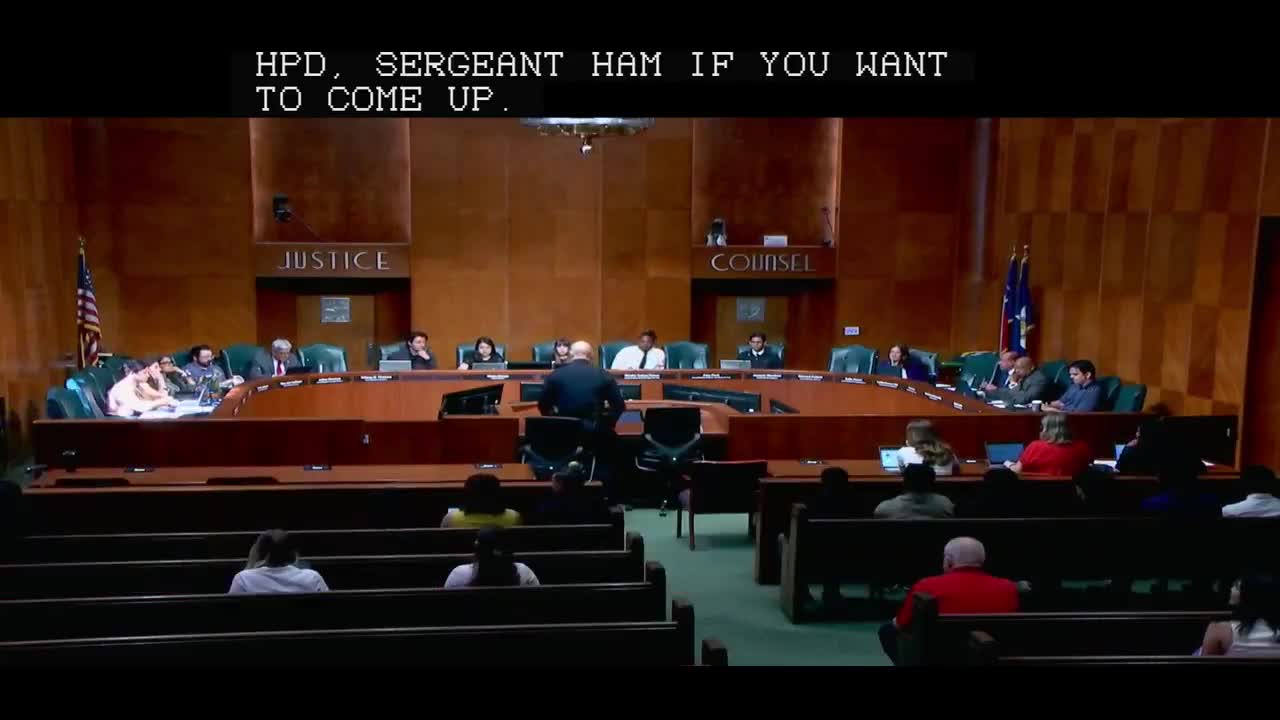
Sergeant Matthew Ham, the sergeant over the Highway Interdiction Unit in the Traffic Enforcement Division for the Houston Police Department, told a City Committee on June 4 that his team focuses on transforming traffic stops into criminal investigations to disrupt smuggling that moves through the Houston area.
Ham said the unit targets highways that connect to the border and the Port of Houston, which he described as “a nexus to the border” and a frequent route for contraband. “Our main focus at Highway Interdiction is to disrupt and dismantle criminal activity that occurs on the highways throughout the Houston area,” he said.
The unit, Ham said, conducts marked traffic stops on freeways and uses two narcotics canines, handheld X‑ray devices and a ZBB backscatter X‑ray van to inspect vehicles when officers develop probable cause or receive canine alerts. Ham described several recent seizures: a refrigerated commercial trailer that yielded 60 kilos of cocaine and 10 kilos of fentanyl hidden inside aftermarket commercial vehicle batteries; 16 kilos of cocaine found hidden in a transit van; and a 2021 stop that led to seizures of 612 kilos of methamphetamine and 135 kilos of heroin.
Ham provided multi‑year and year‑to‑date totals: for 2021–2024 the unit seized 331 weapons, 1,705 kilos of cocaine, 3,726 kilos of methamphetamine, 172 kilos of heroin and 43 kilos of fentanyl. He said year‑to‑date through May the unit had seized 27 weapons, 271 kilos of cocaine, 92 kilos of methamphetamine, just over 1 kilo of heroin and 10.5 kilos of fentanyl.
During the committee's question period, Council Member Alcorn asked whether stops are based on traffic violations or tips. Ham said it is a combination: “A lot … we are just out there watching the road and we look for driver behavior, things that look amiss, and sometimes we are given information” from other officers or agencies. When asked whether eliminating routine traffic stops would hinder their work, Council Member Ramirez asked whether that would “kill a lot of your confiscation of these dangerous drugs.” Ham answered, “Absolutely, it would.”
Ham also described concealment techniques used by criminal organizations—locked luggage, aftermarket compartments on trailers and disguised tanks on tractors—and said the unit often works with HPD narcotics, criminal intelligence, and local, state and federal partners.
He noted canine K9 Frieda retired on June 4 after eight years and credited her for seizures during her tenure; her handler Officer Marisol Gonzales recently received a new partner, Pluma, and the unit began training with the new dog on June 5.
The unit size, Ham said, is 10 officers with two dogs assigned specifically to the Highway Interdiction Unit; other HPD divisions also maintain dogs for narcotics work. Ham said traffic safety remains a primary focus and that officers issue citations or warnings when appropriate while remaining alert for signs of other criminal activity.
The presentation included images from recent stops and descriptions of tools the unit uses to detect concealed compartments and contraband. Committee members thanked Ham for the briefing and for detailing both tactics and recent results.