Get Full Government Meeting Transcripts, Videos, & Alerts Forever!
Get email alerts on the 2016 Phs Bond topic
No spam. Unsubscribe anytime.
2016 Public Health & Safety bond: Zuckerberg Building 5, clinical lab, fire and homeless‑service projects advance; $14M interest earnings appropriated
Summary
Public Works program manager Joe Chin told the Citizens Bond Oversight Committee that most projects funded by the 2016 Public Health and Safety (PHS) bond are in late construction or closeout, with $14 million of interest earnings appropriated and $2.8 million held in reserve pending an arbitrage review.
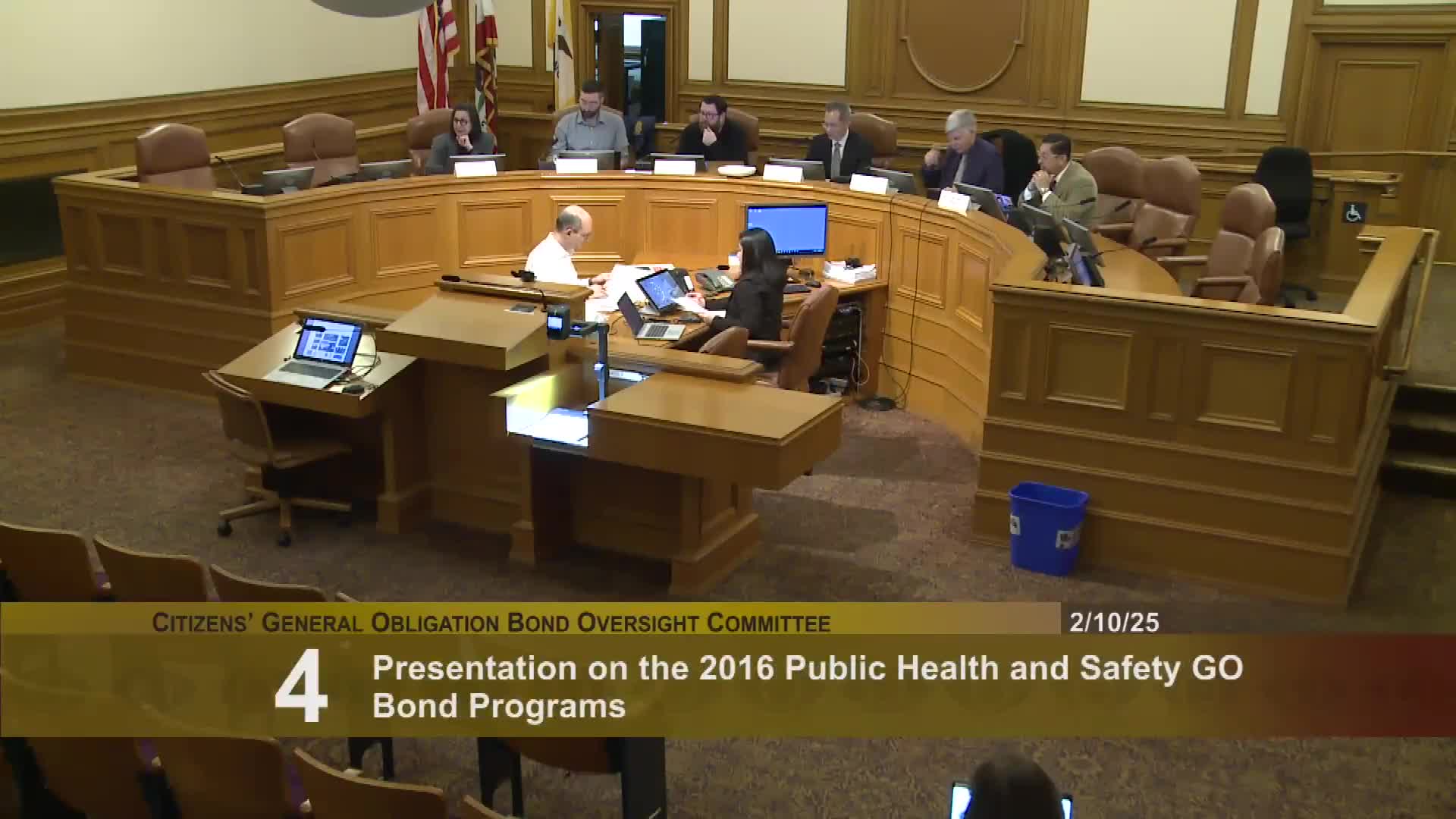
San Francisco Public Works and client departments reported progress on projects financed by the 2016 Public Health and Safety (PHS) general obligation bond at the Citizens General Obligation Bond Oversight Committee meeting on Feb. 10.
Joe Chin, Public Works program manager for the 2016 Public Health and Safety Bond Program, said the bond was approved by voters for $350 million and is currently showing $364 million in available authorization because approximately $14 million of bond interest earnings have been appropriated to project budgets. Chin said, "The total bond authorization amount for PHS is currently showing as $364,000,000 because it includes approximately $14,000,000 of bond interest earnings that have been appropriated as of this fiscal year." He added that $2.8 million of those earnings has been placed on controls reserve pending an arbitrage liability review due by the end of the fiscal year.
Chin gave line‑by‑line status for major PHS components: three Department of Public Health (DPH) projects (Zuckerberg San Francisco General Building 5, Southeast Health Center, and community health centers) have core components completed or in closeout; seven Building 5 projects are in active construction with targets around early 2026; the clinical laboratory project was targeting substantial completion in March 2025. Community health centers (Maxine Hall and Castro Mission) have been serving patients since October 2021 and August 2022 respectively, with only warranty punch items and owner change orders remaining.
On the fire station and ambulance components, Chin said the ambulance deployment facility has been in use since May 2021 and finalized in February 2023. Emergency generator replacements are under construction at several stations, with Fire Station 37/44 targeted for completion in March and removal of host towers at stations 6, 11, 12, 15, 21 and 38 underway.
Chin discussed budget figures for Building 5: the component budget increased to $216.3 million after the appropriation of interest earnings; combined expenditures are roughly $204.3 million with about $10.2 million remaining. He attributed higher-than-expected project controls (soft costs) for some Building 5 scopes to schedule extensions, additional design and construction‑management work, and settlement of contractor claims that were tracked to construction budgets while related soft‑cost litigation support remained in project controls.
Chin described the sequencing and interdependence of work at Building 5 and the public health lab: chilled water piping and other trades must coordinate with the public health lab schedule because the utility chase runs through that project. He said seismic upgrades, phased restroom and finish work, and psychiatric emergency services construction are in varying stages of progress across the program.
Committee members pressed for clarification about what "project controls" includes. Chin said project controls generally cover non‑construction costs such as design, planning, inspection and management; he noted extended project durations increase these soft costs. When asked whether construction claims had been resolved, Chin said some disputes had been settled through mediation and board approval in the prior year.
Chin closed by noting the program is in its ninth year since voter approval; three of six components are in closeout, several projects target completion by late 2025 or early 2026, and the arbitrage reconciliation will determine the release of the $2.8 million in reserve.
The committee had no in‑person public comments during the item.