Get Full Government Meeting Transcripts, Videos, & Alerts Forever!
Get email alerts on the First Responder Mental Health topic
No spam. Unsubscribe anytime.
Committee lays over bill to expand equine therapy program for first responders
Summary
A Minnesota House committee laid over House File 261, which would broaden a pilot equine therapy program to include retired officers, volunteer firefighters, ambulance personnel, 911 communicators and correctional officers after testimony from program operators and a current Lakeville police officer.
A Minnesota House committee laid over House File 261, a measure that would expand a pilot program providing equine-assisted clinical therapy to more categories of first responders, after testimony from program staff, a participant and multiple lawmakers.
The bill, introduced by Representative Kosnick, would extend eligibility beyond active police and firefighters to include active and retired police officers, full-time and volunteer firefighters, ambulance service personnel, 911 communicators and correctional officers. Representative Kosnick said the expanded eligibility builds on a pilot authorized two years ago and on reporting that shows a high retention rate among participants.
The program’s founder, Sally Mixon, testified that Abijah’s — the program she founded and operates at Canterbury Park — has a roughly 98 percent retention rate for first responders who participate, which she said means participants stayed in their jobs. "We have a 98 percent success rate, and success rate in our eyes is first responders remaining in their job," Mixon said.
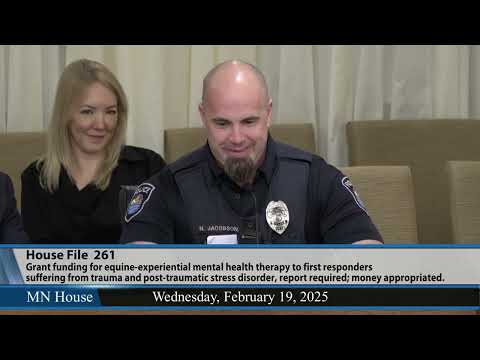
Officer Nick Jacobson of the Lakeville Police Department described his experience as a participant. Jacobson, who said he served more than 11 years in the Lakeville department and earlier served in the Marine Corps, recounted multiple combat deployments and difficulty transitioning back into civilian life. "You can always lie to us as therapists, but you can never lie to the horses," Jacobson said, describing a line from Mixon that helped him engage with the therapy. He told the committee the therapy helped him be more present with family and in his policing duties.
Danny Palmer, identified as a co-founder working on business development for Abijah’s, told the committee the organization began as an LLC and worked under a fiscal sponsor before establishing its own 501(c)(3) in 2024; Palmer said Abijah’s will file its first IRS Form 990 in the coming months. Palmer said the program has worked under donor support while transitioning organizationally.
Representative Pete Johnson, who identified himself as a professional firefighter, asked why Abijah’s does not bill insurance for services. Mixon said some first responders avoid traditional, insurance-billed therapy because completing a formal diagnostic assessment can create a permanent record that some worry could affect their employment. "We've just taken the approach of let's tear down every barrier," Mixon said, describing fundraising to cover care rather than relying on insurance in many cases.
Lawmakers discussed whether the bill should be considered by the Workforce Development Committee or Public Safety Committee; Representative Kosnick said the program was routed to workforce development in previous work with senators because of its ties to retention and staffing. Representative Lehi Pinto suggested additional routes for consideration but did not press the committee to take immediate action.
Committee members praised the program’s reported outcomes and encouraged colleagues to visit Canterbury Park to observe the work. The committee chair announced that House File 261 would be laid over for possible further inclusion, meaning no final vote was taken on the bill during the hearing.
Votes at a glance: No formal recorded roll-call vote was taken on House File 261. The committee took the procedural action to lay the bill over for possible further inclusion.