Get Full Government Meeting Transcripts, Videos, & Alerts Forever!
Get email alerts on the Ev Charging Infrastructure topic
No spam. Unsubscribe anytime.
Council weighs user‑fee options as town expands public EV charging infrastructure
Summary
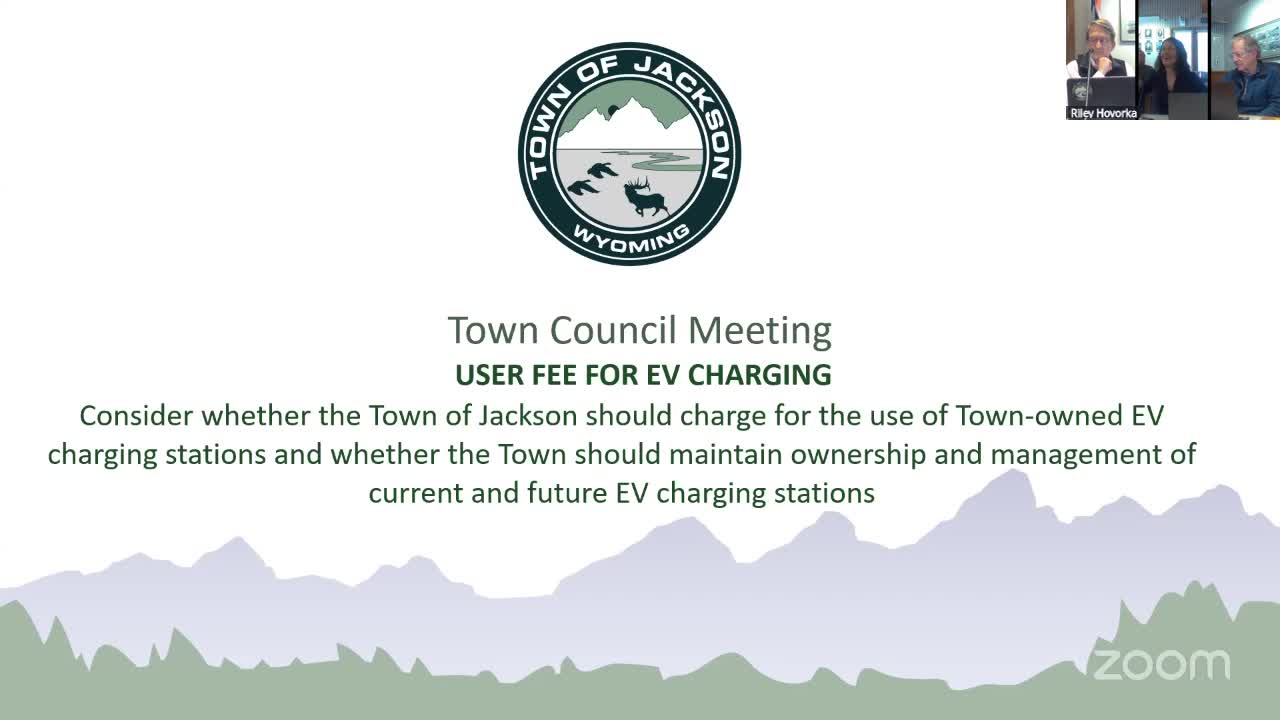
Staff outlined costs and options for user fees and third‑party management of town‑owned electric vehicle charging stations; council continued the discussion to a future meeting after questions about policy goals, equity for residents who cannot charge at home, and pricing guardrails.
Town staff presented a two‑part discussion on Feb. 8 about electric‑vehicle (EV) charging: (1) whether the council wants to initiate user fees for existing and planned town‑owned chargers and (2) whether the town should keep ownership and operation in‑house or seek a third‑party operator/lessor.
Tanya Anderson (Ecosystem Stewardship Administrator) and Johnny Zemas (Public Works) explained the current inventory and projected expansion: the town currently owns 10 level‑2 ports and two DC fast‑charge ports; a regional Department of Transportation grant would add roughly 16 level‑2 ports and four DC fast‑charge ports in town. Staff estimated basic annual operational costs (electricity, cloud software, maintenance) at about $40,000 for existing units and roughly $115,000 after the grant‑funded expansion (estimates vary with contract lengths and electricity rates). Staff emphasized that DC fast chargers account for roughly two‑thirds of ongoing costs because they use more energy and have higher maintenance and software costs.
Staff framed the policy choices and recommended guardrails: staff recommended initiating user fees for both station types but charging more for DC fast charging than for level‑2 charging, with a suggested ceiling of roughly $0.36 per kilowatt hour for DC fast chargers and a target at or below $0.20/kWh for level‑2 to keep EV fueling comparable with gasoline costs for most users. Staff also suggested implementing turnover incentives (hour‑free windows, idle fees after a grace period) and local‑discount programs for residents who cannot charge at home (multi‑unit dwellers). Staff recommended pursuing a hybrid model that preserves town control over policy but uses a vendor to lease and manage equipment (vendor would handle payments, maintenance and potentially replace equipment under a ground‑lease model).
Council voiced several themes and questions: several councilmembers asked about the town's policy goals (encouraging EV adoption, supporting residents without home charging, serving tourists and commercial users) and asked staff to pull usage data (number of charges, kWh, level‑2 vs fast‑charge utilization) to better understand who the town's stations serve. Staff reported they can track number of charges and energy consumed but cannot reliably distinguish whether a user is a resident or a visitor from vendor data; ChargePoint (the town's vendor) provides per‑port utilization and energy reports. Councilmembers asked about demand charges that increase building electricity costs when fast chargers produce large surges; staff confirmed demand charges are a factor in overall cost.
Public comment: Alicia Cox, executive director of Yellowstone Teton Clean Cities, spoke in support of the staff approach and suggested local discount programs and targeted rebate programs for multi‑unit dwellings to provide equitable access.
Outcome: Council agreed to continue the discussion to a future available meeting to allow staff to return with clarified data on usage patterns, options for targeted discounts, and a refined pricing model and vendor arrangements. Councilman Schechter made a motion to continue; Councilwoman Beeman seconded and the motion passed unanimously.
Key points for next meeting (requested by council):
- Provide per‑port utilization and energy usage (kWh) for level‑2 and DC fast ports and a summary showing seasonal peaks and turnover rates. - Model pricing scenarios (examples: free for first hour then $/kWh; idle fees after charge completes; tiered pricing by port type) and estimate revenue vs operational costs under several adoption assumptions. - Describe equity safeguards (local discount program, discounted access for renters/multi‑unit dwellers, employee discount options) and administrative approaches for applying discounts. - Provide vendor models and contract options (town ownership with vendor management; vendor ownership and long‑term ground lease; hybrid approaches) and sample contract terms (revenue share, maintenance responsibilities).