Get Full Government Meeting Transcripts, Videos, & Alerts Forever!
Get email alerts on the Transit Davis Salt Lake Connector topic
No spam. Unsubscribe anytime.
UTA outlines five-year service plan, proposes Davis–Salt Lake connector with 15-minute service
Summary
At a Bountiful City Council work session, Utah Transit Authority trustee Beth Holbrook described UTA's five‑year service plan and a proposed Davis–Salt Lake Connector BRT‑style route that would provide 15‑minute service between Farmington and the University of Utah Research Park; local funding and federal grants remain to be finalized.
Beth Holbrook, trustee, Utah Transit Authority, presented UTA’s five‑year service plan and a proposal for the Davis–Salt Lake Connector at a Bountiful City Council work session. Holbrook said the plan begins with service changes scheduled for April 2025 and includes a higher‑frequency connector between Farmington and the University of Utah Research park.
The plan matters because it would reconfigure several routes that serve Bountiful and south Davis County and create a new limited‑stop, high‑frequency connector Holbrook referred to in UTA materials as the “470X” placeholder. "This is gonna provide us, from Farmington to the University of Utah Research Park, 15 minute service all day long," Holbrook said, describing the proposed service frequency.
Holbrook said the first year of the five‑year plan will consolidate multiple annual change days into a single annual change in April, beginning in April 2025. She said two routes that serve Bountiful now—the 470 and the 455—will be affected: the 470 will be modified and the 455 will remain unchanged in 2025 but could be reconfigured once the Davis–Salt Lake Connector is implemented. "The 455 is not gonna change [in 2025]," Holbrook said, adding that later reconfigurations would focus service around Farmington as a multimodal hub.
Why the changes: Holbrook said UTA updated passenger sensors across its fleet and used the new ridership data to guide route adjustments. "We have sensors in each of our vehicles...so that we have accurate...ridership totals," she said, noting the data is important for federal funding calculations.
Key elements in the plan - Davis–Salt Lake Connector (working name "470X"): Holbrook described a corridor from Farmington and the FrontRunner station to the University of Utah Research Park via Third West and Second South in Salt Lake City. The route is planned to offer 15‑minute frequency all day and would be branded and named later. Holbrook said the physical service will not include continuous dedicated bus lanes across the entire corridor; the connector will operate in mixed traffic in many segments and have station-style stops and enhanced boarding areas.
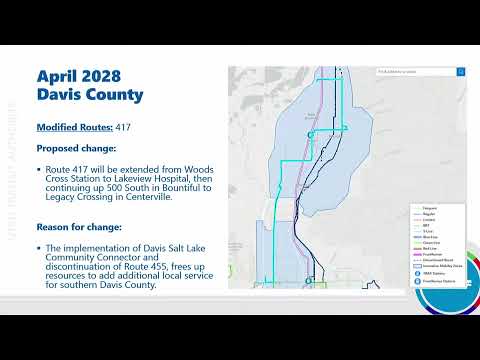
- New and modified routes: UTA proposed a new 417 route along Redwood Road connecting the Woods Cross Frontrunner Station through North Salt Lake into Salt Lake City, and other inter‑county routings to improve north–south connectivity in south Davis County. The 470 will remain a primary north–south corridor, while Farmington is planned as a multimodal hub where multiple routes will terminate or connect.
- Vehicles and infrastructure: Holbrook said UTA will use 40‑foot buses for the connector in electric, compressed natural gas (CNG), and diesel propulsion where needed, and indicated a preference to electrify the fleet for this corridor. She said the agency is not planning articulated vehicles for the initial deployment.
Funding and timeline Holbrook said the project has local funding commitments and a federal funding strategy but remains contingent on competitive federal grants. She described a typical federal/local funding split UTA used previously as approximately 60 percent federal and 40 percent local match and said UTA has identified $18,000,000 in local funds through the Transit Transportation Investment Fund (TTIF) for the Davis–Salt Lake Connector. Holbrook added that TTIF receives a recurring allocation and that approximately $45,000,000 is placed into that account annually for projects with a transit nexus. She said UTA expects to submit a federal funding request around July. "We have $18,000,000 identified through TTIF," Holbrook said, and added that Salt Lake County and Davis County have identified local match funds.
Planning and local involvement Council members asked whether cities would be asked to contribute to the local match; Holbrook said Davis County has identified funds and "they might or might not come back to the cities. I cannot answer that question." She encouraged city involvement on corridor choices such as adding dedicated bus lanes, noting that Salt Lake City invested roughly $15 million on Second South to support bus priority in that corridor.
Local impacts discussed included route coverage changes in Bountiful. Holbrook told the council UTA expects to maintain service on major corridors that pass through Bountiful but that local routing changes and added on‑demand service could be used to maintain coverage where fixed‑route service is reduced. "We do think that either the on demand can pick up some of the extra areas where there wouldn't be as much technical service," she said, describing on‑demand vans as a flexible complement to fixed routes.
Next steps and uncertainty Holbrook described the Davis–Salt Lake Connector as "in a very great position on the federal side" but noted federal grant competition and shifting federal budget priorities could affect timing. She summarized next administrative steps as completing environmental reviews and submitting the federal funding ask. If grants are awarded and local match is secured, Holbrook said service rollouts would occur in stages, with an initial set of changes in April 2025 and additional network changes tied to BRT implementation in later years (Holbrook discussed an example implementation milestone of April 2028 for broader rollouts).
"We anticipate submitting a federal funding ask, probably by July of this year," Holbrook said, and added that the agency is coordinating with county partners on the local match.
Holbrook closed by offering to provide follow‑up materials and tours of existing BRT operations to council members. "If you have any other questions, please feel free to call me," she said.
Local officials raised questions about dedicated lanes and street redesigns, the timeline for naming the new corridor, and how on‑demand service would be used to cover any loss of local stops. Holbrook said naming and branding would follow as the project moves from planning to procurement and construction, and she reiterated UTA's preference for electrification of vehicles on the corridor.