Get Full Government Meeting Transcripts, Videos, & Alerts Forever!
Get email alerts on the Disaster Recovery topic
No spam. Unsubscribe anytime.
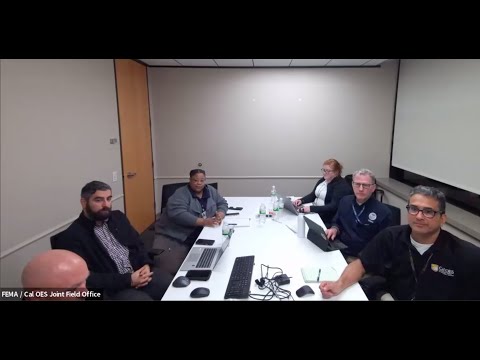
Federal, state and county officials outline how survivors can apply for aid after Palisades fire
Summary
Federal, state and county representatives described available aid — FEMA grants, SBA loans, state supplements — and urged residents to register, document losses and use local disaster recovery centers before the March 10 registration deadline.
Congressional and federal disaster officials on Thursday laid out how people affected by the Palisades fire can apply for federal and state recovery assistance and urged residents to register immediately with FEMA and the Small Business Administration (SBA).
Congressman Sherman told the meeting that FEMA grants and SBA loans are available and summarized common options for homeowners and businesses. "When you register with FEMA ... they send you $770 to deal with immediate needs," he said. Sherman also recited FEMA grant maxima he said survivors might be eligible for: roughly $43,600 toward real property damage and another $43,600 toward uninsured personal property, plus a possible additional $10,000 state grant for eligible applicants. He advised residents to register within 60 days and to check the deadline for tax and insurance relief options.
Why it matters: Residents seeking direct emergency assistance, temporary housing help or long-term rebuilding funds must register with FEMA and consider SBA loans to restore homes or businesses. Officials said acting promptly preserves survivors' eligibility for grants, loans and other programs and helps demonstrate the scale of unmet need.
What officials told residents: Danielle Hill of FEMA's Individual Assistance team urged survivors to contact their insurance companies first and to notify FEMA of any insurance settlements or denials. "If there are any delays in that insurance process, you want to make sure to reach out to that insurance company first. Then make sure to let your FEMA representative know," Hill said. She described FEMA's housing assistance categories (housing repair, temporary rental assistance and lodging-expense reimbursement) and FEMA's Other Needs Assistance for personal property, vehicles and medical expenses.
Robert Troy, assistant director for interagency recovery coordination at the California Governor's Office of Emergency Services (Cal OES), emphasized that many California wildfire survivors are underinsured and repeated the registration message: "Don't miss the deadline to register. Follow through on the process." He noted state supplemental grants may be available to some FEMA applicants.
SBA loans: Garth, a U.S. Small Business Administration representative, summarized low-interest disaster loans available to homeowners, renters, businesses and nonprofits. He said homeowners and renters may qualify for up to $500,000 for structural losses, businesses may borrow up to $2 million for physical and economic injury, and typical fixed interest rates cited at the meeting were roughly 2.563% for homeowners and about 4% for most businesses on eligible loan terms up to 30 years. Garth underscored there is no fee to apply and no obligation to accept a loan.
Key numbers and deadlines discussed at the meeting: FEMA's immediate-need payment ($770), FEMA individual assistance grant figures cited by participants (about $43,600 for real property and another $43,600 for personal property), an additional $10,000 state supplement for some FEMA recipients, SBA homeowner loan maxima of $500,000, SBA business loan up to $2,000,000, and the FEMA registration deadline discussed at the meeting as March 10 (residents were repeatedly urged to register before that date).
How to apply and local help: Officials urged survivors to register at disasterassistance.gov or by phone, visit local disaster recovery centers for in-person help and to apply to SBA via sba.gov/disaster or (800) 659-2955. Danielle Hill said many survivors receive FEMA payments within 24 to 48 hours when they provide electronic funds-transfer information.
What officials asked residents to do now: Register with FEMA, file insurance claims, apply to the SBA if needed, gather documentation (insurance paperwork, IDs, ownership records), and visit the Westside Pavilion Disaster Recovery Center or the upcoming in-person resource events described at the meeting.
Ending: Officials repeated that recovery is a marathon, not a sprint, and asked residents to document losses and to use available federal, state and local assistance channels to speed recovery.