Get Full Government Meeting Transcripts, Videos, & Alerts Forever!
Get email alerts on the Usda Leadership And Policy topic
No spam. Unsubscribe anytime.
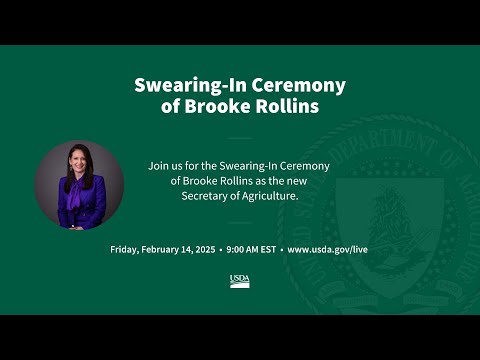
Brooke Rollins introduced as U.S. agriculture secretary, outlines priorities including ending DEI and returning staff to offices
Summary
At a USDA event, Secretary Brooke Rollins was introduced as the department's 30th secretary and laid out policy priorities including ending DEI initiatives, inviting a government-efficiency review, returning personnel to physical workplaces and focusing on avian-flu, livestock markets and wildfire response.
Brooke Rollins was introduced as the 30th U.S. secretary of agriculture at a morning event at the U.S. Department of Agriculture, where she outlined immediate policy priorities including ending identity-based diversity, equity and inclusion efforts at USDA, returning employees to physical workplaces and working with the White House and Congress to focus USDA on core agricultural programs.
The acting official who introduced Rollins praised her background and described her as a “bold energetic leader” who will “chart an ambitious course for this great department,” noting Rollins’s experience in state and federal policy roles and her leadership of the America’s First Policy Institute. The introduction referenced recent work at USDA on executive-order compliance, an avian influenza response, protecting cattle markets at the southern border and wildfire and disaster response.
In her remarks, Secretary Brooke Rollins framed the department’s work as a stewardship of American agriculture and set out specific administrative priorities. She said USDA will "end identity politics, identity celebrations, and DEI here at USDA and across all of the federal government," and that the department would "neither commemorate nor celebrate our immutable characteristics." Rollins called instead for celebrating "merit, our faith, and our liberty." She also said staff will be expected to return to the workplace: "We will return all of our personnel to the workplace, whether that workplace is an office or a farm."
Rollins said USDA will invite a Department of Government Efficiency to work within USDA, describing that outreach as intended to make the department "better," "faster," and "more efficient," and she said she expects "full access from all of our teams here at USDA" for that effort. She framed the emphasis on efficiency and a narrower focus on traditional USDA missions as steps she will pursue with both the White House and Congress.
The secretary referenced recent operational priorities. Rollins said staff had prepared plans to combat avian influenza, taken steps concerning cattle markets at the southern border, and responded to wildfires and other disasters. She praised the U.S. Forest Service and other agency personnel for recent wildfire responses and urged recognition of their service.
Rollins reviewed elements of her background during remarks: growing up in Glen Rose, Texas, participation in 4‑H and Future Farmers of America, attendance at Texas A&M University, a law degree from the University of Texas and past roles including service as director of the White House Domestic Policy Council and as president and CEO of the America’s First Policy Institute. She introduced her mother, Helen Kerwin, and said Kerwin was recently sworn in as a state legislator in Texas.
Rollins repeatedly emphasized support for farmers and rural communities, calling American agriculture “in its worst economic straits in nearly a century” and pledging to work to bring “greater prosperity, greater opportunity, and greater stability to rural communities across this great country.” She said the department would "work to do so together" over the next four years.
The remarks combined ceremonial introduction with policy direction; there were no formal votes or binding administrative actions recorded at the event. Several of the items Rollins raised — including ending DEI programs and inviting a government-efficiency team — are stated administrative priorities rather than enacted rules, and the transcript records these as statements of intent by the new secretary.