Get Full Government Meeting Transcripts, Videos, & Alerts Forever!
Get email alerts on the Gaza Humanitarian Aid topic
No spam. Unsubscribe anytime.
UN official urges sustained Gaza ceasefire, $4.07 billion flash appeal to meet needs of 3 million
Summary
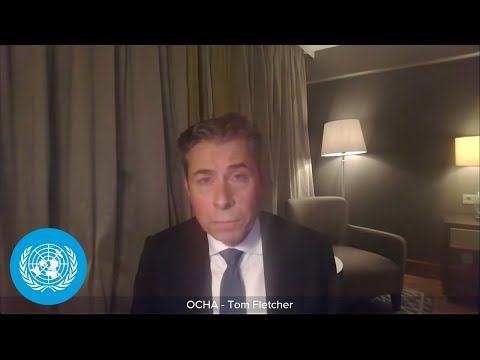
Tom Fletcher, a United Nations official, told the U.N. Security Council that the current ceasefire in Gaza has opened a vital window for humanitarian relief — including hostage reunifications and a surge of lifesaving supplies — but said the pause will not save lives unless parties sustain the agreement and member states fund a $4.07 billion 2025 flash appeal to help 3 million people in Gaza and the West Bank.
Tom Fletcher, a United Nations official, told the U.N. Security Council that the current ceasefire in Gaza has opened a vital window for humanitarian relief — including hostage reunifications and a surge of lifesaving supplies — but said the pause will not save lives unless parties sustain the agreement and member states fund a $4.07 billion 2025 flash appeal to help 3 million people in Gaza and the West Bank.
Fletcher said humanitarian organizations have increased deliveries, scaled up storage and repairs, reopened services and distributed food, fuel and medical assistance across the Gaza Strip since the ceasefire began. “We can save more lives if all parties continue to honor the deal,” he told the council.
The appeal, Fletcher said, requests $4,070,000,000 to meet needs for 3,000,000 people, with nearly 90% of the funds earmarked for Gaza. “Funding this appeal is essential to meet massive needs and to sustain the ceasefire,” he said.
Why it matters: Fletcher framed the brief surge of access as fragile and time-sensitive, saying that the ceasefire has reduced hostilities and criminal looting enough in recent days to allow larger-scale operations but warning that those gains depend on continued compliance and resupply from member states and private donors.
Fletcher emphasized the scale of humanitarian need and the human cost of the past 15 months. He described deep harm to children in Gaza, stating conservative estimates that “over 17,000 children are without their families in Gaza,” that about 150,000 pregnant women and new mothers need urgent health services, and that UNICEF estimates 1,000,000 children need mental-health and psychosocial support. “A generation has been traumatized,” he said.
He named UNRWA as central to response efforts and said humanitarian operations must be complemented by private-sector contributions and steady replenishment of in-country stocks. Fletcher warned that all of Gaza — more than 2,000,000 people, he said — depends on humanitarian support.
Fletcher also warned that violence and restrictions in the West Bank have risen since October 2023 and intensified around the ceasefire. He cited attacks by Israeli settlers on Palestinian villages, movement restrictions that impede access to basic services and livelihoods, mass detentions and the situation in Jenin, where he said a military operation and related actions have caused deaths, infrastructure damage and displacement. He said a weeks-long operation by the Palestinian Authority had also displaced “some 2,000 families from the [Jenin] camp.”
Fletcher delivered three explicit requests to the council: that the ceasefire be maintained; that international law be respected across the occupied Palestinian territory, including East Jerusalem, with protection for civilians, humane treatment of detainees and access for the International Committee of the Red Cross; and that the council ensure humanitarian operations are funded. He called for lifting restrictions on “critical humanitarian items,” including items labeled dual-use, and urged member states to accept patients who need medical evacuation.
He repeated that “UNRWA's role is fundamental and must remain the backbone of these efforts,” and called for accountability for atrocities “in accordance with international humanitarian law.”
The briefing did not include formal motions or votes by the Security Council. Fletcher framed his remarks as an appeal and an update, and he urged member states and private donors to provide immediate financial and logistical support to sustain lifesaving operations.
Tom Fletcher concluded his briefing by focusing on children: “The children of Gaza are not collateral damage,” he said, adding that they deserve “security, education, and hope.”