Get Full Government Meeting Transcripts, Videos, & Alerts Forever!
Get email alerts on the Judicial Review Agency Actions topic
No spam. Unsubscribe anytime.
Committee clarifies judicial review of agency actions, limits appeals by public employees absent contested-case findings
Summary
Senate File 115 restructures and clarifies the statute governing judicial review of agency decisions, specifying that routine public employment actions are not subject to district-court review unless they are final decisions in a contested case.
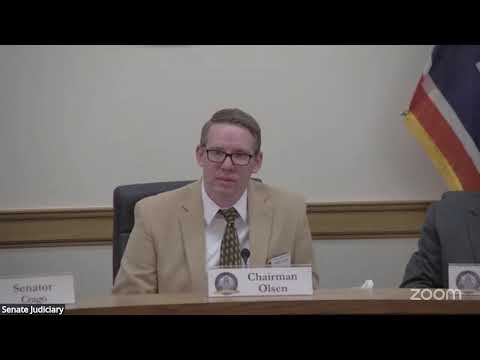
The Senate Judiciary Committee approved Senate File 115, a restructuring and clarification of Wyoming's judicial-review statute, to limit routine appeals to district court for public-employment disciplinary actions unless those actions are final decisions in a contested case.
Senator Nethercott, sponsor of the bill, said the draft reorganizes existing language in what is cited in testimony as "163-114" (the statute governing judicial review) to make clear who may petition for judicial review and under what circumstances. "Any person aggrieved or adversely affected in fact by a final decision of any agency in a contested case ... is entitled to judicial review," the bill states in the restructured language, and it emphasizes exhaustion of administrative remedies before a court petition.
The draft also adds an explicit provision that the right of judicial review does not apply to actions or inaction regarding public employment unless the action is a final decision of an agency in a contested case or judicial review is otherwise provided by law. Sponsor testimony stressed the change is intended to prevent routine personnel management decisions, such as low-level discipline, from automatically prompting district-court appeals that burden agencies and courts and can chill routine supervisory actions.
Committee members asked whether the change could increase appeals; the sponsor said the fiscal note's suggestion that appeals might increase appeared incorrect and that, in his view, the bill would reduce litigation over routine disciplinary actions. Senators also discussed why the statutory language references common law in addition to statutes; sponsor testimony explained that public-employment law draws on statutes and case law because constitutional and due-process issues can attach to government employment.
The committee moved Senate File 115 by roll call (4 ayes, 1 excused). The motion was made by Senator Kolb and seconded by Senator Hicks.
Votes at a glance: Senate File 115 advanced from committee to the floor by a 4–0 vote (1 excused).
Background: Testimony described a rise in suits by public employees seeking court review of written reprimands and other management actions; the bill aims to clarify the limits of judicial review and encourage exhaustion of administrative remedies.