Get Full Government Meeting Transcripts, Videos, & Alerts Forever!
Get email alerts on the Housing Tenants Rights topic
No spam. Unsubscribe anytime.
Duluth council holds first readings on tenant right-to-repair petition and council alternative
Summary
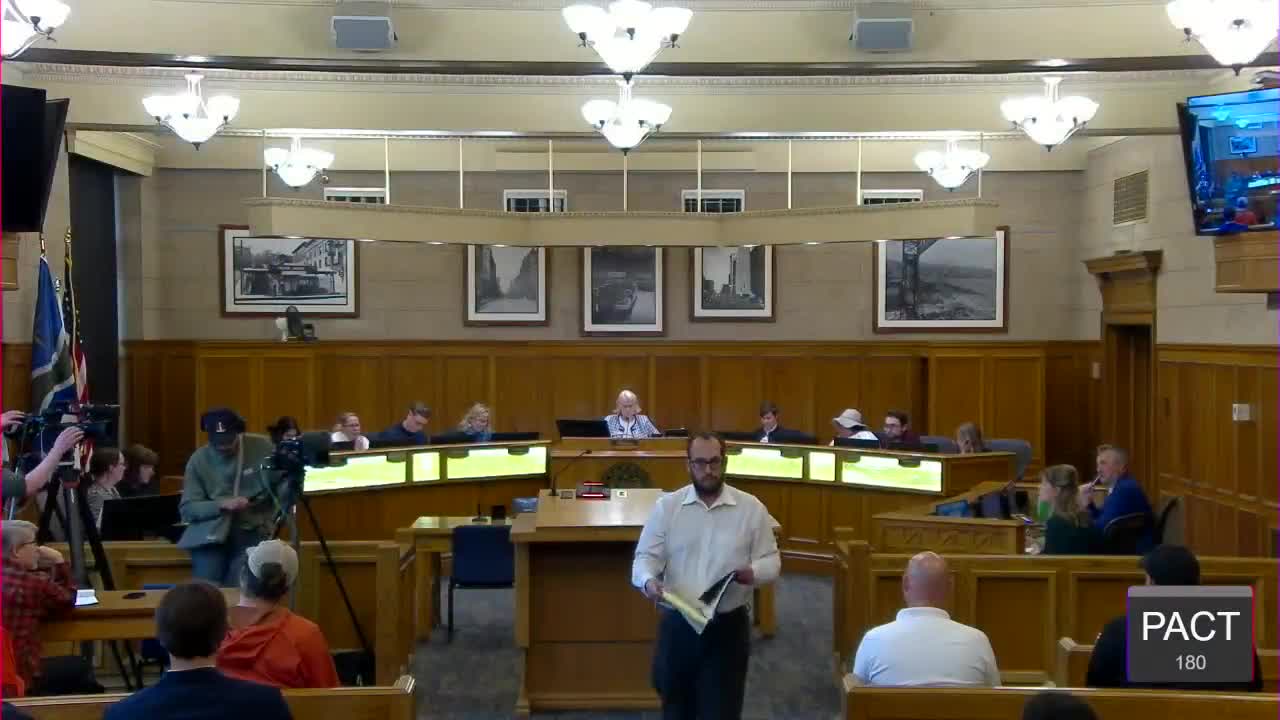
At a special meeting of the Duluth City Council (date not specified), councilors gave first readings to two competing measures aimed at speeding repairs in rental housing: petition ordinance 25-15, submitted by the Duluth Tenants Union, and an alternative ordinance, 25-16, drafted by council members.
At a special meeting of the Duluth City Council (date not specified), councilors gave first readings to two competing measures aimed at speeding repairs in rental housing: petition ordinance 25-15, submitted by the Duluth Tenants Union, and an alternative ordinance, 25-16, drafted by council members. The clerk certified the petition as sufficient with 3,752 verified signatures, triggering statutory and charter deadlines for council action.
The petition ordinance (25-15) would allow tenants who make qualifying repairs to deduct the cost from rent after notice; its supporters say it creates an expedited path for low-cost repairs. Opponents and several council members raised liability and process concerns. "When I look at a policy, I like to read the policy to see if it would screw someone over, like myself," said Ginka Tarnowski, a Fifth District resident, during public comment, adding she feared tenant exposure to costly landlord–tenant disputes.
Riley Barnhart, government affairs director for the Lake Superior Realtors Association, told the council the petition ordinance "introduces a level of operational uncertainty that could lead to real consequences for small local housing providers," and urged the council to reject the petition ordinance "in its current form." David Shaffroth, a member of the public who spoke on development costs, said the measure would function like a "regulatory tax" by raising time and compliance costs for new apartment construction.
Council members focused on two related questions: (1) whether the petition ordinance exposes tenants to legal or financial liability, and (2) whether city enforcement capacity—particularly the Life Safety inspection team—could meet a quicker response timeline. Councilor Randorf, one of the authors of the alternative ordinance, said the council’s measure "establishes a firm 14 day requirement for landlords to secure a repair date and notify the city code official and the tenant when the repair will be made." Randorf argued the alternative places responsibility on landlords and gives the city enforcement authority rather than shifting risk to tenants.
City staff described how enforcement would be handled under the alternative and existing code. Deputy Chief John Otis, who oversees Life Safety, said tenant complaints are prioritized: "We prioritized, tenant complaints. So if a tenant complaints, it comes in, that goes to the top of the queue." Otis told councilors that the department’s larger backlog is for initial or renewal inspections, not complaint-driven responses. Greg Smith, a Life Safety staff member, said documentation would likely be required when a landlord submits proof of completed training or evidence of scheduling repairs: "...they would have to provide some documentation from a source, OneRoof, Justice North, ourselves, to say they've taken it within the 3 year or time period of that new renewal or application."
Councilors pressed staff on capacity. Several members noted the city has a backlog of initial inspections that is measured in months; Otis said an influx of hundreds of new complaints would strain the department and push other work to the back of the queue. Councilor Dirwachter pointed to recent state law changes and said, "The state of Minnesota already has really strong protections for renters," citing anti‑retaliation provisions in SF 3492. Attorney Loehr explained procedural options tied to the Duluth City Charter and state law.
The meeting also reviewed enforcement mechanics in current code. Otis summarized the city’s escalating administrative citation amounts: $200, $400, $800, $1,600 and $2,000, after which license revocation is possible; inspectors retain discretion based on severity. Councilors asked about timelines in the draft: the alternative ordinance includes a 14-day rule to schedule repairs with life-safety involvement and retains discretion to extend to as much as 180 days in cases where contractors or capital work require longer scheduling.
Procedural deadlines were clarified at the meeting. The clerk said the petition submitted under Section 51 of the Duluth City Charter was certified on 06/23/2025 with 3,752 verified signatures. The council must vote on the petition ordinance within 20 days of certification (on or before July 14), and an alternative ordinance must be passed within 10 days of certification (on or before July 3) to trigger a 10‑day withdrawal period for petition signers; if 50% withdraw, the petition would not go to the November ballot. The council scheduled a second reading and final vote for Tuesday, July 1, at 6 p.m.
No final action was taken on either ordinance during the meeting. The council adjourned after a motion by Councilor Nephew, seconded by Councilor Randolph. The agenda item will return for a final reading and vote at the July 1 meeting, where the council may adopt an alternative ordinance, send the petition ordinance to the November ballot or choose to place both ordinances on the ballot.
Votes at a glance: No ordinance votes recorded at this meeting; the only formal vote recorded was the motion to adjourn (moved by Councilor Nephew; seconded by Councilor Randolph).