Get Full Government Meeting Transcripts, Videos, & Alerts Forever!
Get email alerts on the Parks And Recreation topic
No spam. Unsubscribe anytime.
Gastonia council approves RFQ and plan to move Adult Recreation Center to 107 S. Broad
Summary
After months of study, the council voted to solicit private developers for redevelopment near 107 South Broad and approved a phased plan to relocate Adult Recreation Center programs to the former Salvation Army building at 107 S. Broad, drawing questions from seniors over program continuity and from council members over next steps.
The Gastonia City Council voted to seek private development proposals for parcels adjacent to 107 South Broad Street and approved a phased plan to relocate Adult Recreation Center (ARC) services to 107 S. Broad.
Supporters said the move would provide an accessible, modern facility for adults 50 and older and create a more active downtown presence; critics and several seniors warned that some current ARC programs — notably beginner pickleball, certain class times and monthly dances — could be disrupted if schedules and space are not protected.
The motion approved an RFQ (request for qualifications) to solicit private partners for redevelopment of 101, 107, 115 and 117 South Broad Street and to explore a public–private partnership for senior affordable housing or complementary development. Councilmember Danielle Barber, chair of the Facilities Management Committee, said the parcels should be considered together so any future development could include parking and shared uses to support the ARC’s operation.
“107 South Broad Street is one location. It’s one place,” Barber said while presenting the committee recommendation, adding that the site includes about 16,400 square feet on 1.56 acres and existing accessible parking. She told council the building would allow Parks and Recreation to provide membership card check-in, fitness and wellness rooms, ceramic and arts studios, a multipurpose room with an estimated capacity of 104, and space that could make the site eligible for national senior center accreditation and grant funding.
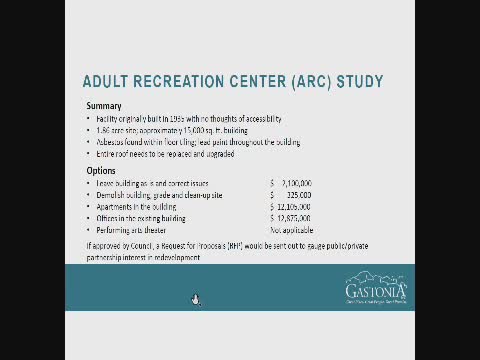
City staff presented a structural and cost assessment of the existing ARC on Franklin Boulevard that found asbestos in floor tile, lead paint and a roof needing replacement. The consultant offered several options with order-of-magnitude costs: repair and renovate the existing ARC (approximately $2,100,000), demolish and grade the site ($325,000), or redevelop into apartments or offices (estimates in the $12–13 million range). Staff reported roughly $25,000 spent to stabilize and start cleaning the 107 S. Broad property, and proposed a phased move: Phase 1A (basic technology/infrastructure, fitness room, furniture and equipment), Phase 1B (window/door and flooring replacements funded by possible CDBG dollars), and a Phase 2 to add specialty features (e.g., digital entertainment, golf simulator) supported by grants and private fundraising.
Councilmembers pressed staff on program continuity. Councilwoman Jennifer Stepp, who said she works closely with ARC seniors, asked for “protected times” so bingo, monthly dances and teaching pickleball sessions would continue without interruption. Tripp (Parks and Recreation staff), who gave the building presentation, confirmed the plan would relocate events that cannot be accommodated by the Salvation Army–era building to Bradley Community Center and other city facilities and said staff aims to reserve those times for ARC programs.
Several council members also asked about whether the RFQ included the existing 107 building or only the surrounding parcels. Staff said 107 S. Broad is included in the RFQ package so proposals could treat the ARC as an amenity, use shared-parking agreements, or propose additions above the existing footprint. City Manager Michael Peoples noted developers sometimes propose podium or pedestal builds, and staff invited that flexibility.
The Facilities Management Committee had voted 3–0 to recommend the RFQ. On the council floor the RFQ motion carried 5–1. Later the council approved the proposal to renovate and move ARC services to 107 S. Broad in a separate vote (5–1), with members saying the phased approach would allow immediate, limited operations while longer-term options were pursued.
Council members acknowledged outstanding issues: weekend staffing, liability, senior input on final programming, and the need to preserve heavily used activities. Barber and Tripp said senior advisory input would be sought for Phase 2 programming and that staff would work to minimize interruptions as rooms are reprogrammed.
Council directed staff to proceed with the RFQ and implementation planning. Staff said they would return with more detailed operational plans and timelines, including specific protections for existing ARC programs and clearer budgeting for phases.
Why this matters: The relocation and RFQ aim to modernize aging recreation infrastructure; proponents say a downtown-located active-living center will help sustain downtown businesses and make senior services more accessible. Opponents and senior speakers urged detailed guarantees about program continuity and protected time slots before major changes are finalized.
The council’s actions are intended to be the first step toward a multi-year redevelopment of the southern Broad Street block; staff will bring back details on schedules, staffing and any required funding requests for final approval.