Get Full Government Meeting Transcripts, Videos, & Alerts Forever!
Get email alerts on the Committee Votes Roundup topic
No spam. Unsubscribe anytime.
Senate labor committee advances package of bills on wage rules, rehiring and public‑contract oversight
Summary
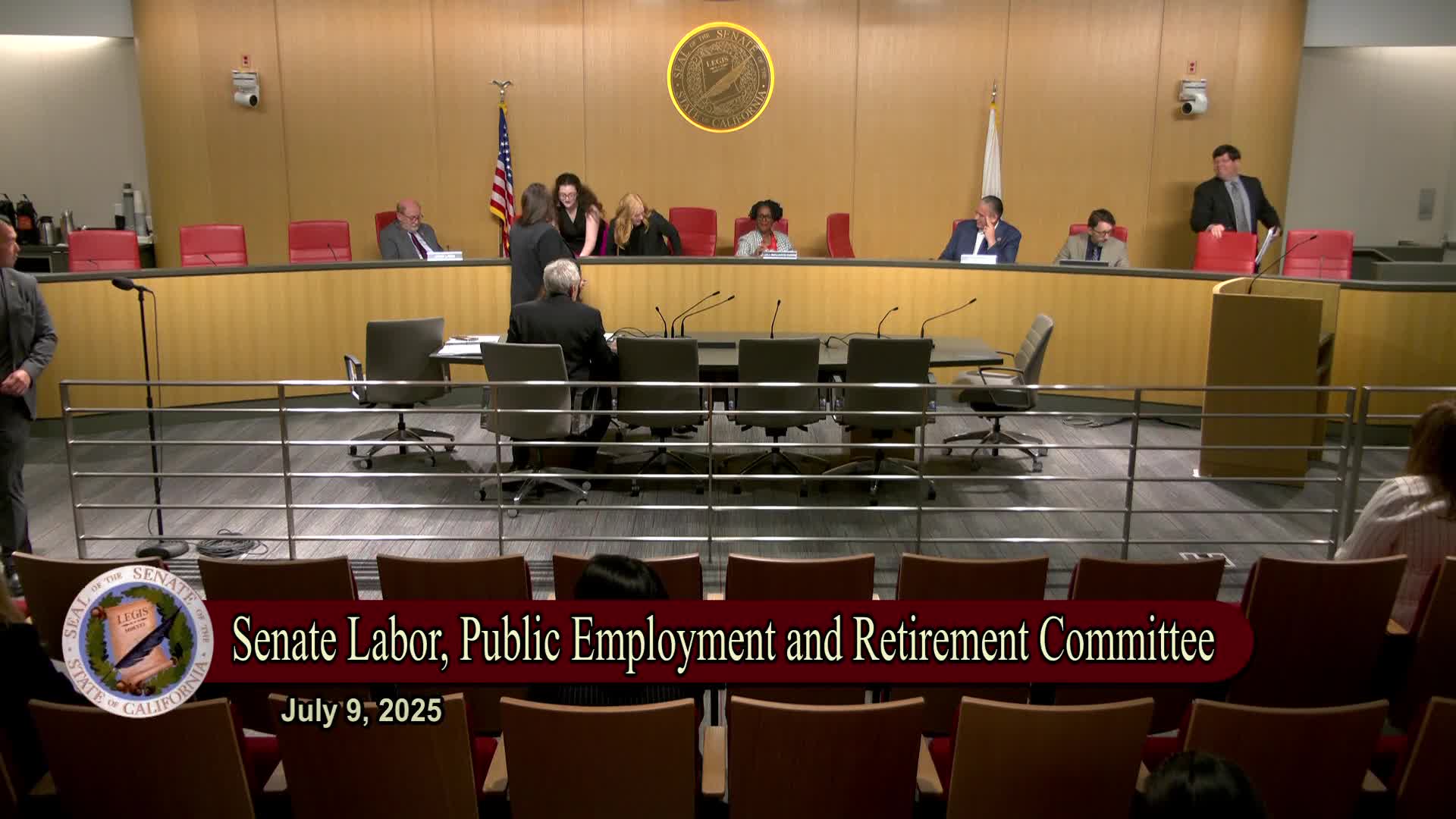
Senators on the California State Senate Labor, Public Employment and Retirement Committee advanced a package of bills addressing fringe‑benefit annualization, public‑records access for private developers using public funds, hospitality rehiring rights after declared emergencies, and related labor enforcement measures, voting to send the measures to Appropriations or Judiciary for further review.
Senators on the California State Senate Labor, Public Employment and Retirement Committee advanced a package of bills after a full day of testimony and debate, moving measures addressing prevailing wage annualization, public‑records access for private developers that use public funds, rehiring rights for hospitality workers after declared emergencies, and several other labor and enforcement matters to the next committee with recorded roll calls.
Why it matters: The bills considered affect how contractors calculate fringe benefits on public works, whether certain documents are available to labor and enforcement entities when private corporations use taxpayer funds, recall/rehire rights for hospitality workers after declared emergencies, enforcement tools for unpaid wage judgments, and additional changes to labor‑related licensing, classification, and dispute processes. The committee’s actions now send many of the measures to appropriations or judiciary for further consideration.
Votes at a glance (selected file items taken up by the committee) - AB 889 (file 12) — Prevailing‑wage fringe benefit annualization: Motion to pass to Appropriations carried; final committee tally recorded as 4–0. Sponsors/witnesses included Operating Engineers and union building‑trades groups. Outcome: passed to Appropriations. - AB 963 (file 13) — Records access for private entities using public funds (CPRA scope): Motion to pass to Judiciary carried; final tally 4–1. Outcome: passed to Judiciary. - AB 792 (file 10) — Consolidated bargaining for court interpreters (consent requirement for consolidated bargaining): Motion to pass to Appropriations carried; final tally 4–1. Outcome: passed to Appropriations. - AB 858 (file 11) — Rehiring protections for hospitality workers after declared state emergencies (extends rehiring protections to 2027 and creates rehiring rules): Motion to pass to Appropriations carried; final tally 4–1. Outcome: passed to Appropriations. - AB 485 (file 3) — Denial/suspension of state licenses for employers with unpaid wage‑theft judgments: Motion to pass to Judiciary carried; final tally 4–0. Outcome: passed to Judiciary. - AB 339 (file 2) — Notice and meet‑and‑confer timing when local governments plan to contract‑out bargaining‑unit work: Motion to pass as amended to Appropriations carried; final tally 4–1. Outcome: passed to Appropriations. - AB 1048 (file 14) — Workers’ compensation: allow independent bill review (IBR) adjudication of disputed payment reductions tied to unauthorized discounts/networks: Motion to pass to Appropriations carried; final tally 5–0. Outcome: passed to Appropriations. - AB 1329 (file 5) — Subsequent Injuries Benefits Trust Fund reforms: Motion to pass to Appropriations carried; final tally 4–1. Outcome: passed to Appropriations. - AB 406 (file 9) — Technical fixes and enforcement alignment for family‑leave provisions (non‑substantive corrections to earlier survivors’ leave law): Motion to pass to Judiciary carried; final tally 4–1. Outcome: passed to Judiciary. - AB 1514 (file 6) — Temporary extensions and reporting for licensed manicurists and commercial fishermen exemptions under AB 5: Motion to pass to Appropriations carried; final tally 5–0. Outcome: passed to Appropriations. - AB 1515 (file 7) — Framework to register and regulate Professional Employer Organizations (PEOs): Motion to pass to Appropriations carried; final tally 4–1. Outcome: passed to Appropriations.
What the votes mean: Most measures were advanced on party‑line or near party‑line votes with at least one dissenting vote on several files (the roll calls recorded in committee show repeated “no” votes from one senator on a number of items). Bills that passed will receive further fiscal or legal review in the committees named above before any floor consideration.
Key themes from testimony - Enforcement and transparency: Supporters of AB 889 and AB 963 pushed for stronger enforcement tools and clearer rules so labor and enforcement agencies can verify compliance on public‑funded projects. Supporters argued that annualization prevents contractors from using timing loopholes to underreport benefit contributions and that allowing records access of private developers that use public funds closes a transparency gap. - Worker protection after emergencies: Supporters of AB 858 urged extending rehiring rights for hospitality workers affected by emergencies and argued the protections help workers and honest employers, particularly after local disasters. Opponents and some business groups warned the measure could impose administrative burdens and urged clarifying timelines, opt‑out procedures, and narrower triggers tied to the scope of emergencies. - Remedies for wage theft: Supporters of AB 485 described local licensing suspensions (already used in Santa Clara County) as a targeted enforcement tool to collect unpaid wage judgments; some long‑term‑care and residential providers warned about potential displacement of vulnerable residents and asked for narrow exemptions and safeguards. - Scope and timing challenges: Opponents of AB 339 (notice before contracting out) — including counties, cities and nonprofit service providers — argued the bill could delay urgently needed services and create administrative barriers; supporters said the bill simply requires notice and the opportunity to meet and negotiate and includes broad emergency/exigent‑circumstance exceptions.
What happens next: Bills that passed will be calendared in the committees specified on each motion (Appropriations or Judiciary) for fiscal or legal analysis. Several measures passed with votes that put them “on call” pending final member returns earlier in the hearing; subsequent roll calls finalized the tallies reflected above. Committees will now consider amendments, analyses and any fiscal attachments before the measures can proceed to the Senate floor.
Reporting and oversight recorded in committee: Multiple bills carried requirements for reporting and for coordination with the Department of Industrial Relations, the Division of Labor Standards Enforcement (DLSE), or the Employment Development Department (EDD) (for example AB 1514’s reporting on manicure classification claims and AB 15xx changes on DIR reporting). Those reporting requirements will be part of the bills’ text as they move forward.
Ending note: Committee minutes and full audio/transcript are available from the Senate for exact roll‑call text and witness lists; this roundup summarizes the committee’s formal actions and principal lines of support and opposition recorded publicly during the hearing.