Get Full Government Meeting Transcripts, Videos, & Alerts Forever!
Get email alerts on the Oversight topic
No spam. Unsubscribe anytime.
Office of Police Oversight presents 2023 annual report, staffing updates and complaint process questions
Summary
The Office of Police Oversight told the commission it has filled several vacancies, is creating a deputy director role and is preparing to publish complaint data and a 2024 annual report; commissioners raised questions about supervisor referrals, evidence access and the office’s handling of anonymous complaints.
Gail McCant, director of the City of Austin Office of Police Oversight (OPO), presented highlights from the OPO’s 2023 annual report, staffing changes and follow‑up responses requested by the commission.
McCant said the OPO filled four roles that had been vacant in March and is creating a deputy director position to expand leadership capacity. The office is actively recruiting for a complaint specialist and a policy analyst; McCant said there are three current vacancies at OPO. She said demographic data on complaints is optional on the OPO intake form and therefore incomplete; sector data (police sector geography) is not fully captured but may be possible in the office’s new shared case‑management system. McCant said all 2024 complaints are published online and that the office is working to publish 2023 and 2025 complaints and will release its 2024 annual report in September.
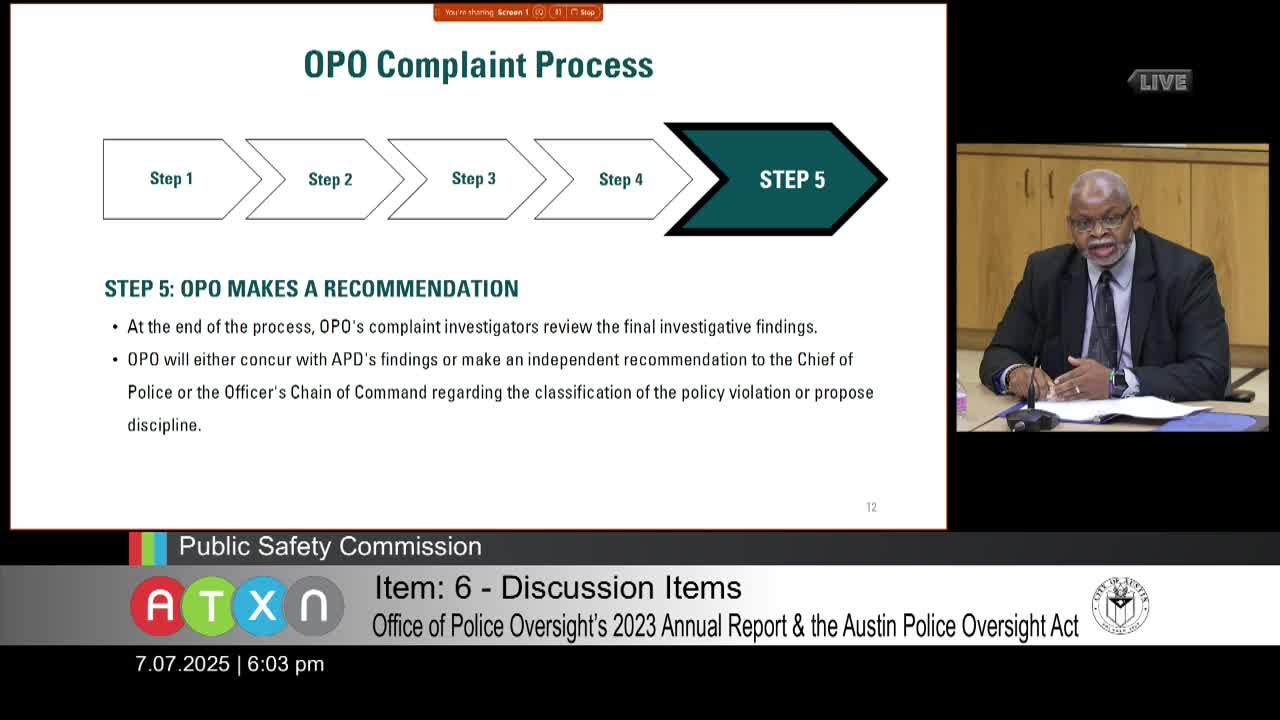
Kevin Masters, OPO complaint supervisor, described complaint intake pathways (phone, in person, online and mail), the preliminary review and affidavit process and how anonymous complaints are handled. He said anonymous complaints may be submitted but require an affidavit with the OPO as affiant in order to prompt an Internal Affairs investigation; OPO will submit an affidavit and route the complaint to Internal Affairs when appropriate. Masters said the OPO will honor complainants’ requests for supervisor referrals, supervisor review or a formal IA investigation; he said the OPO follows up after supervisor referrals and may escalate a case to an internal investigation if the office concludes the supervisor’s review was insufficient.
Commissioners asked whether complainants understand the difference between a supervisor referral and a formal investigation; OPO staff said the office explains options to complainants and documents their preference. Commissioners also asked whether complainants receive evidence such as body‑worn camera footage; OPO said such material is subject to public‑information request rules and the OPO provides complainants with a summary of the disposition and the steps taken during the review.
A commissioner raised concern that the complaint supervisor, Kevin Masters, is a former long‑service police officer. Masters confirmed his public‑safety background and the commission members signaled they would request an expanded review of the office’s processes at a future, dedicated session. McCant said OPO will host a community forum on complaints and the complaint process at the Central Library the following Saturday and encouraged commissioners and community members to attend.
Ending: The commission asked for a fuller briefing on OPO operations; McCant and staff agreed to return with more detail and to publish outstanding complaint materials and the 2024 report on the OPO website.