Get Full Government Meeting Transcripts, Videos, & Alerts Forever!
Get email alerts on the Sexual‑assault‑response topic
No spam. Unsubscribe anytime.
APD, SAFE Alliance and Travis County DA present sexual‑assault data; APD cites coding changes and survivor readiness suspensions
Summary
APD’s special crimes unit, SAFE Alliance and the Travis County District Attorney’s office briefed the commission on Q1 sexual‑assault response data, explaining a title‑code change that affected felony counts, an increase in calls for service and a high share of cases suspended for ‘victim readiness.’
Representatives from the Austin Police Department’s special crimes unit (SCU), the SAFE Alliance (forensic nursing and advocacy) and the Travis County District Attorney’s Special Victims Unit briefed the Public Safety Commission on sexual‑assault response data for quarter one of 2025.
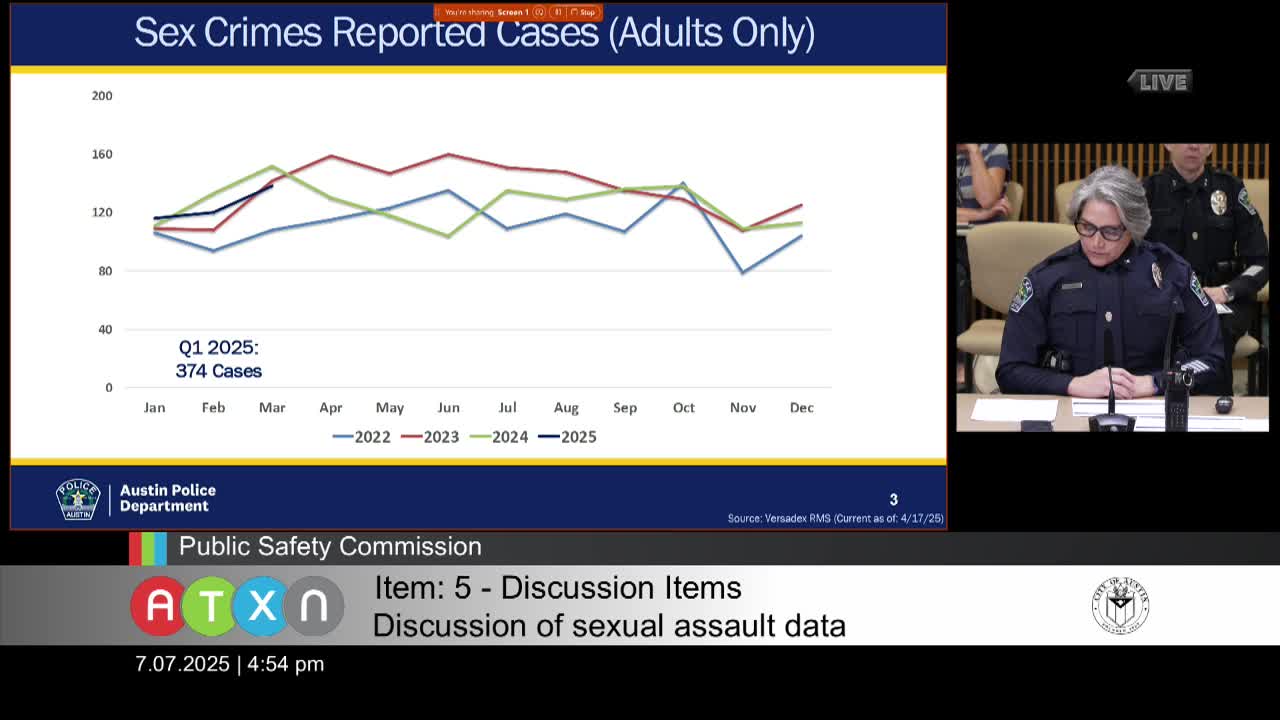
APD SCU described a multi‑agency effort to audit records and improve offense coding after detecting inconsistent use of an informational title code. The unit reported 374 new adult sexual‑crime cases in Q1 and explained that a marked increase in felony assault classifications beginning in September 2024 reflects a deliberate retitling and data‑cleaning effort rather than a sudden spike in incidents. APD said it retired the ambiguous “sexual‑assault information” title code and replaced it with “sex‑crimes information” to reduce confusion with Texas Penal Code offense titles; commanders and detectives were directed to retitle cases when the facts support a reportable offense.
APD also reported calls for service related to sexual crimes are about 14% higher than the same period last year and that the department will not downgrade sex‑crime calls below Priority 2. The department flagged “suspended pending victim readiness” as the largest internal closure category in Q1 — 81 felony cases were suspended this way, and detectives found that 46% of those were closed because the victim told investigators they did not want to pursue the case at that time. APD said detectives document outreach attempts and that the department is developing a survivor survey to learn more about reasons for suspension.
SAFE Alliance presented service data and capacity constraints. SAFE said about 80% of its community clinic clients are served at Eloise House, which relocated to a new community clinic in March and expanded exam capacity (the new clinic has five exam rooms). SAFE reported unduplicated service requests in January totaled 53 individuals (32 evidence collection exams, six medical‑only visits and 19 consults). SAFE said in March it completed 41 evidence‑collection exams, four medical care visits and 33 consults; the organization stressed language access and credentialing at hospitals as ongoing challenges and said it is coordinating with other community providers to improve coverage and Spanish‑language services.
Travis County’s Special Victims Unit reported an increase in trials and convictions in recent years. Andrea Austin, director of the DA’s Special Victims Unit, said prosecutors are taking more difficult cases to trial, and praised APD’s embedded prosecutor model (a DA housed in the APD unit twice weekly) for improving case readiness and outcomes. Austin said the unit tried nine jury trials in 2024 and eight trials in the first six months of 2025, with five guilty verdicts and three acquittals so far in 2025.
Commissioners asked about the bar/nightlife nexus and alcohol‑facilitated assaults. APD said a grant‑funded SART (Sexual Assault Reduction Program) looking at bars and nightclubs has found preliminary patterns — venues with multiple floors, without food service, or with fewer female staff showed more police calls — and that the initiative asks establishments to act as “guardians” of patrons. The city’s SIP Safely program supplies test strips and education focused on individuals; APD described SART as a location‑based prevention effort.
SAFE and the DA discussed warm handoffs and follow‑up. Commissioners asked whether SAFE’s referrals to other programs could be tracked to confirm a warm handoff resulted in services; SAFE said it documents outreach and attempts but that cross‑agency follow‑up can require survivor consent or data‑sharing agreements. SAFE and the SCU emphasized the need to improve contact with vulnerable populations such as people experiencing homelessness, who may not engage with outreach.
Ending: The three agencies agreed to continue collaborative audits of data classification and survivor outreach practices. APD said it is increasing staffing touchpoints with the DA and will continue to provide case‑level staffing and training; SAFE said it will pursue additional grants, work on credentialing and expand language access through partnerships.