Get Full Government Meeting Transcripts, Videos, & Alerts Forever!
Get email alerts on the Meeting Rules topic
No spam. Unsubscribe anytime.
Wausau rules committee narrows mayor remarks, tightens packet filing language and removes name-ban from public comment
Summary
The Wausau Rules Review Committee on July 1 debated and agreed by consensus on several revisions to the city council rules, including where the mayor’s communications appear on the agenda, a one-minute cap on announcements from mayor and alderpersons, keeping a seven-day pre-filing requirement for packet materials with a clarified waiver authority, and removing a rule that would bar members of the public from identifying city personnel by name during public comment.
The Wausau Rules Review Committee on July 1 debated and agreed by consensus on several revisions to the city council rules, including where the mayor’s communications appear on the agenda, a one-minute cap on announcements from mayor and alderpersons, keeping a seven-day pre-filing requirement for packet materials with a clarified waiver authority, and removing a rule that would bar members of the public from identifying city personnel by name during public comment.
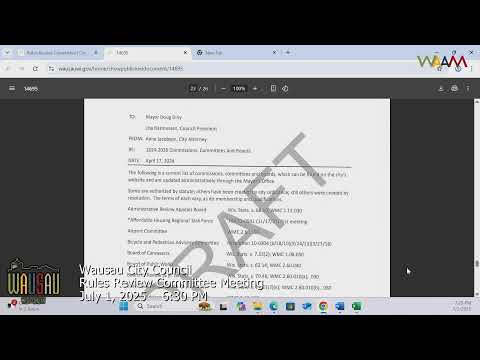
The changes were discussed because committee members said recent practice has produced late packet materials and unclear expectations about mayor remarks and announcements. Committee members agreed to send the package of recommended changes — including the revisions to Rule 5 (Order of Business) and Rule 6 (Introduction of Business/filing requirements) and related wording changes — to the Committee of the Whole for review and possible council action.
Alderperson Killian said she was concerned about moving mayor communications away from the early part of the agenda because of a lack of agendized notice: "It feels to me as though, having the mayor make comments and recommendations at the onset of the meeting ... it seemed like the issues were that he hadn't agendized what he was going to talk about." Several members proposed a middle course: keep communications from the mayor on the agenda but require a clear subject identification and limit remarks to topics not appearing on that meeting’s agenda.
The committee’s parliamentarian outlined a distinction the group accepted: announcements and communications are different. The parliamentarian said announcements should be factual invitations or notices — for example, a neighborhood meeting or an upcoming public information session — and not treated as public comment or as opinions on agenda items. The committee agreed to place announcements at the end of meetings and to impose a recommended one-minute limit on those announcements.
On filing timelines, committee members emphasized the difficulty of digesting large packets that arrive late. The draft rule presented to the committee would require proposed ordinances, resolutions, presentations, proclamations, memorials and communications to be filed with the clerk at least seven days before the scheduled council meeting and would require council and standing committee packets to be prepared and available at least six days before a meeting. The text under discussion included a line reading, "In no case will packet materials be accepted after close of business the preceding week." Committee members who regularly chair other bodies said the seven-day standard has produced better-prepared meetings, and the group moved to keep the seven-day window while clarifying waiver language so that the council or the chairperson of a standing committee — rather than an unspecified "presiding officer" — may authorize exceptions in line with current practice.
Alderperson McElhinney described the practical impact of late packets: "I absolutely detest getting things 2 hours before a meeting, and it's happening more and more. ... I get calls. Where's the packet?" Committee members noted some legitimate outliers exist (for example, time-sensitive procurement that saves money), but they said routine late filings undermine deliberation and produce awkward, on-the-fly questions.
On public comment rules, the committee discussed and agreed to remove the sentence in the draft that read, "Public comments may not identify specific personnel by name." Several members said the chair should enforce decorum and remove or interrupt speakers who are threatening or abusive, but that an outright ban on naming individuals raised free-speech concerns and potential legal risk. As one member put it, remarks should be directed to the chair rather than to individual staff or elected members.
Other procedural edits the committee endorsed by consensus include striking the clause that required each packet item to "contain a brief statement of their content" (because the full ordinance or resolution is already required in writing) and returning the committee’s compiled list of recommended rule changes and committee descriptions to the Committee of the Whole for further review. The committee chair said outstanding items — including a fuller draft of the public health and safety committee description and a process for restaggering appointments to boards, commissions and committees — will be continued at a later meeting.
A motion to approve the minutes of the June 3 meeting was moved by Alderperson Killian, seconded by Alderperson Martin, and approved by voice vote at the start of the session; the minutes were recorded as approved in the meeting record. The committee indicated these rule revisions and related edits will be formally presented to the Committee of the Whole for review before any action by the full Common Council.
The Rules Review Committee meets monthly; the group indicated it will return with a more complete draft of committee duties, any required ordinance cross-references, and an updated appointments form before forwarding final recommendations to the Council.