Get Full Government Meeting Transcripts, Videos, & Alerts Forever!
Get email alerts on the Police‑operations topic
No spam. Unsubscribe anytime.
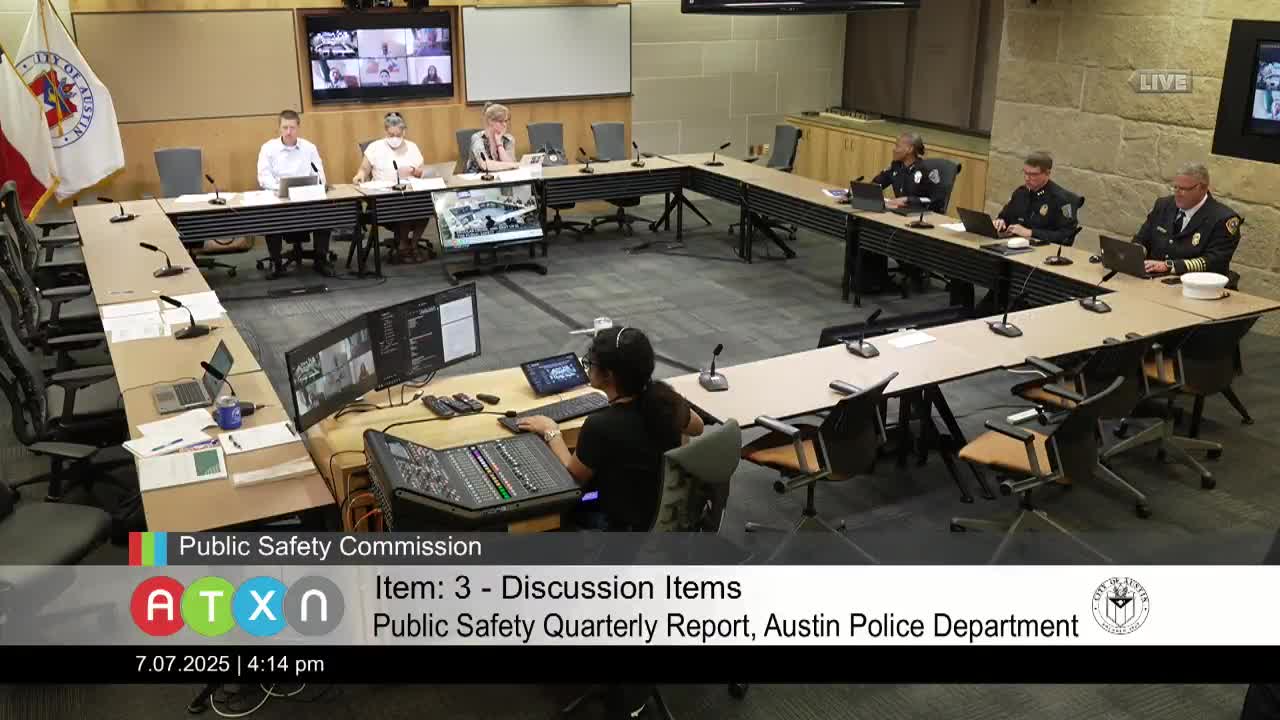
APD reports training expansion, staffing gaps and data follow-up in quarterly update
Summary
Austin Police Department officials told the Public Safety Commission their quarter‑one report highlights evidence‑based trainings, a cadet recruiting pipeline and data audits; the department reported dozens of vacancies in sworn and professional ranks and said it will provide follow‑up on response‑time trends.
The Austin Police Department updated the City of Austin Public Safety Commission on its quarterly operations, describing new training programs, ongoing staffing shortages and work to improve data quality.
Chief Henderson presented the department’s quarterly slide deck and emphasized a push for “data‑driven approaches” across staffing and operations, including training for commanders, crime analysts and cadets. Henderson said APD hosted a three‑day crime reduction course by Dr. Jerry Radcliffe and a data‑management session with Dr. Andrew Wheeler; the department also implemented the Integrated Communications, Assessment and Tactical (ICAT) 16‑hour de‑escalation training for sworn members and cadets.
The report described community engagement activity this quarter — dozens of youth and school events, safety assessments for sites and community fairs — and a new landlord engagement program aimed at reducing crime at rental properties. Henderson said calls for service are tracking with the five‑year summer mean and noted the combined Priority 0 and Priority 1 response times were slightly above the five‑year mean; she said APD will provide follow‑up data in the next quarterly packet to explain that trend.
On staffing the department reported vacancies: 34 sworn vacancies, 43 professional‑staff vacancies and 10 vacancies in emergency communications. Henderson said two cadet classes are currently active: the “150‑fourth” class is scheduled to graduate Aug. 29; the “150‑fifth” class has 51 cadets and is slated to graduate Dec. 12. APD said it has started hiring cycles for future classes and continues a social‑media and youth recruitment push.
Commissioners asked for more detail in future reports. Commissioner Bernhardt requested academy attrition rates and progress toward APD’s 30‑by‑30 recruitment goal, and asked for the BerryDunn audit follow‑up and implementation status; Henderson said the latest BerryDunn study (published in early June) found operational realignments and that a reallocation of some specialized officers back to patrol will occur on Aug. 24.
Questions about the automated license plate reader (ALPR) pilot surfaced during the discussion. Henderson said APD plans to reengage on ALPR conversations later this year and that when the department begins public outreach there will be opportunities for this commission to participate. Commissioners also pressed for more granular cadet‑academy data and for reports showing how the reorganization will affect investigative units.
The commission voted on routine matters at the meeting (see “Votes at a glance”).
APD said it will provide requested follow‑up materials and the department’s ALPR answers are already posted in the commission’s follow‑up backup packet.
Ending: The commission asked for more detailed follow‑up in the next quarterly report including attrition rates per academy, additional data on response‑time trends and the status of reorganization implementation.