Get Full Government Meeting Transcripts, Videos, & Alerts Forever!
Get email alerts on the Wildfire Management topic
No spam. Unsubscribe anytime.
Appropriations committee reviews wildfire funding, staffing after historic 2024 season
Summary
State foresters and county fire chiefs told the Joint Appropriations Committee that Wyoming's decentralized wildfire model strained resources in the record 2024 season and urged rule changes, staffing increases and targeted funding to improve preparedness and initial attack capacity.
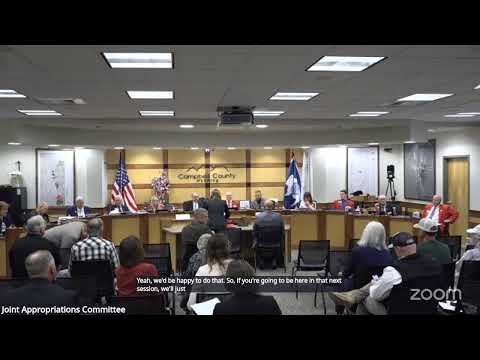
At a June meeting of the Wyoming Legislature's Joint Appropriations Committee in Gillette, state forestry officials and county fire wardens reviewed the state's response to the record 2024 wildfire season and outlined near-term changes and resource gaps they say are needed to speed initial attack and limit the expense of large, multi-jurisdictional fires.
The discussion centered on three tasks identified by presenters: improving capacity for initial attack and sustained response, expanding fuels mitigation, and clarifying funding mechanisms so local fire districts do not hesitate to act. "Wildfires in Wyoming is largely a decentralized operation," said Elizabeth Martineau, senior fiscal analyst with the Legislative Service Office, summarizing her white paper for the committee. She told the panel that the state provided a mix of appropriations, contingency funds, borrowing and other mechanisms that together totaled $176.9 million for wildfire suppression, mitigation and recovery in the 2025-26 biennium.
Why it matters: Presenters said most Wyoming wildfires remain small and are handled locally, but the relatively few very large incidents last year drove most suppression costs and exposed gaps in staffing, aviation and hand-crew availability. Committee members were told those gaps raise the risk that future large fires will again outpace local capacity and produce heavier costs and longer recovery periods.
State and county officials described last year as unusually severe: Kelly Norris, Wyoming state forester, said the state recorded more than 2,000 fires that burned more than 850,000 acres in 2024, and the current suppression cost estimate remains about $55 million. She and county fire wardens said most fires were handled by local mutual aid and that 98% of the incidents were lower-complexity (Type 3'5) responses; a small number of complex fires generated the bulk of costs and work.
"Not a single life was lost," Norris told the committee. "Nothing is worth protecting more than human life." She and others stressed that aviation and hand crews buy time and protect structures but do not substitute for boots-on-the-ground initial attack capacity.
Funding and account details: Martineau summarized state funding instruments and balances. She said the legislature had appropriated $176.9 million for wildfire-related items in the 2025-26 biennium, spread across direct agency appropriations, contingency reserves, recovery grants and borrowing authority. Two accounts managed by the Office of State Lands and Investments, the Emergency Fire Suppression Account (EFSA) and the Fire Protection Revolving Account, are the primary state tools for reimbursing local governments and paying billable suppression costs. Martineau told the committee the EFSA had received $65.7 million in legislative appropriations, most since fiscal 2013, and that as of April 30, 2025 the EFSA cash balance shown in the white paper was $5,052,500 (the white paper notes this snapshot can lag actual reimbursements and encumbrances).
Presenters also described other ways the state supports response: a governor's transfer authority (B-11), a statutory continuing appropriation for emergencies created by 2021 legislation (House Bill 150), and recent increases in the governor's borrowing authority in Senate File 152. Committee members asked for ten-year histories and five-year averages of account use and for county-level lists of EFSA beneficiaries.
Staffing, retention and crews: Officials warned that Wyoming is thin on state-level firefighting staff compared with neighboring states and that the state's firefighting capacity relies heavily on volunteer local departments. Martineau's comparison of western states showed Wyoming ranks near the top for acres of state/private land needing protection but near the bottom in state forestry and firefighting personnel. Presenters said Wyoming State Forestry currently funds only a small number of full-time firefighter positions and that several experienced district foresters are approaching retirement.
County fire leaders described recruitment and retention problems that mirror national trends: roughly nine of 10 departments responding to a statewide survey reported recruitment or retention difficulty, and many departments reported an aging volunteer force. "We're absolutely struggling with keeping and retaining our existing members and recruiting new members," said Chad Cooper, Sublette County fire warden and president of the Wyoming Fire Advisory Board.
Inmate hand-crew program: County and state officials described a multi-year reduction in the state's pre-release inmate hand crews (the "smoke buster" program) from three crews before 2017 to a single active crew now. Forrester (Kelly) Norris and others said the decline reflected changes in corrections population and program availability; the committee asked Wyoming Department of Corrections officials to appear at a future meeting about options and costs for expanding crews. State Forestry said it was using grant funds to augment inmate pay to recruit more workers and had reclassified some vacant crew supervisor slots to fire-trainer roles to increase capacity.
Aviation and prepositioning: Committee members heard that Wyoming had expanded contracted aviation this year but that aviation alone does not solve the shortage of ground resources. Fire chiefs argued for the ability to preposition resources under emergency rules tied to the EFSA so the state can place assets where forecast risk is highest and help prevent fires from escalating.
"Mutual aid was nonexistent" at times during the August storms that produced lightning-driven fires across multiple counties, said JR Fox, Campbell County fire warden. Local leaders said simultaneous fires across counties often meant neighboring departments had no spare capacity to send.
Policy and rule changes: Presenters described Rule revisions and an emergency-rule request to update EFSA procedures to allow prepositioning, clarify reimbursement and notification steps, and align state rules with interagency agreements. The committee was told regular-rule changes will take longer; the emergency-rule route is intended to allow limited prepositioning this season if approved by management council.
Next steps and committee requests: Committee members requested additional data and follow-ups, including: - a five- and ten-year history of EFSA balances and non-wildfire expenditures; - a county-by-county list of EFSA use and which counties had not yet drawn from the account; - a cost estimate and implementation plan to expand inmate hand crews and to fund additional seasonal or full-time fire trainers/crews; - a briefing from the Wyoming Wildlife and Natural Resource Trust on use of its $49 million in 2024 grant funds for invasive-grass mitigation; and - more detail on the proposed emergency EFSA rules and a timeline for public comment.
Committee members emphasized they would consider options in the budget process to shore up aviation, staffing and mitigation programs and asked staff to assemble the requested financial and operational data before the next meeting. Several committee members said the state should aim to reduce the need for emergency borrowing and consider coordinated, longer-term contracts or interstate arrangements for aviation where feasible.
Ending: The committee set a follow-up schedule: a DOC representative to discuss inmate crews, the Wildlife Trust director to brief members on mitigation expenditures, and agency updates on the EFSA rulemaking and five-year account history. The hearing recessed for lunch and planned additional public comment and presentations in the afternoon.