Get Full Government Meeting Transcripts, Videos, & Alerts Forever!
Get email alerts on the General Obligation Bonds topic
No spam. Unsubscribe anytime.
Austin officials outline $358.1 million expected 2025 general-obligation bond sale; closing targeted Oct. 2
Summary
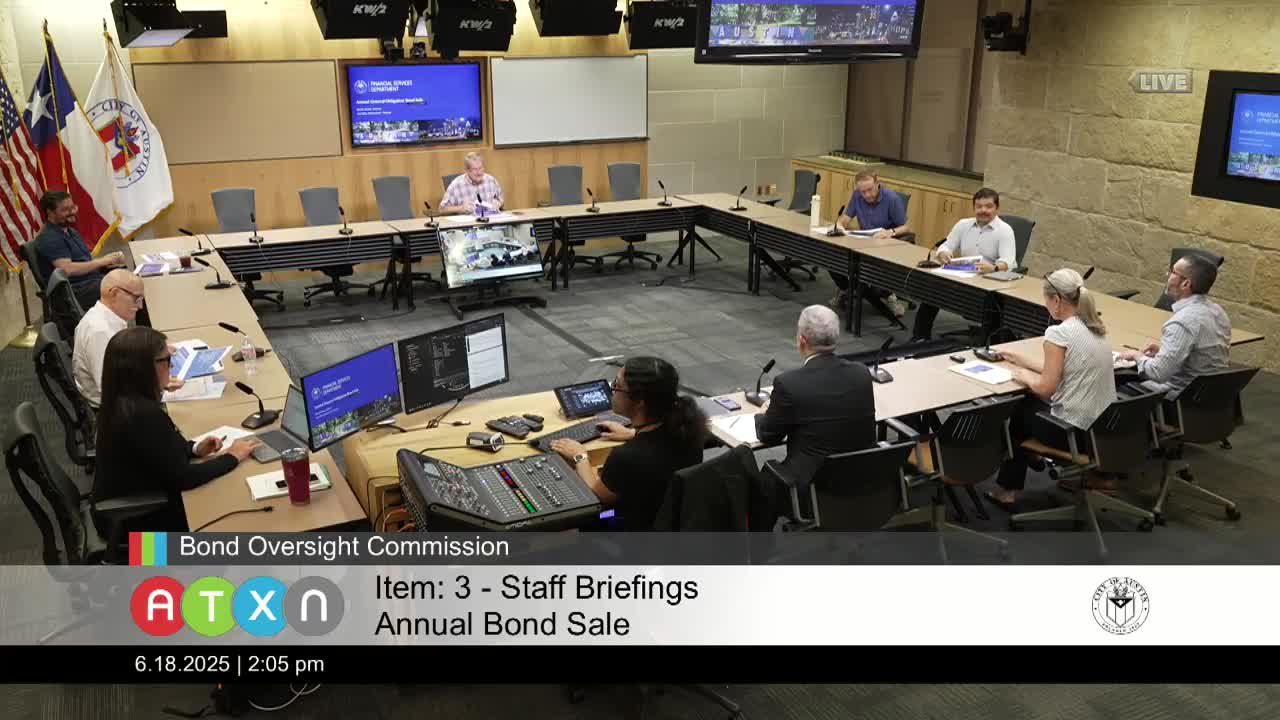
City Treasurer Belinda Weaver told the Bond Oversight Commission the city plans a negotiated sale of about $358.1 million in public improvement general-obligation bonds, with council approval of parameters planned in late July and a closing targeted for Oct. 2.
City Treasurer Belinda Weaver told the Bond Oversight Commission on a June staff briefing that the city expects to issue roughly $358,100,000 in public-improvement general-obligation (GO) bonds in the 2025 sale and will seek a council ordinance to set sale parameters on the July 24 council agenda.
Weaver said the city has $1.895 billion in outstanding GO debt backed by ad valorem property taxes and that the FY2025 property tax rate was 47.76 cents per $100 of assessed value, of which 9.61 cents pays debt service and 38.15 cents covers operations and maintenance. "The city's property tax rate is comprised of two portions. It's the operations and maintenance portion, and the debt service portion," Weaver said.
The presentation explained the three GO debt types Austin issues: voter-authorized public-improvement bonds (20-year term), certificates of obligation for nonmovable capital like buildings (20-year term, not voter authorized), and contractual obligations for movable personal property such as vehicles (seven-year term, not voter authorized). Treasury staff said the city uses reimbursement resolutions at project outset so departments may spend and later reimburse from bond proceeds, reducing arbitrage risk and avoiding interest on idle funds.
Joey Keller, division chief over debt management, walked commissioners through the issuance steps and the bond timetable. The city began preparing the preliminary official statement in early June, will ask council to adopt a parameters ordinance in July, expects a negotiated sale in September and is targeting an October 2 closing. "That is our guideline ... we generally have the sale in September and close on the bonds in October," Weaver said.
The proposed series 2025 sale was described as predominantly transportation-focused within the public-improvement allocation; staff said older voter-authorized programs still have unissued balances. After the sale, staff estimated roughly $1.02 billion of voter-authorized GO bonds would remain unissued. The 2022 program includes a $75 million remaining allocation for affordable housing, staff said.
Commissioners questioned whether the city’s timeline is flexible in light of market moves. Weaver and Keller said the September-to-October schedule is a customary guideline but can be adjusted; pricing-to-closing requires a minimum period (about three weeks) and staff monitors markets while preparing documents. One commissioner observed that potential Federal Reserve rate cuts later in the year could reduce interest costs on future issuance, a dynamic staff said they monitor but would not assume as certain savings when setting timing.
Commissioners also asked about reimbursement resolutions and how bonds are chosen for sale. Weaver said reimbursement resolutions are established when projects are appropriated in the capital budget, and the finance office bases issuance decisions on actual expenditures "out the door" and forecasted spending needs — not simply on the presence of appropriation and reimbursement authority.
The commission asked staff to provide follow-up on a long-standing 2006 voter-authorized balance of about $4 million tied to the Mexic-Arte project; staff agreed to return with an update.
Minutes approval: the commission approved minutes from its prior meeting by motion and voice vote; the record shows a single affirmative response in the transcript but no roll-call tally was recorded on the record provided.
What happens next: staff will bring the parameters ordinance to city council in July and continue market monitoring and document preparation ahead of the anticipated September pricing and early-October closing. The commission will receive further updates as sale documents and departmental spending plans are refined.