Get Full Government Meeting Transcripts, Videos, & Alerts Forever!
Get email alerts on the Public Comment School Boards topic
No spam. Unsubscribe anytime.
Senate committee sends public‑comment bill for school boards to amendment process after split testimony
Summary
Senate Bill 1007, which would remove a requirement limiting school board public comment to agenda items, was sent to the fourteenth order for possible amendment after testimony for and against. Supporters said allowing public comment on non‑agenda items restores community voice; opponents warned of open‑meeting and quasi‑judicial risks.
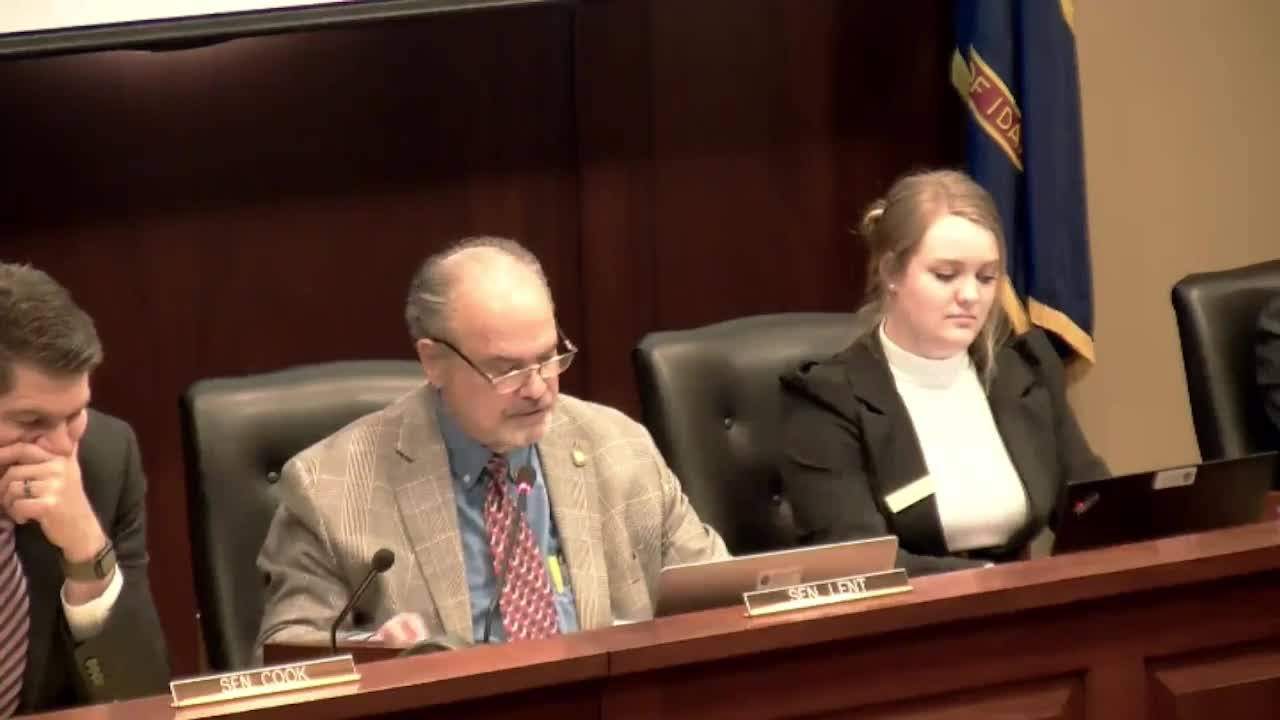
The Idaho Senate Education Committee voted to send Senate Bill 1007 to the fourteenth order for possible amendment after competing testimony about whether school board public comment should be limited to topics on the posted agenda.
Senator Cindy Carlson, sponsor of Senate Bill 1007, described the measure as a cleanup to last year's legislation (Senate Bill 1361) and said she wants to strike a sentence that some districts have used to deny patrons any public comment unless the item is on the agenda. "These are elected people representing patrons in their district, and they need the ability to speak to their school board members," Carlson said.
Several parents and local board members testified in favor of the change. Melanie Phillips, a parent from Kuna, described a 2021 effort to use state "advanced opportunities" funding to cover driver education costs. Phillips said repeated requests to district staff were ignored until she used the public comment period at a board meeting; the district then investigated and adopted the change, which she estimated saved the community roughly $500,000. "If I had been restricted during delegations to only the items on the agenda, I would never have had a voice," Phillips told the committee.
Christina Hardy, a longtime meeting attendee from District 23, said in five years of watching her district's board, public comment rarely used more than 10 minutes and allowed patrons to raise concerns that otherwise went unaddressed. Leslie Bjerke, vice chair of the Coeur d'Alene School Board, said her board historically allowed non‑agenda public comment without problems and that the local board preferred to set its own parameters.
The Idaho School Boards Association, represented by Quinn Perry, opposed the bill as written. Perry said the 2024 change requiring districts to allow public comment at regular meetings was working well and warned that removing the agenda limitation could turn board business meetings "into a free for all." Perry said school boards sometimes act in a quasi‑judicial capacity — for example in student expulsion or termination hearings — and added that boards need protections against prejudicial public statements. "School board meetings are not public meetings. They are business meetings held in public," Perry said.
Committee members questioned how the change would interact with the 48‑hour agenda posting requirement for regular meetings and whether boards could continue to set time and conduct limits. Senator Woodward moved that the committee send the bill to the fourteenth order for possible amendment to allow further work; the motion was seconded and carried on a voice vote.
Senator Woodward said he wanted the bill refined rather than discarded, noting the law affects two million people and that a narrowly drawn solution may be preferable to leaving the statute as written or striking the provision outright. He also asked staff to arrange a briefing by the state Department of Education on the scope of "advanced opportunities" funding, after testimony that the program had been used to fund driver education in some districts.
What happens next: The bill will go to the fourteen order for possible amendment, where sponsors and opponents may work toward language that preserves community access while addressing boards' governance and open‑meeting concerns.