Get Full Government Meeting Transcripts, Videos, & Alerts Forever!
Get email alerts on the School Construction topic
No spam. Unsubscribe anytime.
Board presses staff for subcontractor breakdowns in school construction bids, cites purchasing-rule limits
Summary
Board members asked staff for a vendor-level breakdown of school construction spending and discussed whether bid requirements or ordinance changes could help ensure more city residents and MWBEs benefit from major school projects.
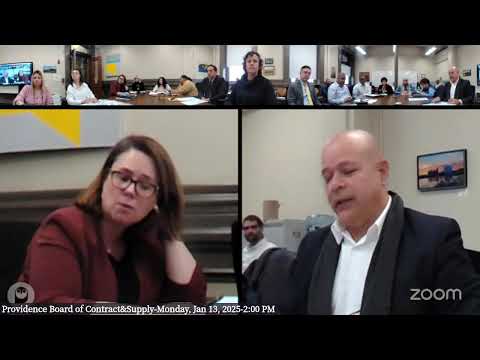
Members of the Providence City Board of Contract and Supply spent part of the Jan. 13, 2025 meeting discussing year-to-date school construction reporting and whether the city can require contractors or subcontractors to provide more detail about how contract dollars flow back into Providence.
Board members said the school-construction report they received listed work by project but did not show how much each subcontractor received or where subcontractors are headquartered. One member said that information is necessary to determine how much of roughly $700 million in school construction spending is benefitting city residents and local businesses.
Staff responding to the board said the information requested is not always available on a per-job basis and noted legal and practicability limits. Staff suggested starting with the dollars-per-vendor figures the city already has and the existing compliance datasets (including First Source and MWBE tracking) and then working from there. Staff also noted that current purchasing rules and the city ordinance require awarding to the low bid in many circumstances, which limits the purchasing team’s discretion to favor vendors because of local hiring or headquarters location.
Board members raised several implementation questions: whether it is legally permissible to ask subcontractors where their employees live; whether the city could require local-hire or local-spend reporting as part of bid documents; and how veterans’ status and MWBE participation are or should be accounted for. One board member noted that the MWBE (referred to in the transcript as “NWBE”) coordinator already keeps some of this information and suggested the board add an explicit request for veterans-related reporting. Staff said they can start by compiling vendor-dollar totals and available First Source/MWBE compliance data and return with options for ordinance or bid-document changes.
No formal motion or vote was recorded on changing purchasing rules or adding reporting requirements during the meeting. Participants agreed to pursue more data and to consider whether ordinance changes or procurement-policy tweaks are necessary and legally permissible before altering bid evaluation criteria.
The discussion highlighted a tension the board described between local economic goals and the legal constraints of the city’s procurement process. Several members urged additional transparency in subcontractor spending and asked staff to report back with data and potential next steps.
(Documentation in the meeting transcript: board members asked for subcontractor-level dollar breakdowns and discussed First Source/MWBE compliance data and legal limits to asking for employee residence information.)