Get Full Government Meeting Transcripts, Videos, & Alerts Forever!
Get email alerts on the Housing Community Development Action Plan 2025 topic
No spam. Unsubscribe anytime.
Committee advances 2025 community development action plan with roughly $21 million in HOME/CDBG/ESG/HOPWA funding
Summary
The committee approved Proposal 51, advancing an action plan that allocates federal HOME, CDBG, ESG and HOPWA funds for 2025; the plan prioritizes affordable housing, homelessness reduction, basic human needs and employment access and will be submitted to HUD after federal budget allocations are finalized.
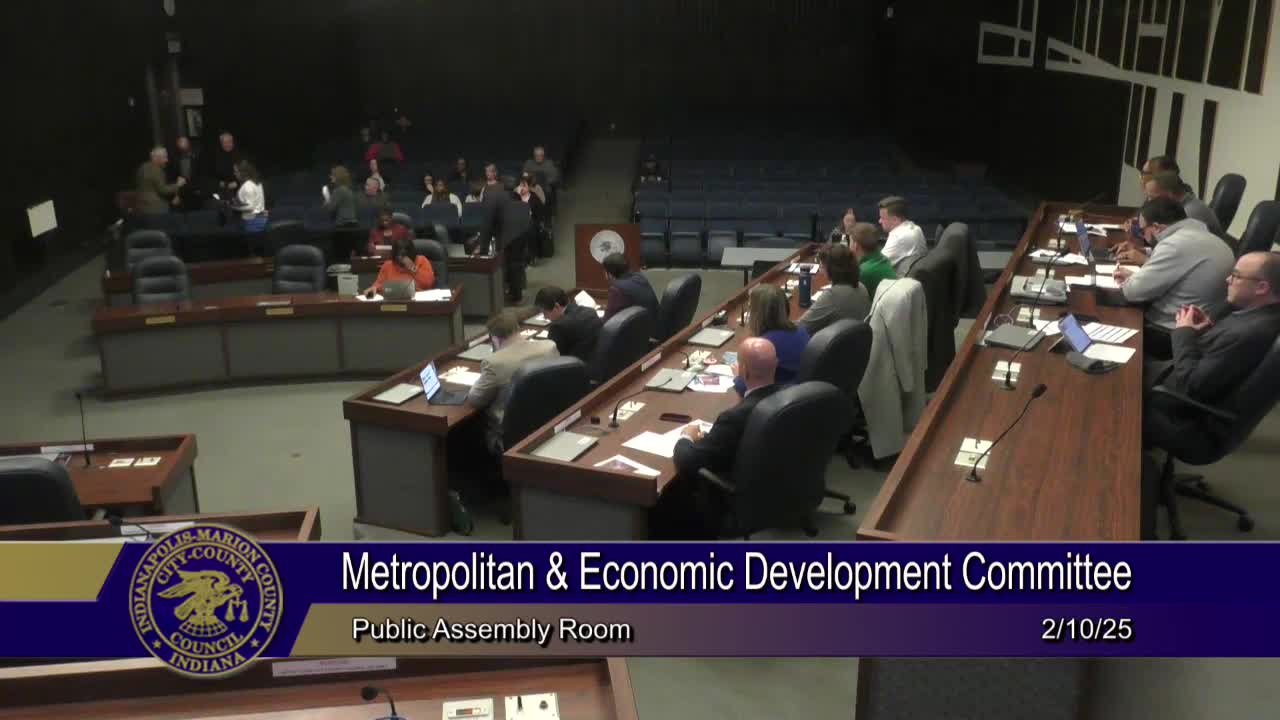
The Economic Development Committee voted Feb. 10 to advance Proposal 51, the city’s 2025 action plan for federal community development grants that combine HOME, Community Development Block Grant (CDBG), Emergency Solutions Grant (ESG) and Housing Opportunities for Persons With AIDS (HOPWA) funding.
Beth Neville, administrator of Community Investments in the Department of Metropolitan Development, presented the proposal and described the federal programs and local priorities. “HOME can be used for creation and rehabilitation of affordable rental and home ownership opportunities,” Neville said. She told the committee the city typically receives about $4 million in HOME, about $9 million in CDBG, roughly $800,000 in ESG and about $2 million in HOPWA in a typical year; the proposed 2025 action plan bundles expected awards and rollover funds and proposes approximately $21,000,000 for 2025 programming and carryover.
The action plan identifies four city priorities that will guide funding decisions over the next five years: developing quality affordable housing; reducing homelessness through shelter, rapid rehousing and outreach; supporting basic human needs and public-facility improvements; and increasing access to employment and neighborhood investment. Neville said programs (other than HOPWA) are limited to projects within the Indianapolis city limits and that HOPWA’s statutory service area includes surrounding counties — Boone, Brown, Hamilton, Hancock, Hendricks, Johnson, Madison, Morgan, Putnam and Shelby.
Neville described program rules and process constraints: awards are reimbursement-based (partners incur costs and then request reimbursement), HUD requires a five-year consolidated plan and an annual action plan, and the city runs competitive application rounds to select projects. She said the draft action plan was released for public comment Jan. 15 and the comment period runs through Feb. 14; the regulatory submission was listed as Feb. 15, but Neville said the city will not submit to HUD until federal budget allocations are finalized later in the spring.
Committee members asked about HUD coordination, long-term outcome tracking and geographic distribution of awards. Neville said staff maintain biweekly meetings with the local HUD office and that the department tracks program-level outcomes required by HUD; she also said staff are pursuing more qualitative measures (user surveys) to measure downtown and neighborhood sentiment. Councilor Delaney asked whether potential reductions at the federal level posed an immediate threat; Neville said prior-year funds approved by Congress remain available and the city is continuing business as usual.
Public testimony included a developer representative from Midwest Support Foundation, who said his organization was awarded HOME funds for a homeownership phase in the Hallsville neighborhood and urged committee support for the action plan.
The committee approved Proposal 51 by voice vote; no roll-call tally is shown in the committee record in the transcript. The action advances the city’s 2025 action plan toward HUD submission once federal allocation amounts are finalized.