Get Full Government Meeting Transcripts, Videos, & Alerts Forever!
Get email alerts on the Elections Voting Machines topic
No spam. Unsubscribe anytime.
Wyoming committee hears hours of testimony on Senate File 184 to ban electronic voting equipment
Summary
The Senate Corporations committee heard more than a dozen witnesses Wednesday on Senate File 184, which would replace electronic tabulation with hand counting; witnesses and county clerks described competing concerns about accuracy, cost, chain-of-custody and county capacity. No committee vote was taken.
CHEYENNE — The Wyoming Senate Corporations, Elections & Political Subdivisions Committee spent an evening hearing public testimony on Senate File 184, a measure that would prohibit use of certain electronic voting equipment and require hand counting of paper ballots for state elections.
Supporters and opponents laid out sharply different views of the state’s current voting system, with witnesses testifying about local testing failures, alleged vulnerabilities in ES&S equipment, and the logistics and costs of switching to hand counts.
The bill’s proponents said the state’s electronic systems are opaque and occasionally unreliable. “SF 184 eliminates all these problems,” said Richard Weber, operations manager of BCR Voter Initiatives and a Story, Wyoming, resident. Weber told senators clerks cannot inspect key internal machine logs, that vendor source code is held externally and inaccessible, and that county clerks rely on out-of-state vendors who are not sworn election officials. He said hand counts reduce complexity and liability for county clerks and cited his experience running control hand-count tables.
Other supporters described local incidents they said raised security concerns. Elena Campbell of Sheridan County recounted an incident in which a precinct worker received a text with an unofficial precinct result while ballots and machines were still being moved, and said the machines’ network and transmission pathways create vulnerabilities. Stanley Jasinski of Weston County and other local party and election-board members described procedural problems in Weston and Campbell counties, including disputed logic-and-accuracy testing, contested hand counts, and complaints that county clerks had not followed statutory testing procedures.
“We were denied representation during the hand count of mailing and absentee ballots,” said Jasinski, who said his group filed complaints with the governor’s office alleging malfeasance; he said the complaints were under investigation.
Witnesses with technical backgrounds described different technical risks. Keith Miller, a retired systems engineer, told the panel that data-carrying conductors such as power lines could be used to transmit information from machines, and that physical seals and cable ties do not address all possible attack vectors. Several witnesses emphasized that the Election Assistance Commission (EAC) does not endorse specific proprietary products and that the federal HAVA testing requirements and EAC guidance are relevant to county testing procedures.
Opponents of SF 184, including county clerks and civic groups, argued hand counting would be slower, costlier in the near term, and vulnerable to other errors and privacy concerns. “Hand counting ballots as the primary method of processing ballots draws out the delivery of the end results, lays way for increased mistakes, subject of bias, and distrust, as well as greater risk to violate voter privacy and ballot security,” said an online witness identifying herself as a county election official. The League of Women Voters’ Marguerite Herman said hand counting may work in limited, simple contexts but is impractical for most modern ballots with many contests.
Several county clerks or their representatives told the committee they had reviewed an early version of the citizen-drafted proposal and supplied administrative comments intended to make a conversion workable; Malcolm Irvin, Platte County clerk and president of the County Clerks Association, said those comments addressed administrative feasibility and were not an endorsement of the policy change.
Cost figures and operational estimates featured repeatedly in testimony. Supporters said the state spends roughly $4.6 million annually on ES&S maintenance and licensing that would be avoidable if machines were removed; proponents and volunteer groups offered hand-count staffing and per-hour cost estimates that they said would be lower than ongoing equipment costs. Several witnesses pointed to the ES&S contract expiring in mid-2026 and questioned whether the state should renew before resolving the concerns raised in testimony.
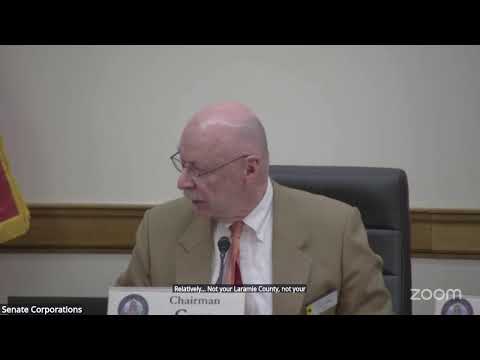
Committee members repeatedly said the measure is complex and that more study was needed. Several senators, including members with election-administration experience, said they were not ready to move the bill forward at the late hour and expressed interest in continuing discussion in an interim study or by comparing the Senate bill with related House proposals. Chairman Case did not call a vote; the committee tentatively planned to reconvene Friday morning to consider other bills.
The hearing included testimony from county officials, election workers, technical experts and civic groups from multiple Wyoming counties, including Weston, Campbell, Platte, Park, Carbon and Crook. No formal committee action was taken Wednesday; the bill remained under consideration.
Looking ahead, proponents urged prompt legislative action before the ES&S contract expiration, while opponents and some clerks urged incremental reforms, additional rulemaking, or a phased approach to any change.
The committee scheduled further business on other election-related bills for a Friday morning session; the SF 184 discussion was left open for additional review and amendments.