Get Full Government Meeting Transcripts, Videos, & Alerts Forever!
Get email alerts on the Economic Development Downtown Enhancement District topic
No spam. Unsubscribe anytime.
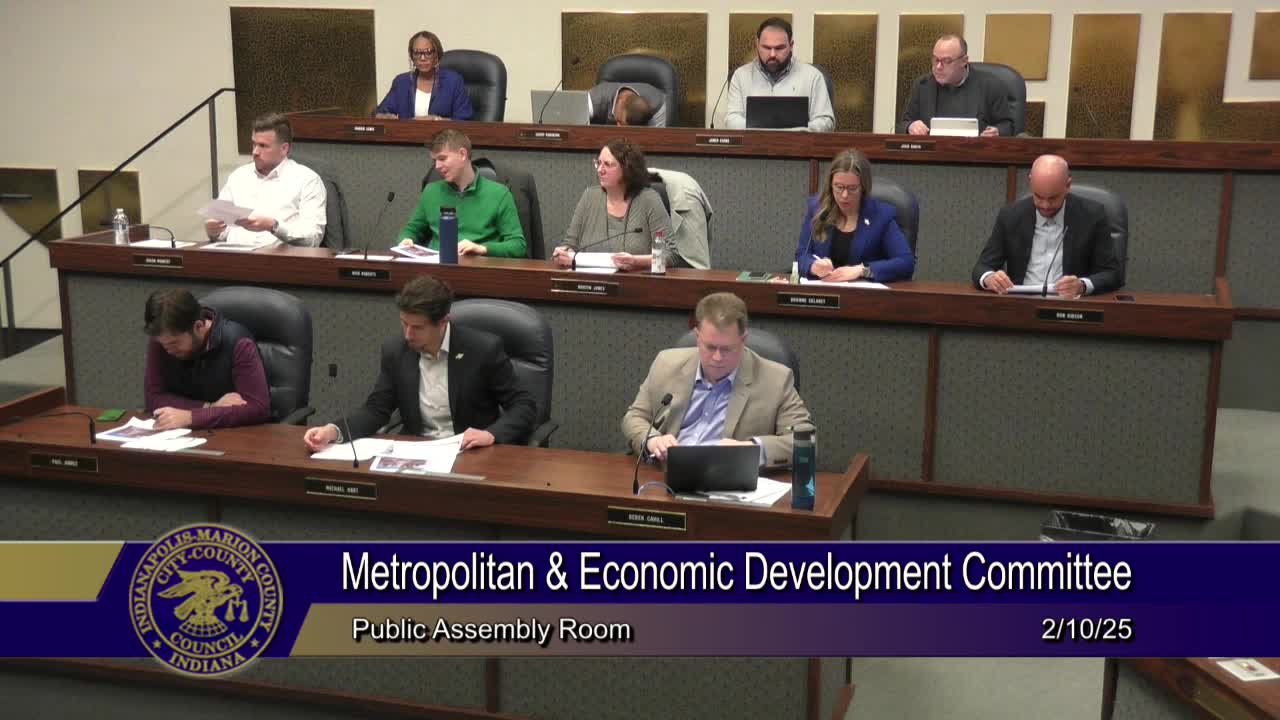
Committee approves six-month, $4.53 million budget for Downtown Indianapolis Economic Enhancement District
Summary
The Economic Development Committee approved a six-month operating budget of $4,530,000 for the Downtown Indianapolis Economic Enhancement District to sustain cleaning, public-safety patrols, outreach and other downtown services while federal pilot funding winds down.
The Economic Development Committee voted Feb. 10 to approve a six-month operating budget of $4,530,000 for the Downtown Indianapolis Economic Enhancement District (EED), the district that will levy an assessment on commercial property downtown to fund cleaning, public-safety services, outreach to people experiencing homelessness and business-support activities.
Taylor Schaefer, a Downtown Indy staff member, told the committee the budget covers operations for July 1 through Dec. 31, 2025, and is intended to ensure continuity of services as one-time federal American Rescue Plan Act (ARPA) funds used to pilot downtown services expire in June 2025. “We want to ensure that there’s not a dip in services, that there’s not a drop off in services,” Schaefer said.
The approved budget follows state statute established for the EED and a series of local steps: the EED board was constituted Jan. 1, met Jan. 3 to approve bylaws and the assessment formula, and held a public hearing Jan. 31. Schaefer told council members that the assessment rate in the enacted district is 0.1681% of gross assessed value applied to most commercial parcels; residential units and apartment units were removed from the statute in 2024, though mixed-use parcels pay on the commercial portion. The first disbursement from the treasurer’s office is expected in June 2025, Schaefer said, and council action was scheduled for March 3 to meet treasurer/assessor timelines for tax statements.
Why it matters: the district takes over services that had been funded with one-time federal dollars, including a 7-day-a-week cleaning program, graffiti and litter removal, power washing, a Safety Ambassador program (non-sworn outreach staff), off-duty IMPD patrols by bike at high-visibility times, and contracted homeless outreach. Schaefer said the budget prioritizes continuity and conservative spending in the first six months; a low-barrier shelter referenced in state law is not yet operating and is not included in the first six-month budget.
Committee discussion and amendments focused on accountability, outcome tracking and program details. Councilor John Barth asked whether ARPA dollars would bridge the gap until EED revenues flowed; Schaefer said ARPA pilot funding totaled about $3.7 million initially, with an additional $2.3 million later, and those one-time funds will wrap up in June 2025. Barth also asked about outcome tracking for homelessness outreach; Schaefer said Downtown Indy and its outreach contractor (Horizon House) compile reports on outreach activities and outcomes and that she would share that data with the committee.
Councilor Kristen Jones offered and moved an amendment to section 1 of the proposal to replace Exhibit A with a revised exhibit reflecting the $4,530,000 total budget; the amendment was seconded and carried. The committee then voted to approve proposal 50 as amended. The committee record shows the motion and the amendment passed, though no roll-call tally was provided in committee minutes.
Key details: the EED board is a nine-member board under state law with appointments by the council, the mayor, legislative leaders and the governor; Schaefer said two board members — Bill Brown (chair) and Greg Henneke (vice chair) — attended the committee meeting and offered brief remarks in support of continuing the services piloted with federal funds. Brown said the district will seek private contributions from some non-assessed property owners who have expressed interest in supporting downtown services. Schaefer described use of a commercial/property reporting app (branded for Downtown Indy) to log service requests and track responses, and said the district targets a 24–36 hour response time for reported issues.
Implementation notes and limits: Schaefer explained the EED’s first-year financial quirk: district spending will occur six months in arrears, so the committee reviewed a budget for July–December. She said the EED will return in November with an annual budget for subsequent years. The low-barrier shelter cited in the district’s statutory uses is expected later (Schaffer said late 2026) and is not funded in this first six-month package.
The committee’s action advances the EED budget to the full council for final consideration on its March schedule, meeting the treasurer/assessor timing needed to appear on property tax statements.