Get Full Government Meeting Transcripts, Videos, & Alerts Forever!
Get email alerts on the Horseshoe Crabs topic
No spam. Unsubscribe anytime.
Scientists and fishermen clash at Assembly hearing after veto of Horseshoe Crab Protection Act
Summary
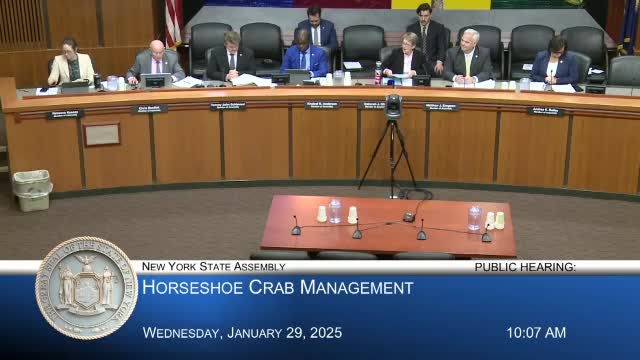
Albany — The New York State Assembly Committee on Environmental Conservation on Friday held a hybrid hearing to review the state of horseshoe crab populations after the Legislature passed the Horseshoe Crab Protection Act and Gov. Kathy Hochul vetoed it on Dec. 13, 2024.
Albany — The New York State Assembly Committee on Environmental Conservation on Friday held a hybrid hearing to review the state of horseshoe crab populations after the Legislature passed the Horseshoe Crab Protection Act and Gov. Kathy Hochul vetoed it on Dec. 13, 2024.
Assemblywoman Deborah Glick, chair of the committee, opened the hearing by saying the panel had convened to examine “the state of horseshoe crabs in New York State,” noting that scientists, advocates and commercial interests were present to offer testimony.
Conservationists said New York’s horseshoe crab numbers have declined for years and urged lawmakers to revive the vetoed bill. Adrienne Esposito, Executive Director of Citizens Campaign for the Environment and founder of the Save the Horseshoe Crab Coalition, told the committee, “If we don't act now, when?” Esposito cited Atlantic States Marine Fisheries Commission findings that several New York surveys have fallen below 1998 levels and said New York Department of Environmental Conservation (DEC) measures so far are not reversing the decline.
Erin McGrath, Policy Director for the New York State office of the National Audubon Society, emphasized the link between horseshoe crab eggs and migratory shorebirds. “Birds really are indicators,” McGrath said, describing how red knots and other shorebirds rely on horseshoe crab eggs on Long Island staging areas to fuel migration and successful breeding further north.
Scientists at the hearing recommended more aggressive population safeguards and improved monitoring. Lawrence (Larry) Niles, who has led long-term studies of shorebirds and horseshoe crabs, and other researchers described egg-density and spawning surveys — rather than opportunistic trawl bycatch — as the most informative way to measure breeding success on beaches.
Industry witnesses and commercial fishing advocates said the existing DEC management actions and quotas deserve more time and improved survey methods before imposing a ban. Robert Carpenter, director of the Long Island Farm Bureau, and Bonnie Brady, executive director of the Long Island Commercial Fishing Association, said commercial harvests are tightly regulated and that the DEC has limited New York’s allowable take to 150,000 crabs (below a higher Atlantic States Marine Fisheries Commission quota). Brady told the committee there are “over 400 commercial fishermen with horseshoe crab permits in New York state,” and warned that an outright ban could end some whelk and eel fishing livelihoods.
Panelists debated biomedical uses of horseshoe crabs. Brian Shapiro, New York State Director for the Humane Society of the United States, told the committee the biomedical industry historically harvested crabs for their blood but that synthetic alternatives exist and are in increasing use. He said studies show the synthetic options are “just as good or even better” than tests that rely on horseshoe crab blood.
Across panels, witnesses recommended a set of next steps: (1) a temporary ban or moratorium while comprehensive spawning- and egg-density surveys are completed; (2) a coast‑wide, standardized monitoring program that uses beach-based spawning counts and targeted egg-density sampling; (3) additional enforcement resources for DEC; and (4) programs to help fishermen transition to alternative baits or to provide economic assistance during closures. Several witnesses noted DEC already enforces lunar closures around key spawning tides and has reduced the state take where possible, but they differed on whether those measures are sufficient.
The hearing did not produce a formal legislative action; lawmakers heard testimony and asked questions about data gaps, enforcement and economic impacts. Committee members indicated they may reintroduce the measure or pursue interim actions after reviewing the scientific and economic evidence presented.
Votes and formal actions discussed at the hearing
The committee reviewed the legislative history of the Horseshoe Crab Protection Act. The measure passed both houses of the Legislature last year (Senate: 53–7; Assembly: 102–39) but was vetoed by the governor on Dec. 13, 2024. Committee testimony included those vote tallies and the governor’s veto message, which cited DEC’s existing management authority and potential impacts on commercial fishermen. The vetoed bill would have prohibited taking horseshoe crabs for commercial and biomedical purposes; the Legislature must act again to change state law.
What’s next
Lawmakers at the hearing heard sharply different prescriptions: conservation groups urged decisive statewide prohibitions pending recovery, while fishing representatives called for improved, standardized science and funding for bait alternatives and economic transition assistance. Several scientists urged rapid, beach‑based spawning and egg‑density surveys beginning in May to establish reliable baselines.
The committee’s record will remain open as members and staff review submitted materials from witnesses and DEC, and any follow-up legislation or committee directives will depend on that review and on whether the governor will accept changes to the bill or new legislation this session.