Get Full Government Meeting Transcripts, Videos, & Alerts Forever!
Get email alerts on the Severance Tax Highway Funding topic
No spam. Unsubscribe anytime.
Committee rejects plan to divert second portion of severance tax to highway fund
Summary
The House Transportation, Highways & Military Affairs Committee on Monday considered House Bill 29, which would redirect Wyoming—s statutorily allocated second portion of severance tax from the Permanent Mineral Trust Fund and the Common School Land Fund into the state highway fund.
CHEYENNE — The House Transportation, Highways & Military Affairs Committee on Monday debated House Bill 29, a bill that would divert the second portion of Wyoming’s severance tax away from the Permanent Mineral Trust Fund and the Common School Land Fund and into the state highway fund.
The bill’s sponsor and the Wyoming Department of Transportation framed the measure as an attempt to address an agency-wide unfunded need the department estimated at roughly $400 million annually. "The first 1 is the severance tax and distribution, and the second 1 is the vehicle sales tax redistribution," the department’s representative said when introducing the bills to the committee, and later summarized HB 29 as “changing the distribution of the second tip of the severance tax to the highway fund.”
Committee members heard that the second portion of severance-tax receipts is currently split in statute between the Permanent Mineral Trust Fund and the Common School Land Fund (about $55 million to each in fiscal 2025), and HB 29 would redirect those statutory shares to the highway fund beginning July 1. The sponsor provided a handout showing the two statutory boxes being moved into a single highway fund box and said the department needs more flexible, dedicated funding for roads, bridges, highway patrol, emergency communications and aeronautics.
Opponents, led by Representative Bob Nicholas, argued the change would take money from the general fund’s long list of programs. "I'm gonna speak against the bill and ask for a no vote on the bill for several different reasons," Nicholas said during discussion, arguing the revenues now routed to the general fund support health, education and other core services and that cuts are already anticipated in the current budget environment.
Committee members also debated alternatives. Representative Nicholas and others raised fuel-tax increases, a delivery fee, tire taxes and redistributions of existing taxes as potential options. Department staff said LSO had surveyed other states and that many alternatives involved new or higher taxes; the bill before the committee was designed to repurpose existing revenue rather than create a new tax.
The Wyoming Department of Transportation and its finance staff described the broader funding picture: Dennis Burn, CFO with WYDOT, said the agency has averaged roughly $100 million per year from the federal Infrastructure Investment and Jobs Act (IIJA) but that a specific federal program providing about $30 million for bridges was discontinued. Director Darren Westby (introducing the bill) and transportation commissioner Jim Willicks said the department and commission have considered priorities and would manage any additional funds collectively.
The Associated General Contractors of Wyoming supported the bill. "Revenue spent on maintaining and improving Wyoming's road system is an investment in Wyoming's future," Kelly Little of AGC told the committee, citing construction-cost inflation and traffic-safety costs.
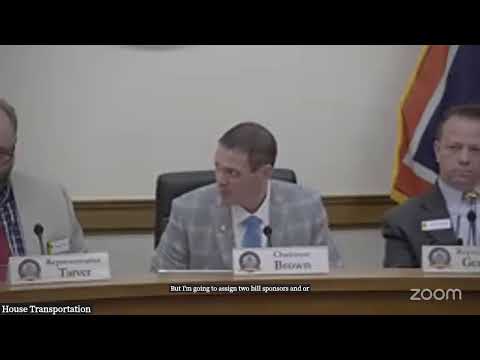
Committee action: Members adopted an amendment to strike subsection F (a legislative budget-balancer provision) from the bill. After debate, Representative Rob Geringer moved for passage, seconded by Representative Ruben Tarver. On a roll-call vote the committee recorded 2 ayes (Chairman Brown, Representative Tarver) and 7 noes; the motion failed and HB 29 did not advance from committee.
While supporters said the redirection would create a dedicated source for transportation and prevent a more expensive “cliff” of reconstruction in coming years, opponents stressed the immediate fiscal trade-offs to the general fund and asked the committee to pursue alternatives or phased approaches.
The committee’s debate left the legislature without a committee-approved mechanism to shift the statutory severance-tax shares; several members said they wanted to explore alternative or partial redistributions and other revenue sources before moving forward.