Get Full Government Meeting Transcripts, Videos, & Alerts Forever!
Get email alerts on the Data Practices Transparency topic
No spam. Unsubscribe anytime.
House GOP leader advances bill to narrow attorney general—s secrecy under Minnesota data law
Summary
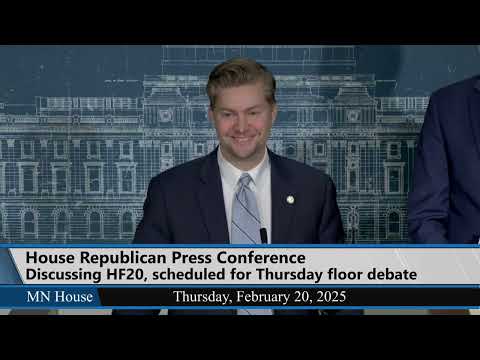
House Majority Leader Harry Niska, R‑Andover, said he will bring House File 20 to the House floor to amend the Minnesota Data Practices Act so the attorney general's office cannot classify non‑personal materials as "private data on individuals," he told reporters.
House Majority Leader Harry Niska, R‑Andover, said he will bring House File 20 to the House floor to amend the Minnesota Data Practices Act so the attorney general's office cannot classify non‑personal materials as "private data on individuals," he told reporters.
Niska said the change responds to a 2022 Minnesota Supreme Court decision, Energy Policy Advocates v. Ellison, which he said allowed the attorney general's office to withhold policy‑making materials and closed investigative records that do not implicate an individual's privacy interest.
"It is absolutely crucial to our democracy that we know what is happening with our public resources and our public offices," Niska said. He told reporters the bill simply "adds the words 'on individuals' to make sure that we are talking about data that actually relates to an individual person." He said the addition corrects what four justices on the Minnesota Supreme Court interpreted differently in 2022.
Niska cited the dissent by former DFL House Speaker Paul Thissen, saying Thissen called the majority's interpretation "Orwellian." Niska said the bill's aim is to prevent the attorney general's office from designating policy material or closed investigative information as private under the "private data on individuals" rubric when no individual's privacy interest is at stake.
Niska said he discussed the issue with the attorney general on Jan. 17 and that the attorney general's office has submitted letters of opposition to the bill in both the relevant House and Senate committees. He said the attorney general's stated concerns included the cost of responding to wide data‑practice requests and potential edge cases, such as whether certain businesses or family‑farm information could be treated like individual privacy interests.
Niska also raised funding concerns he said have prompted the dispute over disclosure. He said some positions in the attorney general's office are funded by outside entities and mentioned New York University and, as he put it, "the Bloomberg Foundation," saying those funding relationships are the sort of information the public cannot fully see under the current interpretation. He framed that lack of visibility as troubling: "We don't know what we don't know. We don't know what's being hidden from public view," he said.
On procedure, Niska said House File 20 was a Republican‑introduced bill two years ago that did not receive a hearing; he said it is being moved now because of committee control and that a companion measure is moving in the Senate. He said he expects the bill to be brought to a floor vote, but he did not record the outcome. He told reporters he had been told by Democrats that they would oppose the measure as a bloc; Niska said it was important for voters to see how their representatives vote on the issue.
The bill, as described by Niska, would insert the two words "on individuals" into the statutory definition for private data on individuals created, collected or maintained by the Office of the Attorney General. Niska said data that genuinely implicates an individual's privacy interest would remain protected under the Data Practices Act.
The matter under discussion refers to the Minnesota Data Practices Act and to the 2022 Minnesota Supreme Court case Energy Policy Advocates v. Ellison. Niska framed House File 20 as a targeted fix and said other transparency and oversight priorities may follow as committee and floor schedules permit.