Get Full Government Meeting Transcripts, Videos, & Alerts Forever!
Get email alerts on the Veterans Benefit Assistance Regulation topic
No spam. Unsubscribe anytime.
Committee advances bill to regulate companies that charge veterans for help preparing VA claims; VFW opposes
Summary
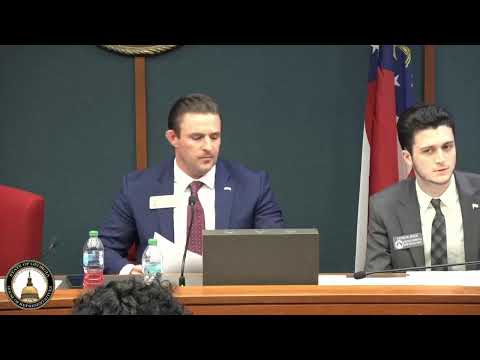
Chairman Bonner introduced House Bill 108 as a framework to regulate for-profit companies that assist veterans in preparing Department of Veterans Affairs benefit claims, describing it as a balance between protecting veterans from predatory actors and preserving options for veterans who want paid help.
Chairman Bonner introduced House Bill 108 as a framework to regulate for-profit companies that assist veterans in preparing Department of Veterans Affairs benefit claims, describing it as a balance between protecting veterans from predatory actors and preserving options for veterans who want paid help.
Bonner told the committee the sponsors held three statewide hearings — in Atlanta, Warner Robins and Augusta — to hear from veterans, veteran service organizations and Department of Veterans Services staff, and that no representatives from the federal Veterans Administration attended those hearings.
The bill would amend state law to require written disclosure and a signed agreement before any compensated assistance begins, ban upfront fees, bar the use of international call centers and the collection of veterans’ personal login credentials, require background checks for staff handling medical or financial information, and cap compensation at five times the monthly increase in benefits awarded as a result of the claim.
"If you say you get a benefit that's worth $300 a month, then it'll be $300 times 5 — dollars 1,500 is what it's gonna cost the veteran," Bonner said as an example of the cap. He said companies could not be paid until a veteran actually began receiving the increased benefit.
Joshua Sterner, who identified himself as founder of Veritas Ratings, testified in support of the bill. "There are predatory businesses out there and there are some out there, but we do fully support things like this because we work within those parameters and we do respect them," Sterner told the committee.
Charles Dobbins, legislative representative for the Veterans of Foreign Wars, testified in opposition. Dobbins argued federal law (Title 38) establishes that initial assistance to veterans should be provided without charge and said the bill would allow companies to extract large fees from veterans. He described an example where a veteran could go from 0% to 100% disability and, under a five-times cap, pay tens of thousands of dollars: "you have $4,000 a month. And 5 times that's $20,000 out of the Veteran's pocket," he said.
Committee members pressed both sides on enforcement and accreditation. Bonner said the measure places these companies under the state Fair Business Practices framework so the attorney general’s consumer protection division could prosecute deceptive businesses. Dobbins said the VFW prefers stronger federal enforcement and that accredited veteran service organizations provide similar services free of charge.
Several lawmakers voiced support for the bill as a practical response to long delays veterans face with the VA. Representative Jenkins noted differences in VA processing priorities, saying an appeal can take many years longer than an initial claim and that options to shorten delays could be important to some veterans.
Opponents called for either tabling the bill until federal action or for writing stronger language to ensure veterans are not charged for initial assistance. Proponents countered that prohibition would leave the market unregulated, allowing predatory firms to continue operating in Georgia without any consumer-protection guardrails.
After debate and public comment, members moved and seconded a motion. The committee voted to advance House Bill 108 to the rules committee. The transcript records a voice vote and notes: "House Bill 108 will move to the rules committee."