Get Full Government Meeting Transcripts, Videos, & Alerts Forever!
Get email alerts on the Tangible Personal Property Depreciation topic
No spam. Unsubscribe anytime.
House Revenue committee approves change to tangible personal-property indexing and depreciation
Summary
The House Revenue Committee voted 7-1 to advance Senate File 49, which limits how valuation indexes and depreciation schedules can increase the assessed value of tangible personal property once an asset reaches a statutory depreciation floor.
The House Revenue Committee voted 7-1 to advance Senate File 49, a bill that changes how fair market value of tangible personal property is calculated by limiting the effect of valuation indexes and depreciation schedules once property reaches a statutory depreciation floor.
Ken Gill of the Department of Revenue told the committee the bill's core effect is to prevent valuation indexes or depreciation schedules from increasing the fair market value of "fully depreciated property above the depreciation floor." The department offered an amendment the committee adopted that reads, in part, "once the tangible personal property reaches the depreciation floor, the trending factor shall remain constant for subsequent years until it is removed from service." Gill said the amendment clarifies that trending stops after an asset reaches its defined useful life and the value remains at that level until removed from service.
Supporters argued the change would correct situations in which older equipment could be valued higher than similar new equipment after indexing. Hank Hoversland, executive director of the Wyoming Taxpayers Association, told the panel the proposal is "justified" and "equitable," saying current practice can produce higher valuations for older items than for new ones. Industry witnesses, including representatives of petroleum and agricultural interests, said the change would provide predictability and allow reinvestment in businesses.
Opponents cautioned about fiscal impacts for local governments and the school foundation program. During committee discussion, a member cited fiscal estimates that would reduce the School Foundation Program by roughly $21 million and local government property-tax revenues by about $12.5 million (figures shown in the committee materials and discussed during testimony). County officials and the Wyoming County Commissioners Association asked the legislature to assess cumulative impacts of multiple property-tax proposals and to consider whether exemptions and valuation changes are producing unintended revenue declines in some counties.
Department and county assessors warned the bill would change appraisal practice by substituting a statutory mathematical approach for appraisers' judgment in certain cases. Dixie Huxtable, Converse County Assessor, said the change would turn "fair market value" at the end of an asset's economic life into a mathematical calculation rather than an appraisal: "When that property reaches the end of its economic life...that value in use is would now be a mathematical calculation, not an appraised value."
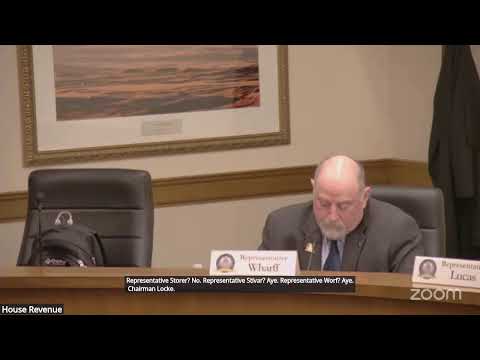
The committee adopted the department's amendment and then voted to move the engrossed bill as amended. The roll-call vote recorded seven ayes (Representatives Brown, Campbell, Lean, Lucas, Steibar, Wharfe and Chairman Locke), one no (Representative Storer) and one excused (Representative Riggins). The committee recorded the amendment as moved by the Department of Revenue (Mr. Gill) and accepted by voice vote before the roll-call.
Committee members asked the department to update guidance and the Department of Revenue's personal-property manual if the bill becomes law; assessors requested the 2026 effective date included in the bill to allow changes to CAMA systems and the personal-property manual to be implemented uniformly.
Votes at a glance: Senate File 49 (tangible personal property index and depreciation) '108: engrossed as amended; amendment moved by Department of Revenue (Ken Gill); committee vote 7-1 (Aye: Brown, Campbell, Lean, Lucas, Steibar, Wharfe, Locke; No: Storer; Riggins excused).