Get Full Government Meeting Transcripts, Videos, & Alerts Forever!
Get email alerts on the Tax Policy topic
No spam. Unsubscribe anytime.
CTA reviews rewritten room-tax policies; DA's office clarifies exemptions and recordkeeping
Summary
Board and staff reviewed a substantially revised set of Carson City room-tax policies and procedures, discussing changes to exemptions, recordkeeping, informal audits and references to municipal code; the deputy district attorney advised on government exemptions and payment-source tests.
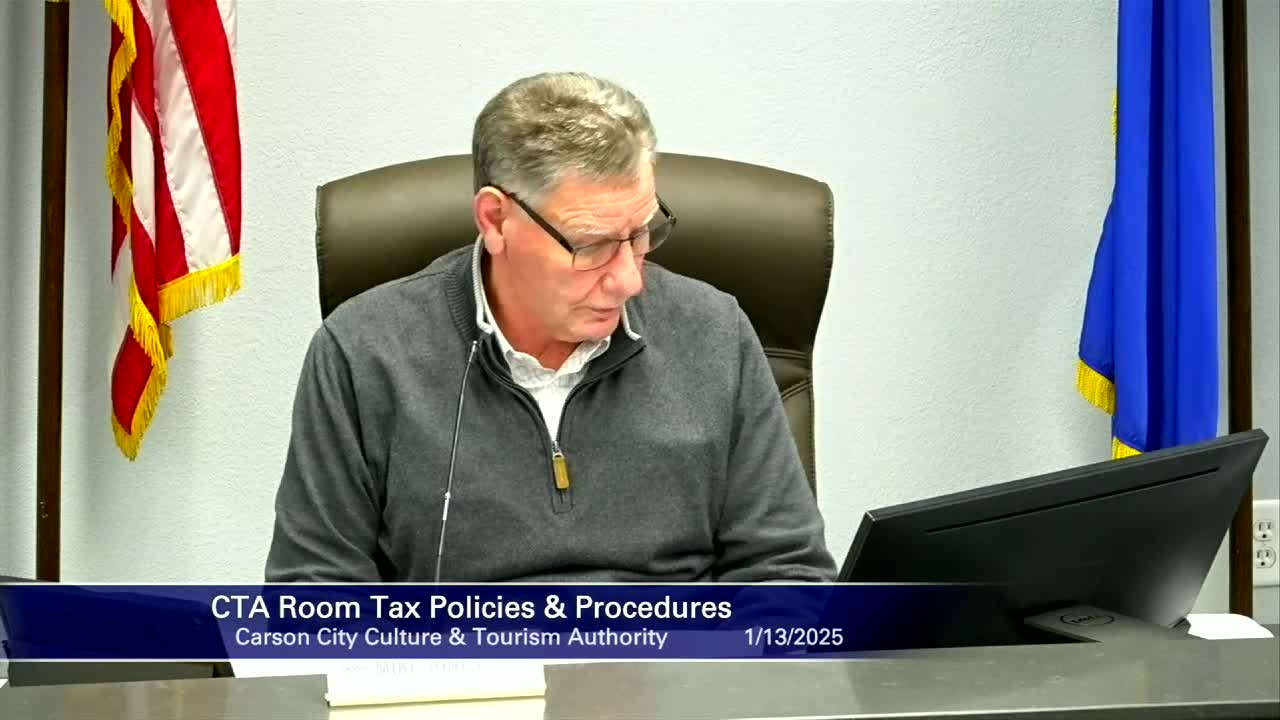
At the Jan. 13 meeting, CTA staff presented a substantially redrafted set of Carson City room-tax policies and procedures that reorganize the document, remove incorrect or redundant business-license guidance, clarify exemptions, add sample letters and introduce an informal-audit step.
Chris (staff) described the changes as extensive: rearranged sections, removal of incorrect Carson City business license details, clarification of current tax rates and how money is allocated, added appendix D with a governmental-exemption claim form and sample letters, and a planned sample lodging-tax return in appendix A. The redraft also removed a prior early-reporting allowance after direction from the district attorney's office.
Todd Reese, deputy district attorney, advised the board on governmental exemptions. Reese said broadly that if a government entity itself pays for lodging, the stay is generally exempt; but if an individual employee pays and later seeks reimbursement, that individual stay is not exempt. Reese said the DA's office continues to examine whether the State of Nevada is broadly exempt under the current rules and that the office was "preserving the status quo" pending a final conclusion.
Board members asked for clarifications about exemptions for legislators and how payments processed on state credit cards or checks are treated. Peterson and Reese said exemptions depend on the payment source: a state check or state payment instrument is exempt; individual payment with later reimbursement is not.
Staff described a new informal-audit process intended to give the executive director and licensee an opportunity to meet and resolve issues before penalties are assessed. The draft also tightens recordkeeping requirements and plans to post the final return form on the CTA lodging property page.
Board member Stacy Chiome asked about delinquencies and whether the $75 penalty is an adequate disincentive. Todd Reese said the $75 penalty is set in the Carson City Municipal Code and would require a Board of Supervisors action to change; staff noted peers have higher penalties (Reno-Sparks Convention and Visitors Authority lists the greater of $100 or 10% of taxes due as penalty plus interest) and staff offered to research peer practices.
Staff said final cleanup edits would be made after board feedback, the DA's office inputs, and that staff would deliver finalized copies to lodging operators and publish them on the CTA website.
The transcript records a motion to approve the policies; the public record does not include a recorded vote result in the meeting text available. The board directed staff to incorporate final edits and work with the city and DA's office on any CCMC (Carson City Municipal Code) changes required for alignment.