Get Full Government Meeting Transcripts, Videos, & Alerts Forever!
Get email alerts on the Land Use topic
No spam. Unsubscribe anytime.
Tamarac adopts new certificate-of-use rules, adds short compliance period for plaza owners
Summary
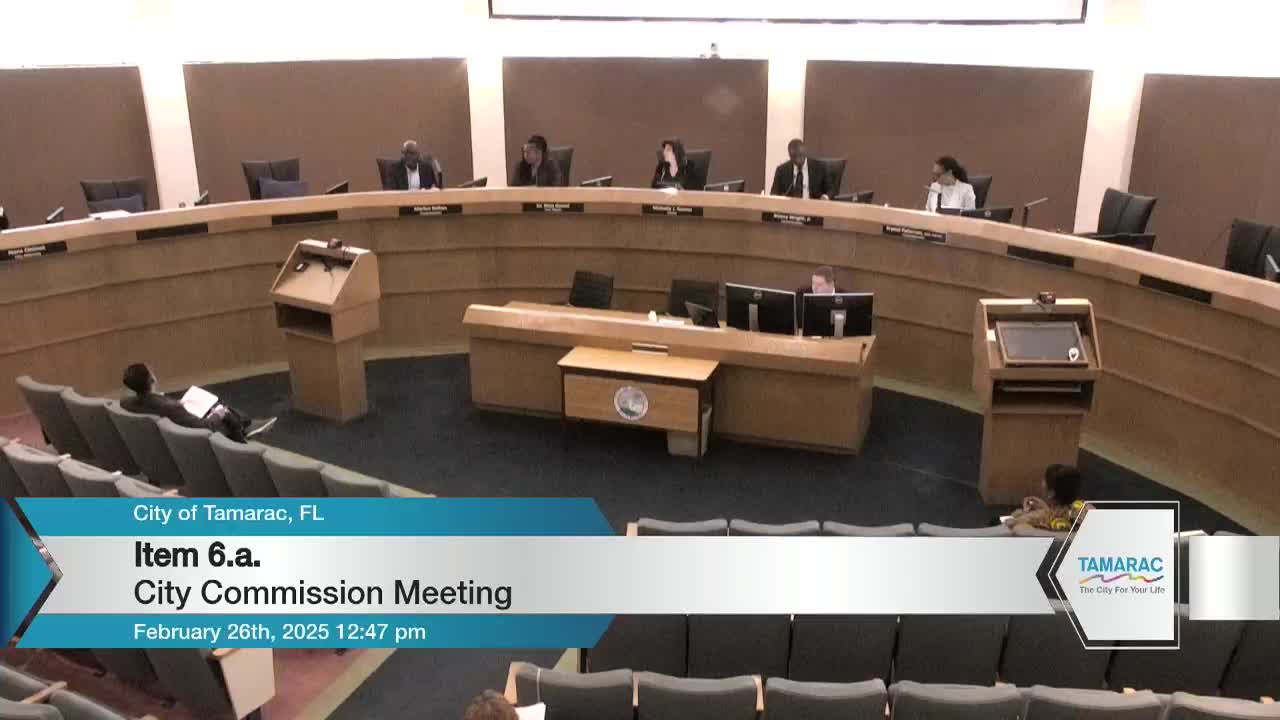
After extensive debate about commercial plazas and landlord obligations, the Tamarac City Commission adopted a certificate-of-use requirement for new commercial tenants and amended related rules to give staff limited discretion and a three-month public-education/compliance window before enforcement.
The Tamarac City Commission on Feb. 26 approved new rules requiring certificates of use for new commercial tenants and tightened processes for dealing with blighted or noncompliant plazas, adding a three-month education-and-compliance period and a manager-level discretionary path for owners who present credible plans.
The ordinance, adopted on second reading after a motion to reconsider and an amendment, is intended to prevent landlords from leasing space in properties with outstanding code violations or liens and to give the city a clearer tool to require repairs and maintenance. The commission also removed a proposed $75 landlord-registration fee from the fee schedule earlier in the meeting.
The measure grew out of weeks of public attention to aging and poorly maintained shopping centers in Tamarac and a long staff review. Deputy Community Development Director Maxine Calloway told the commission the certificate-of-use provision is intended to “ensure a business tax receipt is not issued until code and safety violations are remedied,” and staff recommended a process that includes an option for property owners to submit an improvement plan for limited administrative relief.
The item prompted lengthy testimony from plaza owners and tenants. Jack Casamilla, representing Shop1 and Midway Plaza, warned the change could undercut property owners’ ability to finance planned multi-year improvements and, he said, “ultimately limit property owners and businesses alike from making improvements and bringing new businesses to the city of Tamarac.”
Residents and some commissioners pushed back on that argument. Commissioner Keisha Daniel said repeatedly that cleaning up plazas is a top resident concern and that holding owners to a standard would make the city more attractive to higher-quality tenants. Commissioner Marlon Bolton told staff and owners that the commission must hold plaza owners accountable: “When your business place or the plaza looks safe, is well lit, it invites customers.” Commissioner Patterson pressed staff to make the compliance window actionable, asking that the city send certified notices and require a meeting and plan rather than just provide an informational “education” period.
After discussion the commission first voted 4–1 on the ordinance on second reading (Mayor Michelle J. Gomez opposed), then agreed to reconsider. Following reconsideration commissioners approved an amended motion that added (a) a manager-led discretion to accept a compliance plan where staff sees good-faith progress and (b) a three-month public-education and compliance period before enforcement begins. The final motion passed 5–0.
The commission also addressed a related but separate item earlier in the meeting: a resolution to adopt a new community-development fee schedule. That resolution initially included a $75 landlord-registration fee. Multiple commissioners and residents argued that a fee could deter small landlords; Commissioner Patterson moved to strike the fee, and the commission voted 5–0 to remove it from the resolution. City Manager Leventsa Zulu told commissioners the registration database will be used for targeted outreach and enforcement and that staff would conduct an education and marketing campaign.
What the commission adopted leaves several enforcement tools unchanged: staff may continue to use code-enforcement notices, citations and the city’s magistrate process when owners fail to comply. The amended certificate-of-use language also permits staff discretion to allow a tenant to occupy space while an owner implements an approved plan, provided the plan shows progress within the three-month period.
Commissioners and staff said the city will post implementation details, registration links and outreach materials on the city website and through the communications office. Commissioners asked staff to coordinate notice directly to property managers and homeowner associations in affected neighborhoods.
The ordinance is intended to apply to commercial properties citywide and to affect future tenant moves; the three-month window begins upon adoption, after which the city will begin enforcement unless a property owner has a demonstrable, approved compliance plan.
The discussion drew dozens of public comments across the meeting about blighted plazas, financing of repairs, existing liens and the city’s code-enforcement capacity. Several speakers said a short, enforceable compliance window is needed; plaza representatives asked for more time to sequence capital investments. The commission’s amended approach attempts to balance those positions by requiring documented plans and giving staff a limited ability to approve temporary occupancy under monitored compliance agreements.
What’s next: staff will return the adopted ordinance language and the amended fee schedule into final form for implementation and will begin the three-month outreach and compliance period. The city manager and community development staff will report back to the commission on progress and enforcement actions.