Get Full Government Meeting Transcripts, Videos, & Alerts Forever!
Get email alerts on the Energy Policy Generation topic
No spam. Unsubscribe anytime.
Business roundtable and utilities urge faster permitting and more generation; stakeholders clash over HB15 tax approach and OVEC rider
Summary
At a House Energy Committee hearing, the Ohio Business Roundtable proposed a 90-day shot clock for siting and other steps to speed new power plants while utilities warned that tax shifts and repealing certain recovery mechanisms could undermine investment and grid readiness.
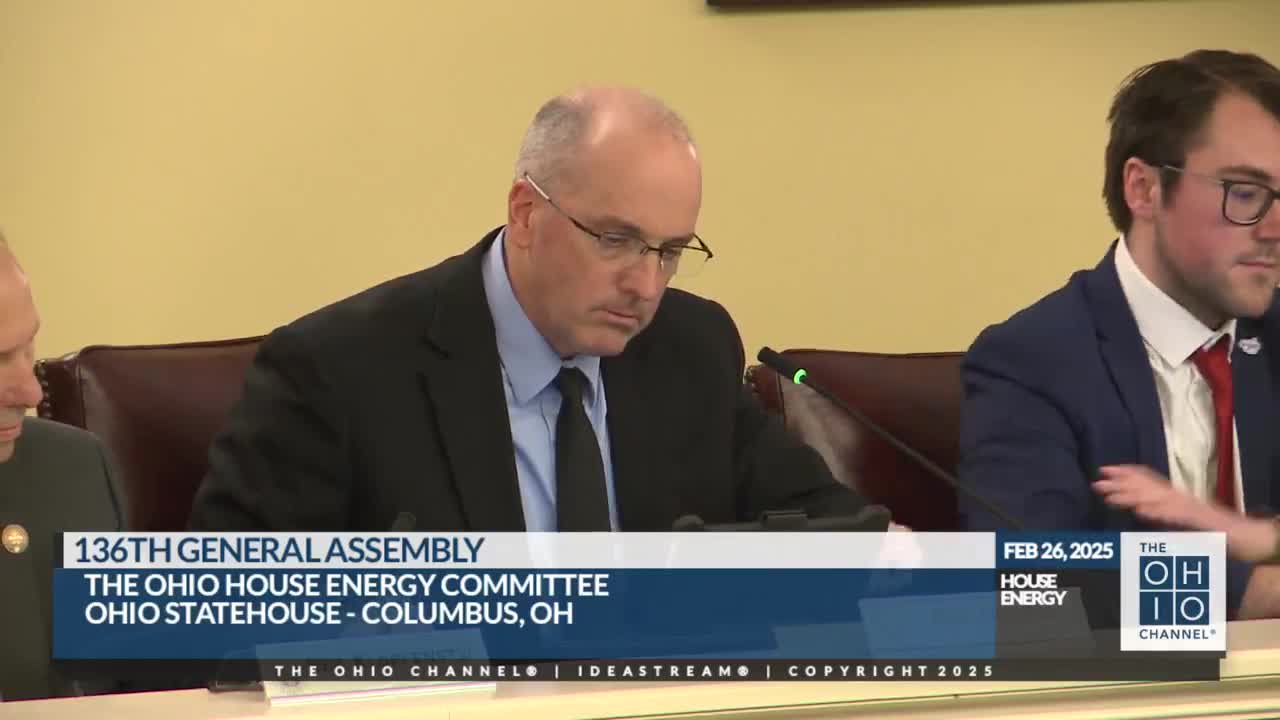
The Ohio House Energy Committee received competing advice on how to accelerate new power production and protect reliability while considering tax and regulatory changes in House Bill 15.
Alexandra Denney, invited by the committee to present the Ohio Business Roundtablea CEO-led groupoutlined the roundtable's Energy Competitiveness Study and urged state action to shorten permitting, clarify behind-the-meter frameworks, reduce regulatory lag and study grid-enhancing technologies. "On average 366 days for an application to get through the Ohio Power Siting Board process," Denney told the committee; the roundtable recommends a 90-day shot clock and even faster timelines for designated priority investment areas.
Denney described six state-focused recommendations from the study: a 90-day siting and permitting shot clock for ordinary applications and a 45-day clock for designated priority investment areas; creation of an Office of Energy Resilience focused on economic development and coordinating timelines across state offices; priority investment area incentives including a five-year tax exemption for new generation in brownfields and accelerated siting review; clarification of the statutory framework for behind-the-meter generation; reinstatement of a 275-day shot clock for regulatory lag and cost recovery reviews; and a study committee on grid-enhancing technologies. "We want to be an all-of-the-above state," Denney said, noting Ohio's natural gas resources, nuclear capacity and solar supply chain.
Utilities and sector groups raised concerns that the bill's proposed tax shifts and repeal of certain riders could harm utility balance sheets and reduce timely investments. Mark Reiter, president and chief operating officer of AEP Ohio, opposed a wholesale repeal of electric security plans (ESPs) and warned that those statutory mechanisms have supported grid modernization and reliability investments. "If this bill passes without amendments, we won't invest because our balance sheet won't have the capacity nor the credit profile to support it," Reiter said, adding AEP Ohio plans about $5 billion in system investment over five years under current recovery constructs.
Craig Grooms, president and CEO of Buckeye Power and Ohio's Electric Cooperatives, urged adoption of the tangible personal property changes contained in Senate Bill 2 rather than House Bill 15, saying SB2 better targets incentives to new generation without transferring tax revenue from communities that host existing plants. Grooms said higher taxation of transmission infrastructure, as in HB15, would raise costs for cooperative members and all consumers because transmission owners' tax and cost increases flow through rates.
The hearing also focused on the legacy generation rider (LGR) for the Ohio Valley Electric Corporation (OVEC) facilities. Witnesses debated the rider's costs and function. AEP and Buckeye Power witnesses argued OVEC provides a capacity hedge and has been dispatched by PJM for reliability purposes during high-price periods. Committee members and other speakers noted fiscal estimates showing the rider's net effect varies over time; one committee fiscal note projected savings to ratepayers if the rider were repealed over an extended horizon.
Mark Ranity of the Energy Policy Network presented an independent reliability analysis, telling the committee PJM has retired many plants and that the interconnection queue is heavily weighted toward wind and solar. Ranity cited PJM data stating that, among recent and proposed new projects, roughly 86 percent are wind and solar with only 14 percent base load, and he warned of supply-chain and siting delays for combined-cycle gas plantsincluding long turbine lead times. "We're closing power plants much faster than we're building them," he said, summarizing NERC and FERC concerns about PJM reliability risk.
Committee members asked witnesses about concrete fixes: Denney and industry witnesses pointed to permitting timelines, interconnection queue reform at PJM, and better-aligned state-level regulatory processes such as forecasted test years for rate cases. AEP suggested a multi-year forecast framework to replace ad hoc riders while preserving timely cost recovery; several parties supported a transition period if riders such as the OVEC recovery are ended.
Ending: The committee heard a wide range of recommendations and signaled plans to circulate substitute language and amendments. No committee votes or final decisions were taken; the committee asked for amendment proposals and indicated a substitute bill would be circulated for review prior to further testimony.