Get Full Government Meeting Transcripts, Videos, & Alerts Forever!
Get email alerts on the Public Finance Taxation topic
No spam. Unsubscribe anytime.
County auditors tell House committee HB15 would shift tax revenue away from generation-hosting communities
Summary
County auditors and local school officials testified that House Bill 15would reduce public utility personal property valuations for generation sites, increase transmission assessments and transfer revenue away from rural counties that host power plants, jeopardizing school budgets and emergency services.
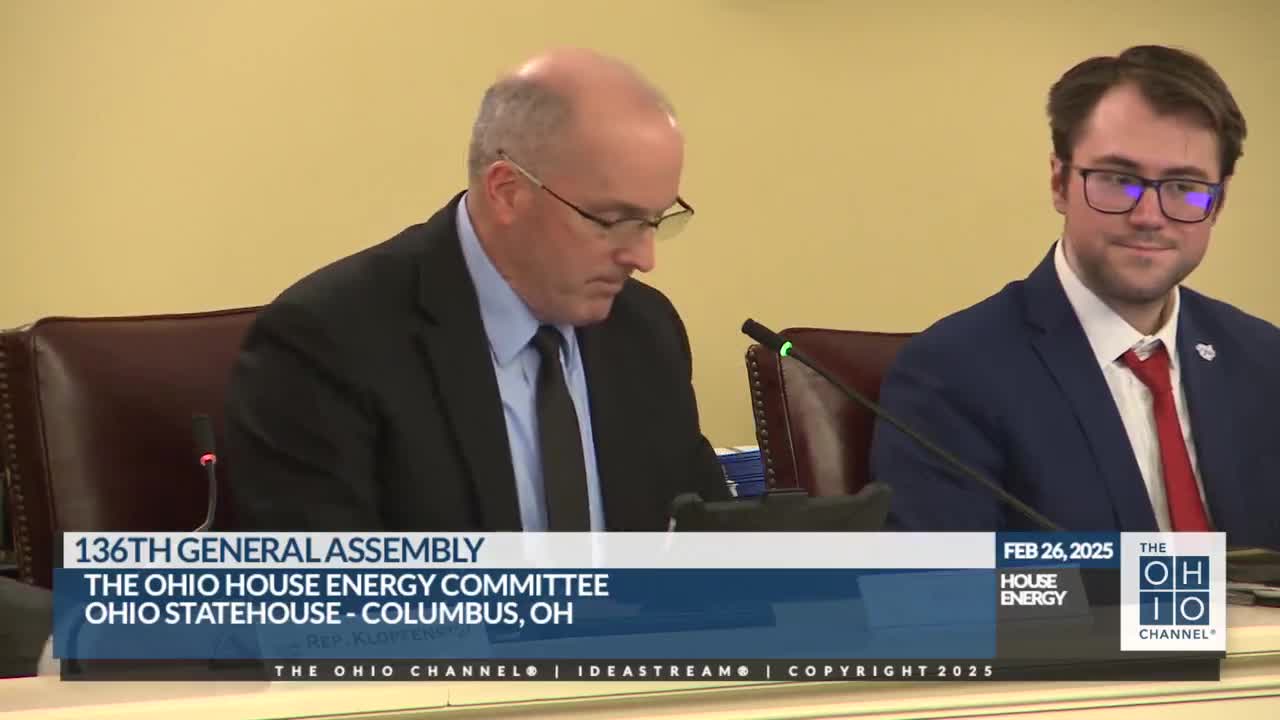
Chairman Holmes and members of the Ohio House Energy Committee heard repeated warnings from county auditors and a school district treasurer that House Bill 15, as drafted, would sharply reduce local government revenues in counties that host electric generation facilities.
Paul Knipp, Lawrence County auditor, told the committee he and Chief Deputy Auditor Chris Klein came to oppose the bill on grounds that it would eliminate the public utility personal property (PUPP) tax on electric generation while increasing the assessment rate on electric transmission properties by 4 percent. "House Bill 15 in its current form . . . is far from revenue neutral. More likely it will be devastating," Knipp said, describing how Lawrence County could see a net valuation loss of roughly $30.8 million and detailing estimated annual shortfalls for fire, EMS, schools and county funds.
Knipp said the countywhich offered a 13-year abatement to attract a generating plant two decades agowould lose the bulk of that plant's $219 million PUPP valuation while transmission valuations in the county would rise only modestly. "If all this valuation goes away . . . the school district needs to pass a new bond levy," Chief Deputy Auditor Chris Klein added, warning that the remaining taxpayers would have to shoulder higher levies.
Robbie Jackson, Gallia County auditor, and Jack Webb, treasurer of the Gallia County Local School District, described similar effects in Gallia County, where auditors said generation property valuations total roughly $173 million and a 4 percent transmission uptick would not offset the loss. Jackson provided account-level estimates his office prepared showing about $3.8 million in annual revenue losses to county funds, school operations and townships. Webb said his districtwhich serves about 2,100 students across 431 square mileswould face a $2.7 million annual reduction in revenue and that the district would be forced to eliminate staff and cut services if the money is not replaced.
Lake County Auditor Christopher Galloway gave comparable testimony about the Perry Nuclear Power Plant, which his office values at roughly $52.9 million and which generates more than $4.4 million a year for local governments and schools. "Removing that much revenue shifts the burden to our local taxpayers," Galloway said. He warned that changing the tax treatment for generation would create a strong NIMBY incentive: counties would be less willing to host plants if the fiscal benefits disappear while responsibilities such as emergency preparedness remain.
Several members of the committee sought assurances that counties would be held harmless if language changed. Knipp and other auditors expressed skepticism based on prior experiences with state promises to local governments. "Promises made to hold harmless have never come to fruition," Knipp said, citing past state funding changes.
Committee vice chair Klopfenstein and other members said they were receptive to feedback and that substitute language and amendments were expected. Chairman Holmes told interested parties to submit amendment ideas by Friday so the committee could consider a substitute bill the following week.
The testimony focused on fiscal math: auditors repeatedly contrasted the appraised value of generation equipment (reported as personal property) with the smaller real property valuations for plant sites and highlighted the distributional effects of shifting the tax base toward transmission infrastructure that tends to traverse more densely populated, urban areas.
The local officials urged lawmakers to avoid a bill that would be "revenue neutral" at the state level but devastating for particular counties and taxing districts, and they detailed specific annual shortfalls for school operations, bond levies, health departments, fire funds and EMS units.
The committee heard from multiple county officials representing rural generation-hosting counties; members said they would consider amendments before advancing legislation.
Ending: The committee did not take votes on the measure during the hearing. Chair Holmes signaled a plan to circulate a substitute bill and invited written amendment proposals; county auditors said they would continue to work with committee staff to seek changes that avert the local revenue losses they described.