Get Full Government Meeting Transcripts, Videos, & Alerts Forever!
Get email alerts on the Demand Response topic
No spam. Unsubscribe anytime.
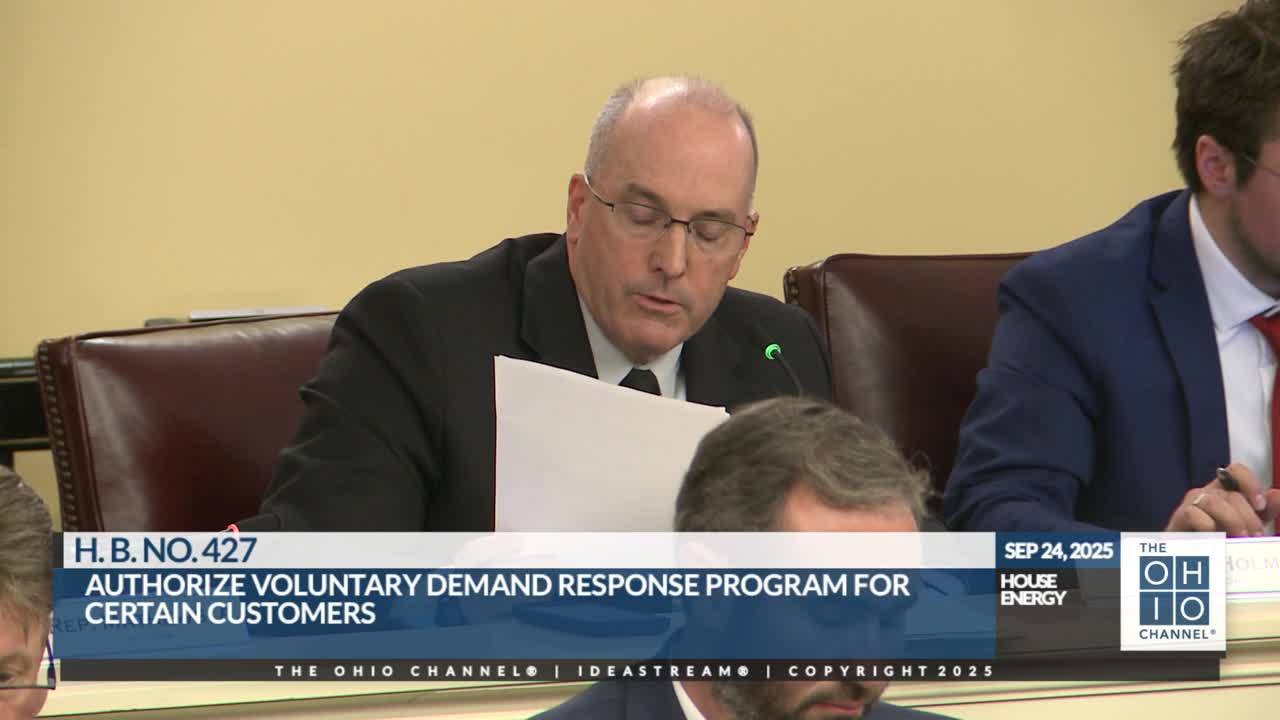
Committee hears sponsor testimony on demand-response bill HB427, including consumer protections and PUCO oversight
Summary
Representative Klopfenstein presented sponsor testimony on House Bill 427, which would set guardrails for demand-response programs: voluntary opt-in enrollment, consumer override, PUCO cost-effectiveness review, and a three-year PUCO report. The committee adopted the sponsor's amendment and held a detailed Q&A on enrollment, smart meters, program
Representative Klopfenstein offered sponsor testimony on House Bill 427, a bill to formalize guardrails for demand-response programs in Ohio, and the committee agreed to the sponsor's amendment by unanimous consent.
"I want to emphasize these programs are completely voluntary," Representative Klopfenstein told the House Energy Committee during sponsor testimony.
Klopfenstein said HB427 does not create demand-response programs but would: require voluntary opt-in enrollment; give customers the right to override events; require PUCO approval of programs for cost-effectiveness; and require PUCO to report back to the legislature after three years with recommendations to improve customer benefits. The bill would also allow utilities and competitive retail electric service providers to bid aggregated demand reductions into the PJM capacity market, enabling so-called "virtual power plant" participation, the sponsor said.
Sponsor testimony cited current measures of program participation and projected savings: average electric bills have increased about $30 per month statewide compared with last year, with another 5% increase projected in 2026; Midwest Energy Efficiency Alliance estimates statewide net savings from demand-response programs in a range the sponsor described as about $34.5 million to $104 million depending on participation assumptions. Klopfenstein said AEP territory had nearly 18,000 enrollees and Ohio's 24 electric cooperatives reported more than 106,000 water-heater switch enrollments and over 16,000 air-conditioner switch enrollments.
Committee members pressed on several operational questions: whether nonparticipants could face higher costs (the sponsor said PUCO would monitor program structures to avoid cross-subsidies and that overall reduced peaks can lower costs for all customers); whether consumers could disenroll or override (sponsor said programs include override and opt-out provisions and that persistent noncompliance by a participant could prompt removal from a program); whether smart thermostats were required (sponsor said no; many programs use radio-controlled load-management switches and smart thermostats may enhance but are not required); and what methodology PUCO would use to judge cost-effectiveness (the sponsor said PUCO's method is not specified in the bill and the committee will ask PUCO for details).
Representative questions also covered public-safety uses of demand response during extreme events, equity concerns for customers without enabling devices, and whether rural cooperative territory customers and customers in non-ESP territories could participate. Klopfenstein said co-ops generally have strong participation and outreach models and that the bill aims to preserve and expand program access across utility territories.
The committee recorded the sponsor's amendment 0815 as "agreed to" without objection and incorporated it into the bill. The hearing concluded with no roll-call vote recorded; the bill remains in committee for further review.