Get Full Government Meeting Transcripts, Videos, & Alerts Forever!
Get email alerts on the Consumer Protection And Pricing topic
No spam. Unsubscribe anytime.
Licensing and Consumer Affairs says it enforces pricing and weights but lacks criminal investigatory authority and enforcement staff
Summary
Deputy Commissioner Myrna George told the Legislature that DLCA enforces consumer and weights‑and‑measures laws, publishes fuel and grocery price snapshots and handles hundreds of complaints, but the agency lacks authority to investigate criminal fraud and has limited enforcement staffing and overtime funding.
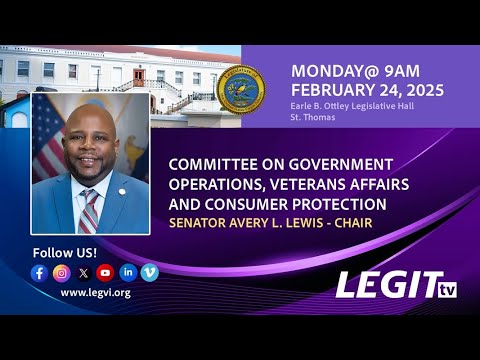
Deputy Commissioner Myrna George and DLCA staff told the Committee on Government Operations on Feb. 24 that the Department of Licensing and Consumer Affairs enforces consumer‑protection and weights‑and‑measures rules, operates consumer complaint and mediation services and publishes periodic fuel and grocery price snapshots — but the agency is limited in two key ways: it cannot conduct criminal fraud investigations and it has constrained enforcement staffing.
"DLCA does not conduct investigations or provide advisement in cases involving fraud, as fraud is classified as a criminal offense," Myrna George said during her opening remarks, and she urged complainants to report alleged criminal fraud to the Virgin Islands Police Department’s white‑collar crime unit or to the Federal Trade Commission for issues in their jurisdiction. The department’s testimony reiterated that DLCA’s role is regulatory and civil enforcement rather than criminal prosecution.
DLCA said its core consumer functions include complaint resolution and mediation, enforcement of consumer‑protection statutes, price monitoring during declared emergencies and weights‑and‑measures checks (fuel pumps, scales, and measuring devices). Staff reported that DLCA handled roughly 320 consumer complaints over the last year that were either resolved internally or forwarded to other agencies as appropriate. Director Matthew Padgett described the most common complaint types as vehicle‑related issues, construction and contract disputes, and unlicensed business operations.
The department also described a territory‑wide shopping‑basket exercise and a renewed two‑year food, fuel and housing cost analysis (performance period 12/31/2024–12/31/2026) funded to provide a deeper cost‑of‑living analysis than the regular DLCA shopping basket. DLCA emphasized that its weekly or periodic shopping‑basket snapshots are not a CPI or long‑term market index; that work is done by the Bureau of Economic Research.
Staffing and enforcement limits were a recurring theme in committee questioning. DLCA said weights‑and‑measures field work currently has one inspector per district, and the enforcement team reported six officers across the territory (plus supervisors) with vacancies. Deputy Commissioner George later confirmed seven current job vacancies for the department. Enforcement Director Wilbur Francis and others told senators that overtime funds have been limited since fiscal 2023 and that the department relies on scheduled operations or joint operations with VIPD for after‑hours enforcement.
On penalties, Director Padgett described the civil penalty schedule for pricing and truth‑in‑advertising issues: fines can start at $25 per mispriced item and escalate to $100 per item depending on the violation and history; price‑gouging statutes apply only during declared emergencies. General Counsel Geraldine Vaval said service‑charge or menu disclosures must be posted conspicuously; where businesses create a public nuisance, DLCA may pursue administrative hearings and license revocation.
What happened next: Senators asked DLCA for data on complaint counts, fine collections, staffing vacancies and the department’s fuel‑price figures. DLCA said it would provide recent enforcement and licensing statistics and noted an allotment of $1,947,465.50 so far this fiscal year.
Why it matters: DLCA’s work affects everyday costs and consumer confidence — from fuel and grocery prices to fair‑weight measures and accurate pricing. Committee members flagged gaps in enforcement coverage and the need for clearer public communication about DLCA’s remit versus criminal investigatory authorities.
Provenance: Committee hearing testimony and Q&A with Deputy Commissioner Myrna George and DLCA staff (Feb. 24, 2025).