Get Full Government Meeting Transcripts, Videos, & Alerts Forever!
Get email alerts on the Treatment Courts Diversion topic
No spam. Unsubscribe anytime.
Committee does not advance bill expanding treatment courts to cover diversion and updates substance‑use terminology
Summary
House Bill 49, which would update treatment court statutes, allow treatment court teams to operate diversion pilots and replace the term "substance abuse" with "substance use disorder" across multiple statutory sections, failed in committee by a 4-5 vote after testimony on costs, pilots and program scope.
The House Judiciary Committee voted 4-5 against a do-pass recommendation for House Bill 49, a measure that would amend Wyoming treatment court statutes, add diversion court authority to court-supervised treatment teams and standardize statute language to "substance use disorder." The committee vote ended the bill’s progress from the committee.
Representative Larson introduced the bill and asked Alisa Butler, state court administrator for the Wyoming Judicial Branch, to explain treatment courts and the diversion pilot. Butler told the committee treatment courts are typically post-adjudication programs for defendants convicted of crimes with a substance-use component and that diversion courts are pre-adjudication programs for people charged with low-level offenses who screen positive for mental illness and can be diverted to treatment rather than prosecuted. "If they're successful in diversion court, they're never actually convicted of that crime," Butler said.
The draft would amend definitions in Title 5 (treatment courts), update several statutory cross‑references and allow treatment court teams to accept participants from other jurisdictions and to provide diversion services. The bill would also replace "substance abuse" with the term "substance use disorder" through several Titles (including Title 5 treatment court statutes and Title 7 public defender provisions) to align statutory language with current clinical terminology.
Supporters included the Wyoming Association of Mental Health and Substance Abuse Centers, which told the committee treatment and diversion programs can reduce repeated jail contacts and preserve community ties. "We think that's an excellent return on investment," Andy Somerville, executive director of the association, said of treatment courts. Clark Fairbanks of the Wyoming Youth Service Association testified in support, citing family and workforce impacts.
Witnesses described limited pilot activity: Butler said Campbell County’s diversion pilot identified about 12 people during its first year, admitted roughly four, and had one graduate who had not returned to jail in the months following graduation. Law enforcement representatives said sheriffs and chiefs generally support pilots because they reduce repeated jail contacts and the operational burden of caring for people with mental illness in county jails.
Questions from legislators focused on diagnostics, eligibility and cost. Representative Kelly raised concern that some participants could enter diversion without a prior diagnosis and worried the system could be manipulated; Butler said screening and a more in-depth behavioral health assessment would be used to determine eligibility. Representative Bratton and others asked about fiscal impacts; witnesses said treatment and diversion services are currently funded through behavioral health redesign and Department of Health contracts and that a fiscal note would be prepared if required.
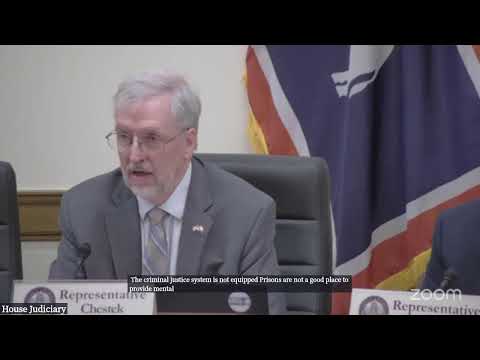
Motion and vote: Representative Feiler moved the bill for a do-pass recommendation; Representative Chastock seconded. The roll call recorded 4 ayes and 5 no votes and the chair announced the bill did not receive a do-pass recommendation.
The bill contains a rulemaking section and a provision allowing the Supreme Court to request funding for court‑supervised treatment programs in its biennial budget. Proponents called the bill a foundation measure to align statute language and allow pilot expansion rather than an immediate statewide program expansion.