Get Full Government Meeting Transcripts, Videos, & Alerts Forever!
Get email alerts on the Governance topic
No spam. Unsubscribe anytime.
Commission narrows standing committee model, appoints three new commissioners to Public Arts Advisory subcommittee
Summary
Stockton Arts Commission members discussed shifting from multiple standing committees to ad hoc panels, in line with the municipal arts ordinance, and approved appointing three new commissioners to the Public Arts Advisory Standing Subcommittee.
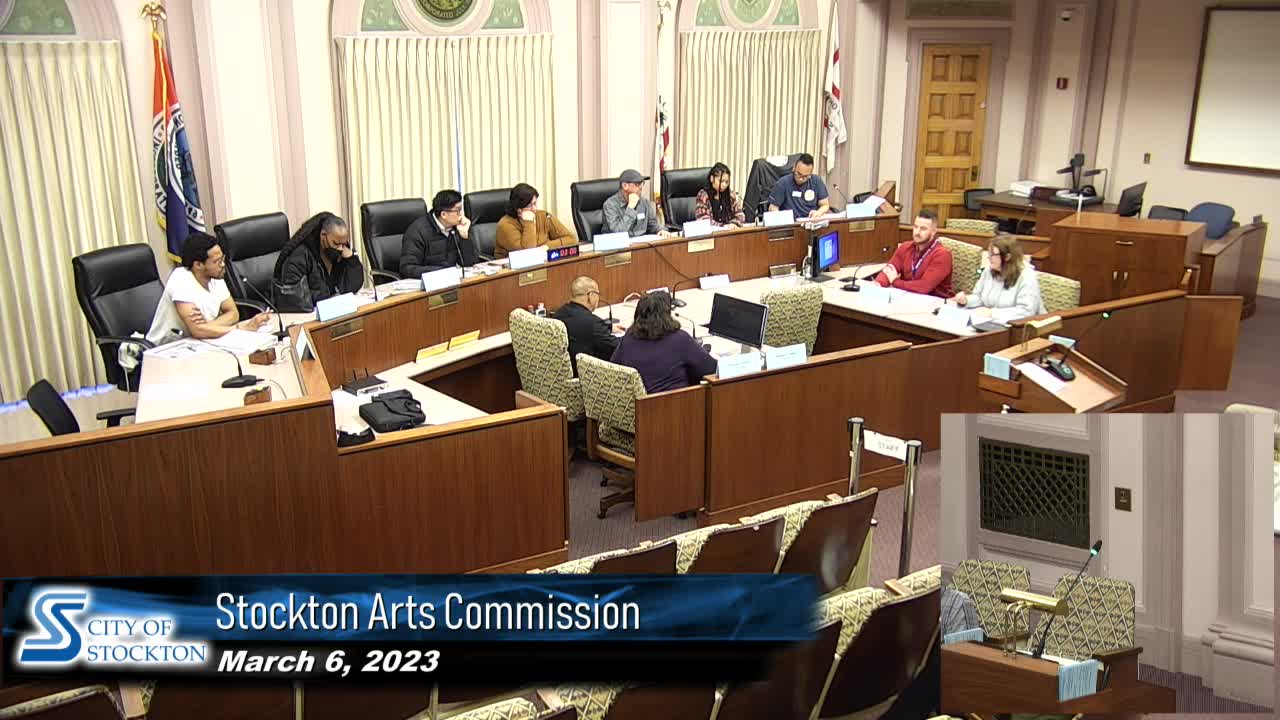
The Stockton Arts Commission on March 6 discussed reorganizing its committee structure to align with the municipal arts ordinance and appointed three newly seated commissioners to serve on the Public Arts Advisory Standing Subcommittee.
Staff explained the municipal code identifies a single standing committee for the arts commission; other working groups should be created as ad hoc panels for time-limited projects. "A standing committee is something that is always being used. An ad hoc is a team of people that are put together to talk about a specific topic that is not going to go on forever," a staff member said during the meeting.
Why it matters: The change affects how the commission reviews artist applications, project proposals and project-specific work such as park art or murals. Commissioners asked for clarity on ad hoc timelines, quorum limits, and how recommendations from subcommittees move to the full commission for action.
Appointment vote and process: Commissioners nominated several members for the Public Arts Advisory Standing Subcommittee. After discussion the commission approved a motion to assign the three newest commissioners to the Public Arts Advisory Standing Subcommittee; the motion was seconded and passed by voice vote. Staff and commissioners emphasized that the subcommittee—s recommendations will come to the full commission for discussion and final action. "This standing committee would review all of the artist applications that were received... They would come to the full commission and say, here's the top four finalists," a staff member said, explaining the review pipeline.
Context and limits: Commissioners asked about Brown Act limits and quorum; staff clarified ad hoc groups must be smaller than a quorum and that ad hocs should have a clear start and end tied to a project. Commissioners also discussed the need to update the ordinance language if the commission wants additional standing committees in future.
Ending: The commission will proceed under the municipal-code-aligned model (one standing committee plus ad hocs) and staff will record subcommittee membership and procedures; the full commission retains authority to change or reject subcommittee recommendations.